Sunday, November 20, 2016

Miss Ella Paine

Miss Ella E. Paine lived on the Mandeville lakefront for many years, enjoying her position as the "go-to" person on Mandeville history. She took part in much of that history and was a key member of the St. Tammany Historical Society when it organized in 1972. 


Miss Ella Eugenia Paine

She was born on July 21,1893, in Anacoco, La., the daughter of the well-respected Dr. R. B. Paine. He  moved to Mandeville in 1894, and soon was well-known throughout St. Tammany Parish for his work in improving the lakefront community. In fact, in 1902 he was elected mayor of Mandeville and served two terms, in addition to serving as the health officer for the town. 

He had memberships in the St. Tammany Parish Medical Society, the La. State Medical Society, and the American Medical Association. His office was located at the corner of Lake St. and Coffee St. in Mandeville, according to A History of Louisiana, (vol. 2),by Henry E. Chambers, published in 1925.


Reading on her front porch overlooking Lakeshore Dr. 

Miss Ella began taking an active part in community life at an early age, as the following excerpt of Frederick S. Ellis' book on St. Tammany history illustrates:


In 1911, she was listed as a student at Tulane University in New Orleans, and her name also appears in a 1922 Edition of the St. Tammany Farmer as a member of the Order of the Eastern Star.


Anyone doing serious historical research on the Mandeville area would include her in their interviews, and even young people doing history reports for school would visit her at her home to hear about the early 20th century hurricanes, the lakefront lifestyle, and even the Mandeville earthquake she had lived through. 

In 1956 she guided the operations of the St. Tammany Parish Library System for a few months. 

Her work with the St. Tammany Historical Society was extensive, and she served as president of that group in 1978 when she was 83 years of age. Here is a picture of her greeting guest speaker Pie Dufour


Miss Paine at a historical society meeting with Carl Fredericks. 


Reading a proclamation on the Mandeville Lakefront, 1976.
Miss Ella Paine at right


Ella Paine, at left, with Bertha Neff on her Mandeville porch looking over a stack of old photographs


In 1985 this article about her appeared in the St. Tammany Farmer newspaper:

Miss Ella Paine Remembers Life In Mandeville
 
At 92 years of age. "Miss Ella" Paine's memories are older than most of Mandeville's citizens. Having been a resident of the city since she was eight months old, she vividly recalls incidents from her early childhood.

ln the mld-1890's when Mandeville had a population of approximately 800 and horses and buggies were familiar sights, her father, Dr. Rufus Paine, had a pharmacy on the lakefront, and "Little Ella," as she was called, prided herself on her ability to dispense directions and information to his customers and patients.

She chuckles now as the Dupres, neighbors on Carroll Street, come to mind. The family, she explains, owned a grocery store, and Mr. Dupre would hide her in a pickle, bean or rice barrel when her mother came looking for her.


She can still almost taste the ice cream her mother made made in 1896. That winter, she remembers, a hard freeze occurred, and tin cans were filled and taken outside while she eagerly waited for the dessert to harden.

Her current home on the Lakefront, she says, was begun in 1914  and completed three years later. "If walls could talk," she says,that house would provide an absorbing commentary. Though the hurricane of 1897 was destructive, the one in 1915, which ravaged many old landmarks, was the worst one in her memory.

"Anyone who lived through it can live through anything." says Miss Ella. The level of the lake rose eight inches in twenty minutes, and the water in the family's backyard reached to her chin.

The house was generally a center of activity, overflowing with frequent crowds of people. She reports that the home once accommodated 28 guests "with nobody having to sleep on the floor." African violets and orchids were at one time grown in a large room upstairs where she could regulate the light and heat.

One Sunday In October of 1955 is particularly memorable to her. Some 2400 invitations had been sent to those whom Dr. Paine bad delivered to participate in the celebration of his 90th birthday. More would have been asked, she notes, had a fire not destroyed her father's records prior to 1915.

Cake, fifty pounds of coffee and more than fifty gallons of Ice cream were consumed by the 1300 white patients who attended the party during its first day and the 300 blacks who came on the second, and reporters from local newspapers were there to document the festivities.

On that same Sunday, Miss Ella entertained 39 members of her family at a reunion featuring a large turkey dinner with all the trimmings.

The past fifteen years have seen her activities curtailed, and she regrets that she is unable to socialize as much as she used to. A 1919 graduate of Newcomb with a Masters degree from LSU, she has been a high school teacher, "principally math and science," and a librarian.

Retaining her interest in "people and what they are doing," she often receives visits from former students and from her father's patients, and her mind is keenly aware of what's happening to the hometown that she loves.

When asked the secret of her longevity, she admits to no special factors and says with a smile that her physician has proclaimed her "disgustingly healthy."

Though modest about her achievements, Miss Ella, a dedicated historian, has filled volumes of scrapbooks. and paging through them allows a glimpse of a journey through time and a segment of local history which can only be imagined.

Included are numerous newspaper photographs and articles relating her community involvement and her leadership role in its organizations, correspondence from the U.S. Treasury Department where she worked during World I and knew Franklin D. Roosevelt before he became president, and certificates commemorating her fiftieth college reunion.

But especially touching are the original photos, a six and a half-year-old Ella, her long dark curls flowing over the shoulder of a ruffled and ribboned white organdy dress, details of which she can still fondly describe; a middy-bloused Ella posing with friends beside a gushing well; a college chemistry lab; the first Easter Service at the Mandeville Union Protestant Church where she played the organ for 67 years and proudly participated in ceremonies marking the church's 100th anniversary.

Her mobility may be limited, yet she delights in an occasional luncheon out and attends church when her health permits. She is a determined and charming lady who says, "I've led a very busy, full life, and I've enjoyed It."

St. Tammany Farmer 1985


She died on October 25, 1990, and is buried in the Mandeville Cemetery. 
Here is her obituary. 


Saturday, November 19, 2016

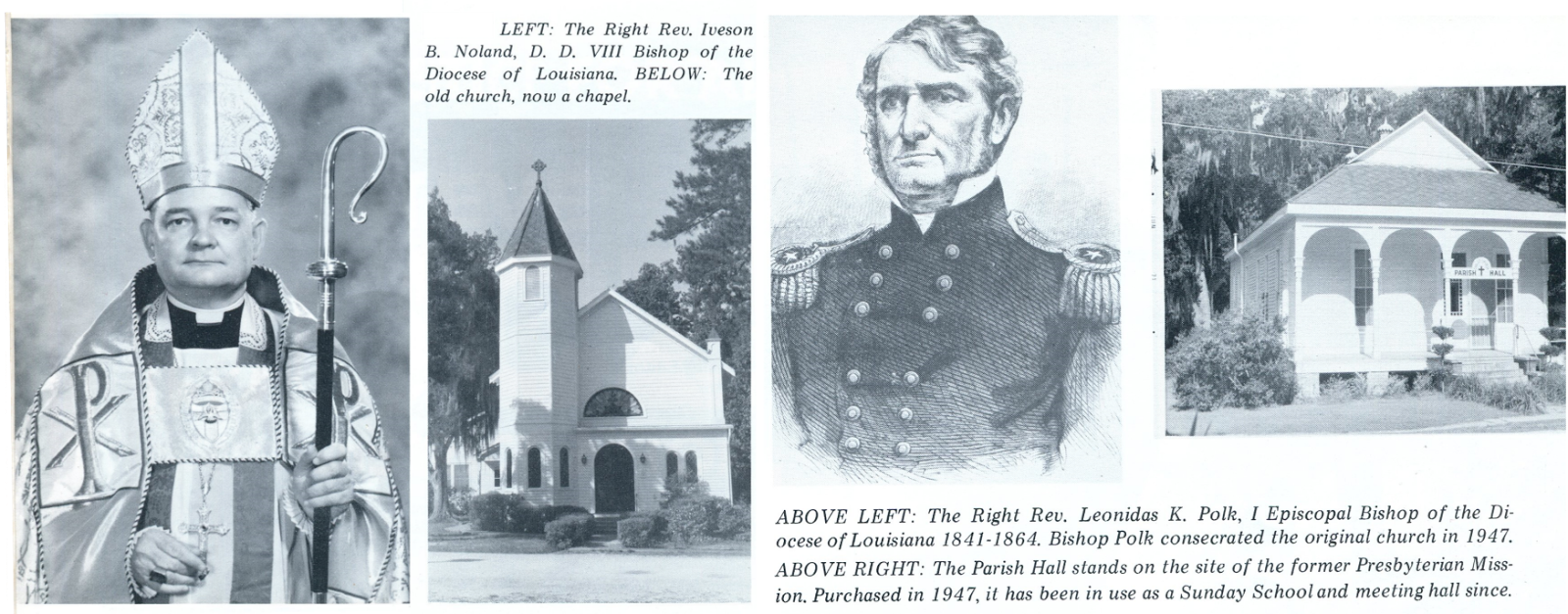
Christ Episcopal Church History

The history of the Christ Episcopal Church on New Hampshire St. in Covington was written about in detail in a 1972 article published in Pathways Magazine. Click on the images below to read the article and see the photographs in a larger size. 


For a history of the Christ Church Chapel, CLICK HERE.


Friday, November 18, 2016

Letsch Pontiac-Buick in 1972

In 1972, Pathways Magazine ran an article about the Letsch Pontiac-Buick dealership in Covington, at the time the largest automobile dealership in St. Tammany Parish. Click on the images below to read a larger version of the article and enlarge the photographs. 


In the early 1980's Paul Lumpkin, left, Danny Letsche, center, and Barney King were new officers for the auto dealership.

100 Years Ago This Week

What was going on 100 years ago this week? The following link is provided by the Library of Congress and its Chronicling America service. CLICK HERE for a link to the St. Tammany Farmer edition of November 18, 1916. Some of the headlines are "Every Store In Covington Is Rented," Covington Trying for a Big League Team, and Better Depot Petition Now Has Many Signers. 


Click on the images to see a larger version. 
And here are some ads that appeared in the above edition:


Advertisements from 1916


Thursday, November 17, 2016

Pearl River High School Photos

For a variety of photos from Pearl River High School over the past three decades, CLICK HERE.


Just click on the thumbnail images to go to the larger photographs. 

St. Tammany Found

In the 1970's Polly Morris of Lacombe wrote a number of fascinating articles about the history of St. Tammany Parish and the legends and traditions of the Lacombe area. I always enjoyed reading her articles, though I didn't always know where she found her information. Here is one of those articles. 

Click on the images below to enlarge the type. There are three pages. 


Wednesday, November 16, 2016

Beach House Cartoon

Below is my cartoon drawing of the Beach House restaurant in Mandeville, one of my favorite places to eat. Try the turkey sandwich. It is located on Girod Street half a block from the lakefront. Click on the image to see a closer up view. Since I made the drawing, they have added a roof shelter over the dining area section. 

Click on the images to make them larger.


Here's a closer up view of the customers enjoying their lunch. 


Below is a video showing the coloring sequence for the Beach House Cartoon. 


Click on the "play triangle" to view the video

After I finished this cartoon, they put a metal roof over the outdoor dining area, removing the umbrellas, so it looks a little different than depicted in the cartoon.

Covington Rotary Club

The Covington Rotary Club has long been an important community civic organization, one that has been representative of the progressive nature of the area's local business people. Here is an article that was published in Pathways Magazine in 1972 featuring that group and their international service organization. Click on the images below to enlarge the view. 


The St. Tammany Farmer featured an article in 1927 
about the formation of the local Rotary Club.


Ron Barthet speaking to Rotary Club


Tuesday, November 15, 2016

The History of Citizens Bank & Trust, Covington

Citizens Bank & Trust Co. celebrated its 70th anniversary on Tuesday, November 15, 2016, with food, refreshments and visits by bank dignitaries. The North New Hampshire branch of the bank in Covington welcomed customers with a variety of special treats, including jambalaya, brownies and iced tea.


The picture above shows some of the bank dignitaries and staff on hand for the special occasion. 


This picture shows two of the appreciative visitors who dropped in on the anniversary celebration event. 

The History of Citizens Bank & Trust As told by Louis Ross Jr.

At the end of World War II, as all the soldiers were returning home, there arose a need to help them return to civilian life. They were going back to their hometowns looking for a place to live, a place to buy their needed appliances and furniture, and a place to bank. Citizens Bank & Trust was formed to help meet their needs, chartered on December 31, 1945.

Prior to that, there had been only one bank in Covington, and all across America, new banks were being chartered to handle the growth in the economy that was expected now that the soldiers were coming back home and setting up new households. The hardships caused by the war made certain things hard to buy, like cars, but the banks saw an opportunity to help people borrow the money needed to buy cars now that they were being made available again after the war. 


Louis Ross Sr. was president of the St. Tammany Homestead Association at the time, and he and several others on the Homestead board of directors decided the time was right to open another bank in Covington. That group included Alfred Alexius, Archie Smith, Thomas Champagne, Theodore Dendinger, Weldon Poole, RIchard Privette, and Hebert Frederick.

The paperwork and applications were filled out with the state banking commission, and a "feasibility study" was done that documented the need for a new bank. It opened in 1946 with $105,000 in capital at a location in the 300 block of New Hampshire Street, next to the St. Tammany Farmer office, across from the Star Theater. The bank opened its doors with 8 employees.


  Renovating that first building owned by Weldon Poole took some time, as did outfitting it with all the modern bank machines, including adding machines and typewriters.  Its name was chosen as "Citizens" to make it sound more people friendly than some of the other bank names that were popular at the time. 


A photograph taken in 1946 at the new bank.


Those were the days in banking when everyone knew the local banker and the local banker knew everyone's signature. "People found that the bankers at Citizens Bank were nice people to deal with, and the bank grew and grew," said Louis Ross Jr. who joined the bank in 1954 after returning from duty with the Air Force.  

After 10 years, the bank started looking for a larger location, and it was decided to re-locate to the current New Hampshire St. site one-half block south of Boston St. The property was purchased from the Werhli family and plans were made for a brand new building. Soon the new building was ready, complete with a drive through in the southeast rear corner of the bank. Citizens Bank & Trust was the first bank in St. Tammany to have a drive-up window and a night time depository, Ross stated. 


That new location was opened just after Nov. 11, 1954, with a dedication after Thanksgiving of that year. 

The bank continued to grow and in the early 1970's, it purchased the lot next to current location, the one between itself and the Boston Street business known as Heberts Drugs (now Del Porto Restaurant). The old Werhli home was located on the lot, and the bank tried to give it away to help preserve the structure, but there were no takers, so it was removed from the site. 


The existing location was added onto and a parking lot was installed, along with the new two lane drive through window. 

Outside of Covington, the first branch to be built was on Girod Street in Mandeville, which is now the building that is home to the Samaritan Center. A more modern branch was later built at 3100 East Causeway Approach in Mandeville. Branches were also opened in Slidell on Gause Blvd. , in Abita Springs at the corner of Level and Maple Streets, in Barker's Corner on Lee Road, Claiborne Hill and in Folsom on Hwy. 25.  The bank's computer operation center is another facillity located in Covington. The bank's newest branch is on Hwy. 25 just north of Covington, on the west side of the road.


In 1972, Citizens Bank locations included, from left, Covington, Claiborne Hill and Mandeville.

Today the board of directors consists of Laura L. Brandt,  Wanda S. Braswell, Daniel S. Berlin, Edward J. Fielding, III, Louis D. Ross, Jr., Gary T. Schoen, Rodney J. Strain, Jr., and Mark J. Bitterwolf. The bank currently has 41 employees, according to its website, www.cbtbanking.com.


Over the years, a number of banks have come and gone in St. Tammany Parish, but the Citizens Bank & Trust after 70 years still serves the public in the same downtown Covington location. 

In 1974, the St. Tammany Homestead Association celebrated its 50th Anniversary. 


The article below appeared in 1988.


Louis Ross Sr. was a member of the Covington Rotary Club for many years, having joined in 1935 and having attained the "perfect attendance" award for the group's weekly meetings for 40 years. He was president of the group in 1940. 

He was a charter member and organizer of St. Tammany Homestead since 1926, a member of the Board of the Federal Home Loan Bank of Little Rock for 20 years, and one of the organizers of Citizens Bank and Trust Company in 1945.

He received an award from the Louisiana Bankers Association for over 70 years of distinguished service in banking. He was also active with various civic and Carnival organizations.

In an effort to improve his father's health, his family moved to Covington  in 1916, with the original Ross family home located on 23rd avenue in Covington.  

While he couldn't afford to go to college, he was a supporter of the public school system, saying it has enabled people with modest or no means an opportunity to receive a good education. He did enroll in a two-year commercial course at St. Pauls, worked very hard and managed to finish the course in one year. 


The article below appeared in 1985.

Louis Ross Oversees Financial Growth of St. Tammany
 
It is perhaps rare to find an in­dividual who has remained active in one industry for more than half a century. Such is Louis D. Ross, Sr., whose career in banking and finance spans over 6O years.

Ross's desk at Citizens Bank and Trust Company in Covington im­mediately attracts the attention of a visitor, for under its glass are displayed the coins and colorful paper money of many of the world's nations, including Ireland, England, Lebanon. Mexico, Italy, Canada and Israel.

Familiar with the various ex­change rates, Ross enjoys sharing his knowledge concerning the value of the currencies, many of which, he explains, would amount to only a few pennies. Also under the glass are a  Louisiana Baby Bond, worthless currency issued shortly after the Civil War, and tickets from signifi­cant events he has seen, including the 1962 World Series when the Yankees were competing, and a papal visit to the United States.

Ross, the current president of Citizens, began his career in finance when he helped to organize the St. Tammany Homestead in 1924. Citizens was established in 1945, and, for his experience in lending, Ross was selected to head the bank. In 1979, he retired as president of the Homestead but still retains a seat on the board, and his nephew succeed­ed him as president.

One of the principal changes he was to see in the financial industry was insurance of deposits which, he says, "restored confidence in the financial institutions after the Great Depression of 1929, a time when many banks and homesteads failed.  When the program was initiated, deposits were insured for $2,500. This close government supervision, he explains, now protects depositors against losses up to $100,000.

Another change he cites is that financial institutions have become more liberal in their lending and paying interest on their savings ac­counts. The original passbook sav­ings and one type of certificate of deposit have been replaced by "all kinds of savings certificates at all kinds of variable rates with different lengths of time. In the old days the most banks ever paid on savings was 4 percent," says Ross. Drive-in win­dows and after-hours depositories are also listed by Ross as changes and additions for customer conve­nience.

The area's growth, he believes, has resulted in too many banks in the parish. From the initial three that had existed for many years,  their number has increased to seven. He thinks that a bank charter is much easier to obtain than it was 40 years ago, noting that then "you had to show need for it in the com­munity and you had to show that the bank would be successful, among other things."

In 1916 Covington was considered a health resort, and Ross and his family moved here from New Orleans. He attended grammar school, high school and what was then St. Paul's College, finishing in 1924, at which time he joined a group "like a parish-wide chamber of com­merce whose purpose was to stimulate enough interest to build a bridge from Goose Point, the mouth of Bayou Lacombe, across the lake to West End," a distance of 16 miles.

 But the money couldn't be raised. By 1926, however, a bridge built in Slidell supplemented the two other modes of transportation available  for trips to the city. A pleasant day could be spent by taking the two-hour boat trip from Mandeville or Madisonville, followed by a street­car ride to New Orleans. Two daily trains were also available for com­muters, though this method came with its own hazards. "They were kind of dirty because they ran on coal," says Ross, and a cinder in the eye was guaranteed if the rider stuck his head out the window.
He advises young people today to finance a home instead of paying rent. It may take a long time, he says, but ultimately they'll own their home.

He foresees a successful banking industry for the future's thickly populated parish, for residents will need banking facilities in order to transfer, store and borrow money.
His bank, he says proudly, is still owned by the original organizers of the bank and their families. Though several have died, their children and grandchildren still maintain their interest in the 40-year old business, "a pretty good record for a small independently owned institution," he says.

Working six days a week leaves him little spare time, but he and his wife of 54 years, Helen May, like driving through the Parish. This civic-minded great-grandfather is 'the oldest member of the local Rotary and, with 50 years of- service, its longest member. He also belongs to several social and fraternal organizations as well as to the St. Tammany Industrial Development Board, a group which tries to get money for new businesses coming to the parish. Since its reorganization about four years ago, $50 million worth of financing has been approved.

For the past four years Ross and his wife have made an annual trip to England and Ireland, and Ross generously praises the friendliness of these countries people and the delicious meals that were served. They've also visited pre-Castro Cuba, Canada, Hawaii and many other locations throughout the United States.

He predicts a bright outlook for Covington and the parish, "for they're growing, healthy and accessible to a large city, and we thought enough of it to invest a substantial amount of money in the banking business. All of our banking money is invested to St. Tammany Parish," he explained.


In October of 2021 Louis Ross Jr. took part in a Covington Heritage Foundation event during which he shared the history of Citizens Bank and Trust and other financial institutions in the 200 block of North New Hampshire Street in Covington. That block was called "Covington's Wall Street," he said. He was also an active member of the St. Tammany Historical Society.