Showing posts with label Trees. Show all posts

Thursday, December 11, 2025

Trees At The Old Courthouse

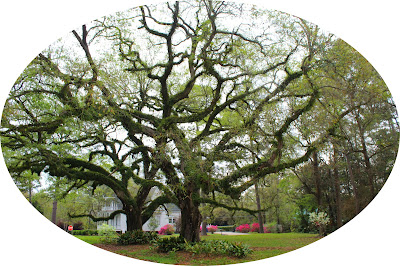
 The ancient oaks and other trees at the front of the old courthouse on Boston Street in Covington have stood the test of time, overseeing many swearing in ceremonies, Veterans Day ceremonies and even some art market sales booths. 

Here is a photo essay showing some of their shining moments. Click on the images to make them larger. 


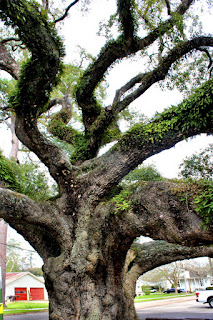
Moss-laden limbs


The World War I Memorial


Saturday, April 19, 2025

Big Tree Giveaway Held

Five hundred big trees were given away by the NOLA Tree Project Saturday, April 19th, the first time the tree giveaway had come to the Northshore. The Covington City Recreation Center was the scene of the event. 

Many of the trees were given away free, and there was also a selection of fruit trees for sale. The Arbor Day Foundation was one of the sponsors of the event, and employees of the Niagara Beverages of Ponchatoula , LA, helped distribute the trees.

The trees were 3-5 gallon size trees (not saplings) from 4 to 6 feet tall. Many of the trees given away sell for $50 or more at local nurseries, it was said.

There were 35 different types of trees given away, including Little Gem Magnolias, Japanese Magnolias, Southern Magnolia, Japanese Maple, Sweet Olive, Pecan, Sycamore, American Elm, Bald Cypress, Pond Cypress, Red Maple., Live Oak, Shumard Oak, Nuttall Oak, Weeping Willow, Mayhaw, Gingko, Persimmons, Cassia, River Birch, Crape Myrtle, Tulip Poplar, Bottle Brush, Vitex, Slash Pine, Savannah Holly, Celeste Fig, LSU Purple Fig and Green Ash.

Members of the LSU Ag Center were on hand to offer tips on how and where to plant the trees. The City of Covington hosted the tree distribution in the hopes of freshening up the city's tree canopy in the years to come.

Here are some photographs. Click on the images to make them larger.


(Photos by Ron Barthet)


The Nola Tree & Volunteer Project empowers volunteers to transform lives & communities through Tree Planting, Disaster Response, & Community Engagement projects


Saturday, February 10, 2024

Theodore Dendinger Cemetery

 In the late 1950's a new cemetery was established off La. 21 north of Madisonville. It became the Theodore Dendinger Sr. Memorial Cemetery. The five acres of land was formally donated in 1962 and has been in use ever since. 


At the front of the cemetery are three massive oak trees. 

Click on the images to make them larger. 


In 1979 the Madisonville highway alongside the cemetery was widened, prompting numerous local preservationists to keep an eye on the trees, wary of what had happened during a state highway widening project in Mandeville. That was where the "Chinchuba Oaks" were secretly cut down one Mardi Gras. Next Tuesday is the 46th year anniversary of that  eye-opening event.

Here are some recent photographs of the oaks in front of Dendinger Cemetery. 


See also these links:

The Chinchuba Oaks and Mardi Gras Day

The Oak Trees of 21st Avenue 

Trees Green Up For Spring 

A Monumental Oak Tree 

City Hall Oak Tree 

Post Oak 

Seven Sisters Oak - 1982 Cover Tree 

Vintage Court 

Live Oak Trees Recognized 

Lakeshore Drive Tree 

The Tree on the Wall 

St. Tammany Loves Oak Trees

Tree Branch Avalanche

Monday, April 3, 2023

Theodorus Willems - Gardener Extraordinaire

 When Theodorus Willems came to America from Holland, he discovered a land of opportunity, especially for young folks with landscaping and gardening skills. Here is the article I wrote about him 48 years ago.


Theodorus Willems

Skill in Gardening Brought Willems Luck

When Theodorus Willems came across the Atlantic ocean to America 56 years ago, he had a feeling it would bring him luck. Since then, he has made his mark on properties throughout southeastern Louisiana as a professional gardener and landscaper. He is currently turning his talents on the yard around the First Baptist Church in Covington.

Willems lives in Waldheim now after moving here from New Orleans many years ago. He came to know many top names in the nursery business there, men who admired his talent and knowledge in the gardening field.


Click on the image to make it larger. 

He came to America after reading a newspaper ad in a Holland newspaper which gave five Dutch boys a chance to come to the United States. When his Dutch mother asked him why he wanted to leave his home land. he said, "I want to see some of God's beauty."

He was truly impressed with the sight of the Statue of Liberty as his boat sailed into New York harbor, and he was also impressed by the story behind the statue as told by one of the boat's crew.

Once in New York, he took a train to New Orleans, then went down to Barataria to a place called Hopehill Farm. He tried living there a while, but he yearned more and more to get back into nursery work. 

He finally went to New Orleans to work for millionaire heiress Mrs. John Dibert. She was like a mother to him, he said, teaching him to read and write English. Her family had made millions in timber, so she was able to impress upon him the importance of saving money.

He worked for Mrs. Dibert as her gardener, putting skills to work that he had learned in Holland. "I never went to school," he said, "but I'm a professional gardener, having learned everything from my work." For a while, he operated a florist business in New Orleans, sold everything and then went to Waldheim.

He helped maintain the Waldheim Azalea Garden for 12 years, planting thousands and tending to thousands more azalea bushes. He also introduced flowering bushes here that no one had ever seen in these parts.

One reason for his expert knowledge of flowers is that Holland is a "flower world", whereas America is a "money world." That difference is quite pronounced, he has noted throughout his life, and he has taken advantage of it. He is planting seeds now that he has saved for over 60 years, quite a money saver, considering the cost of seeds nowadays.

His fondest memories include the time Holland decided to stay out of World War I, when the Queen voted for peace instead of war. He remembered when his mother sold the family farm and moved to a city, his six brothers and sisters, also when Louisiana Governor Leche used to come over and ride horses at the azalea garden on $10,000 saddles, and his first experience with American cigarettes which he smoked for a few years.

He is concerned about America now, saying that God will eventually punish the land if things keep going the way they are. "Things are getting worse and worse," he said. "I love this country with my whole heart. It's the best in the whole world."

His experiences include a visit to Angola state prison where he was able to turn two prisoners to Christianity by helping them study the Bible. "You've got to have the Lord in your heart," he said, summing up his life's philosophy. "Love means everything in the whole world."

He considers himself a lucky man, and volunteering the gardening work at the First Baptist Church is one way he fills his time now that he is retired. He has been married to his wife Elizabeth, for 53 years now, with one son, Ted, working for the highway department in Hammond and another son, Edgar, working as head of the Boston post office.

He came to the First Baptist Church in October of 1973, and one day last year he took a look at the church grounds and said "something has to be done." Since then, he has been doing something about it, much to the congregation's approval. Each Sunday the church empties after morning worship and churchgoers commend Willems for his expertise in gardening. 

"It isn't bad for a Dutch boy, eh?" he chuckles.

St. Tammany Farmer August 28, 1975


Theodorus Willems and his seed 


Sunday, October 24, 2021

Tree Branch Avalanche

There's a reason why I take so many pictures of trees. It’s obvious that trees make a significant contribution to any community, and since nearly all of them are older than I am, I treat them with respect and admiration.

For one thing, they have roots. They are fully rooted in the life of the community, providing shade for hard working people over the years, giving the youngsters a natural gym and climbing wall, maybe a place to build a tree house.


Some trees are historic. They have seen hundreds of years of history pass under them: Post Oak in Madisonville, the Seven Sisters Oak in Lewisburg, the Sunnybrook oaks.

The Lumber Industry

St. Tammany's economy began with trees, with timber being cut, and lumber being processed and shipped to New Orleans and many points beyond. Hundreds of thousands of people built their homes  of 2 x 4 studs that were once part of the St. Tammany landscape.

Many of those trees helped make paper, onto which your newspapers are printed and read by thousands daily to share local goings on as well as the world news. Paper also goes into the endless parade of books being published. Some of that paper goes into cardboard boxes, which now shelter your treasured keepsakes in the attic, help people move their belongings from coast to coast, and protect and transport the products that are trucked to your local store where they are taken out of the box and put on shelves.

Some of that lumber went into the making of millions of pallets, which are used by shipping concerns around the world. Trees are what are called a "renewable resource" as more trees are planted to replace the ones converted to lumber and paper.

Trees Are Artists

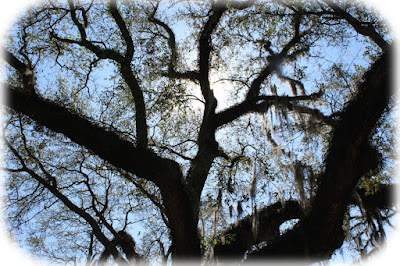
Trees are also artists, lifting up a network of twisted limbs framing the blue of the sky in a mosaic of shapes and shades. They entertain us with the different textures of their barks, the ground-level network of knots and knees. In the spring, they inspire us with green leaves and buds; in the fall, they astound us with oranges and yellows and reds, leaves in a rainbow of colors, which then all fall to the ground and give us the endless pleasure of raking them all up (or blowing them from one end of the yard to the other.)


The physics of a tree amazes me. The huge network of roots underneath the ground somehow supports, stabilizes and makes possible the huge network of limbs overhead. It's hard to imagine the weight of the heavy limbs, pulling mightily at the main trunk, the off balance leaning of the top canopy, the tensile strength of wood fibers, the conveying of water from deep in the ground to the tip tops of the branches, the swaying back and forth in the gentle breezes, the violent contortions of being buffeted by hurricane-force winds, 100 miles per hour winds.


Which brings me to why I wrote all this: I will miss the trees brought down by Hurricane Ida. The dense canopy of treetops has been thinned out considerably, the tall pines toppled, people’s homes and cars shattered.

The trees tried to hold on, but the twists and jerks of the wild bursts of winds overcame them. Many just keeled right over after hours and hours of rain-soaked ground gave way, their roots pried from the nurturing dirt, their limbs on the way down taking out powerlines and cable wires, rafters, ceiling joists, and walls. Thousands upon thousands of light poles were smashed and snapped, and many more trees will have to be cut down to replace those light poles.

The trees didn’t want to damage anything.  The trees just wanted to live and grow and provide leaf mulch for years to come. But now those trees that fell have been sawed into sections, stacked on the side of the road, picked up by a mechanical claw and placed in big metal dumpsters on wheels. They are being taken somewhere else where we cannot see their undignified remains as they rot or get shoved into a chipper. 

There are still many trees, of course, some of which will be taken down as a precaution against future storms sending them crashing down into nearby homes and automobiles.

I’ve known people who live out west, in towns with few if any trees. When they come to Louisiana they are amazed by the trees, the moss, and the tree-cradled ferns, the lattice of limbs where birds nest and squirrels romp.

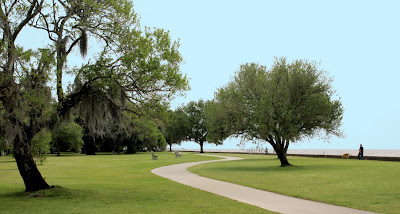
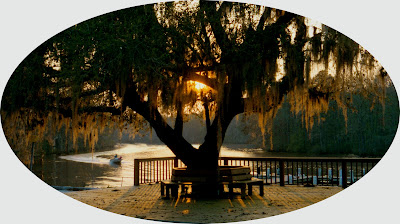
I send the visitors to the lakefront in Mandeville, where they can enjoy a variety of trees of all shapes and sizes. It's a place to marvel at the trees, sit under them and think about things in a quiet and thoughtful manner, as people have done for centuries, sitting under those very same trees that have stood there for centuries, and hopefully for many more years to come.

 
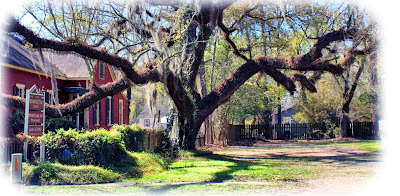
Mandeville

 
Abita Springs


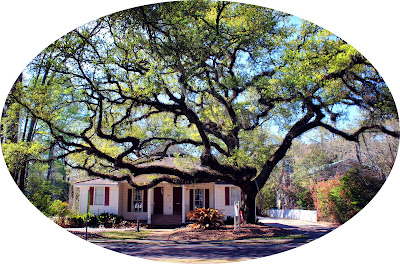
Covington


Million Dollar Road


See also:

Trees Green Up For Spring 

A Monumental Oak Tree 

City Hall Oak Tree 

A Tree's Knees 

Post Oak 

Seven Sisters Oak - 1982 Cover Tree 

Vintage Court 

The Oak Trees of 21st Avenue 

Live Oak Trees Recognized 

Lakeshore Drive Tree 

The Tree on the Wall 

The Chinchuba Oaks and Mardi Gras Day 

St. Tammany Loves Oak Trees