Showing posts with label Madisonville. Show all posts

Friday, May 23, 2025

Madisonville News 1922

 Here is the "Madisonville Letter" sent in by the town's community newspaper correspondent for publication on April 1, 1922. Click on the image to make it larger and more readable. 


Saturday, April 19, 2025

Sharp Shares Madisonville's Part in American Independence

   The last confrontation of the American Revolution was recorded in the Florida Parishes some 27 years after the end of military hostilities and the subsequent political resolution, according to research done by historian Don Sharp. He feels that the final resolution of the conflict actually came with the raising of the American Flag in Madisonville in 1811. 


Sharp sees the upcoming celebration of the 250th anniversary of American independence as a great time to focus on the part played by pioneer residents of St. Tammany and Tangipahoa Parish residents. 


Link of interest:

Wednesday, April 2, 2025

The Battle of New Orleans Revisited

The events that took place between the Louisiana Purchase in 1803 and Gen. Jackson's victory at the Battle of New Orleans in 1815 are known to be of critical importance. In the following two articles are interesting accounts of St. Tammany Parish history and how it relates to the battle in Chalmette. They were printed in the St. Tammany Farmer newspaper, the first in 1902 and the second in 1924.  

Politics behind the Battle of New Orleans

Shocking information about the Battle of New Orleans and the Louisiana Purchase was revealed by the following 1902 article. It tells of the incredible importance of the victory in the Battle of New Orleans, the diplomatic trickery surrounding the entire affair, and flaws in the Louisiana Purchase which Britain was planning to exploit. The fate of the United States hung in the balance, and only Jackson's victory on the Chalmette battlefield prevented a national catastrophe. 

The article begins with an overview of the Louisiana Purchase and the 100th anniversary celebration being planned by a special commission in 1902. It then explores earlier reports of what President Jackson said about the negotiations leading to the Purchase. 

Here is the text of the article:

TALK WITH JACKSON

Great General's Comments on the Battle of New Orleans

Old Hickory's Wonderful Victory Meant Much More to the United States Than Most Historians Have Supposed.

[Special Washington Letter.]

The Louisiana Purchase commissioners are making considerable progress in their work, as shown by official and unofficial communications from the chairman of the board to eminent gentlemen in this city. The exposition will be a notable one, not only because of its general excellence, but because of the historic incidents thus commemorated. 

Concerning those events the writer has come into possession of some facts which are not generally known. While folks are celebrating the anniversary of the battle of New Orleans, this is an opportune time to talk of the events which led up to that battle.

On December 15, 1802, President Thomas Jefferson notified our Congress that Louisiana had been ceded to France. There was great excitement throughout the country and in Congress. After much persuasion and the exercise of limitless diplomacy, Jefferson induced the congress to permit him to send James Monroe to Paris with an appropriation of $2,000,000 for the purpose of negotiating for the purchase of Louisiana from Napoleon.

With the cooperation of Minister Livingston, at Paris, Mr. Monroe successfully conducted the negotiations, so that the cession was concluded April 30, 1803; a little more than four months after the Congress was first notified of the cession from Spain to France. When it is remembered that it required almost a month to cross the ocean; that there were no cable or telegraphic means of communication; no telephones; no street cars, and that all negotiations were necessarily conducted in person, it must be conceded that the work was done as speedily as it was well done.

Flaws in Louisiana Purchase

After the treaty had been negotiated, M. Barbe Morbois, the head of the treasury of France, called the attention of Napoleon to some technical flaws in the wording of the treaty, and suggested that the American commissioner be recalled for the purpose of making corrections, but Napoleon said: "No. Let the flaws remain, so long as we only are aware of them. Later on, those flaws may be pointed out by one of my generals, at the head of an army corps."

The great military miracle, Napoleon, never had opportunity to take advantage of that flaw. Great Britain, however, a few years later, undertook to capture New Orleans, and with it the entire grand territory of Louisiana. It will sound strange to many, but it is a fact that there would be no Louisiana purchase commissioners today preparing to celebrate the expansion under Jefferson's administration if it had not been for Jackson's success at the Battle of New Orleans.

Only a thin American line of soldiers that day stood between British conquest and American integrity. Cotton bales played a great part in saving "the land of cotton" from a separation of greater danger to our national integrity than would have been the separation sought 40 years ago.(referring to the Civil War.)

It is a singular historical fact, by the way, that when the battle was fought at New Orleans, on January 6, 1815, Gen. Packenham and Gen. Jackson, the American commander, were not aware that on December 24 previously plenipotentiaries representing Great Britain and the United States had met at Ghent and had signed a treaty of peace, so that the war was practically over, although that treaty was not ratified by the United States senate until February 17, 1815.

And now we come to a historical anecdote of interest and value. Augustus C. Buell, now with Cramps at Philadelphia, was for many years one of the ablest and most capable newspaper men in our country. In 1875 Mr. Buell interviewed the late Gov. William Allen, of Ohio, at his home near Chitlicothe, for a St. Louis daily newspaper. 

In that interview, after discussing current political affairs, Gov. Allen said: "Shortly after the admission of Arkansas to statehood, I, being a member of Congress, called at the White House. Gen. Jackson—he always preferred to be called general, rather than Mr. President, so we always addressed him by his military title — Gen. Jackson invited me to lunch with him. No sooner were we seated than he said: 'Mr. Allen, let us take a little drink to the new star in our flag—Arkansas." 

"This ceremony having been duly observed, the general said: 'Allen, if there had been disaster instead of victory at New Orleans, there would never have been a state of Arkansas. Did you know that?

"This, of course, interested me greatly, and I asked: 'Why do you say that, general?

Treaty of Ghent

"Then he said that if Packenham had taken New Orleans the British would have claimed and held the whole Louisiana purchase. But I said: 'You know, Gen. Jackson, that the Treaty of Ghent, which had been signed 15 days before the battle, provided for the restoration of all territory, places and possessions taken by either nation from the other during the war, with certain unimportant exceptions.'

"'Yes, of course,' he replied. 'But the minutes of the conference of Ghent, as kept by Mr. Gallatin, represent the British commissioners as declaring in exact words:
'We do not admit Bonaparte's construction of the laws of nations. We cannot accept it in relation to any subject matter before us.' "

"'At that moment,' pursued Gen. Jackson. 'none of our commissioners knew what the real meaning of these words was. When they were uttered the British commissioners knew that the Packenham expedition had been decided upon. Our commissioners did not know it. Now, since I have been chief magistrate, I have learned from diplomatic sources of the most unquestionable authority that the British ministry did not intend to permit the treaty of Ghent to apply to the Louisiana purchase at all. 

"The whole corporation of them — Pitt, the Duke of Portland, Grenville, Percival, Lord Liverpool and Castlereagh — denied in toto the legal right of Napoleon to sell Louisiana to us, and they held, therefore, that we had no right to that territory. So, you see, Allen, that the words of Mr. Goulburn, burn on behalf of the British commissioners, which I have quoted from Albert Gallatin's minutes of the conference, had a far deeper significance than our commissioners could penetrate. 

"Those words were meant to lay the foundation for a claim on the Louisiana purchase, entirely external to the provisions of the treaty of Ghent. In that way the British government was signing the treaty with one hand in front, while, with the other hand behind its back, it was dispatching Packenham's army to seize the fairest of our possessions.

"'You can also see, my dear William (having once or twice during the luncheon toasted the new star) you can also see what an awful mess such a situation would have caused if the British programme had been carried out in full. But Providence willed otherwise. All the tangled web that the cunning of English diplomats could weave around our unsuspecting commissioners at Ghent was torn to pieces and soaked with British blood in half an hour at New Orleans, by the never-missing rifles of my Tennessee and Kentucky pioneers. 

"And that ended it. British diplomacy could do wonders, but it couldn't provide against such a contingency as that. The British commissioners could throw sand in the eyes of ours at Ghent, but they could not avert the cold lead that my riflemen sprinkled in the faces of their soldiers at New Orleans. Now, Allen, you have the whole story. Now you know why Arkansas was saved at New Orleans.' "

There is a chapter of British soldiery and British diplomacy which it was well to have incorporated in our school histories. Gen. Packenham had a force of 14,000 men of all arms and was on his way to New Orleans to overwhelm the thin American line, while the British commissioners were blandly preparing a treaty of peace—preparing it in a manner as dilatory as possible but carefully inserting the clause of treachery and unfairness.

Fortunately for the American cause, Gen. Packenham underestimated the fighting capacity of Jackson and his riflemen. Of the 14,000 men under his command Gen Packenham only took into the battle 5,601, the remaining troops were disposed guarding roads and making demonstrations along the river. 

But 5,601 British soldiers would have been sufficient to triumph over Jackson's 1,500, if they had been ordinary militia. But every man under Jackson's command was a sharpshooter. Every time a trigger was drawn a British soldier felt the lead. The slaughter was so appalling and so rapid and so unexpected that veteran British soldiers fled from the plain of Chalmette panic stricken, and many of them collapsed with nervous prostration. They were as brave men as Great Britain ever sent into battle, but they never met with such foemen.

So, when we are celebrating the anniversary of that battle, and toasting "Old Hickory," and while great preparations are being made for the celebration of the Centennial of the Louisiana Purchase, it is well for us to remember that American soldiery under Jackson cemented and riveted the diplomacy by which Jefferson acquired that magnificent empire beyond the Mississippi. 

SMITH D. FRY
St. Tammany Farmer
March 1, 1902

End of first article

To view the original article, click on the image below to make it larger. 


The second article, this by an area resident calling himself Wildwood, was part of the "100 Years Ago In Covington" column regularly run in the paper at that time, one which discussed a wide range of topics. This also focused on the Battle of New Orleans, giving it a bit more background. 

ONE HUNDRED YEARS AGO IN COVINGTON.

St. Tammany Farmer Nov. 29, 1924

(By Wildwood)

History tells us that Spain by reason of discovery and settlement once possessed much of the territory embraced by the Southern States of Alabama, Florida and Louisiana. The name given to Spain's possessions was the "Province of Florida. The geographical subdivisions of Louisiana now known as St. Tammany, Washington, St. Helena, Livingston and Tangipahoa parishes were at one period the boundaries of this Spanish "Province of Florida," and were long designated as the "Florida Parishes."

At one time Spain ceded part of the Province to Great Britain to whom the country belonged until the close of the war between that country and the United States in 1815, when Great Britain's claims were ceded to the United States by treaty of peace. About this time the American government purchased from Spain the remainder of the Province of Florida. In 1810, while all the region was still under Spanish domination an interesting event occurred that lights up a page in the history of Louisiana. 

Many native Americans had settled in the Florida Parishes, and becoming tired of foreign rule they rose en masse, formed the "Free State of Florida," marched to Baton Rouge and defeated in battle the troops of the Spanish governor. The patriotic aim of these Americans was to be annexed to the United States and this came about peaceably a few years later.

In the early part of the last century when Congress and President Madison bought the territory from France known as "Louisiana," this name was applied to the section now comprised by the Central States and those that adjoined. This was the historic "Louisiana Purchase,' while the State of Louisiana was subsequently formed and admitted into the Union.

Battle of New Orleans

Herein is an outline of the past political status of the country that embraces St. Tammany parish:

Among the events that stand out prominently in the period of the past the conflict of the British and American armies on January 8th, 1815, near New Orleans, is notable to a high degree. Both in the Battle of New Orleans and the one at Baton Rouge, the patriot men of the Florida Parishes performed their duty.

The old account book told about is of historical value that warrants preservation.

A company of Louisiana State Militia, under Capt. John K. Goff, attached to General DeClouet's regiment, fought along with Andrew Jackson and won a victory. Scores of these old names printed I venture to remark could be found on the roster of Capt. Goff's company, among them Morgan, Evans, Stafford, whom I have been told about. 

One of these, Ethelred Stafford, I can recall as a visitor to my boyhood home in New Orleans, when he took dinner one day during the time of the Civil War. This veteran was then an old man but active enough to get around and enjoy a good laugh.

Curiously enough I have found among these names from out of the past that of Noble Butler. When I was a boy at school in New Orleans years ago, I remember that the author of the grammar then used in the schools was Noble Butler, A. M., L. L. D. Were these two related in some way? Perhaps so, since a line contingent of representative American names in here offered. Farmers, artisans, teachers, and others who came from older states of the Carolinas, Georgia, Kentucky and Tennessee to settle here. Of what absorbing interest would be a recital of the story of St. Tammany parish around 1817.

The half cent figures in the price of many articles of merchandise entered in the 1817 account book (which has caused the editor to wonder what became of the half cents when settlement was made with country merchant. If I am not mistaken a silver coin of the value of 12 1/2 cents circulated in those days.

This piece of money was called a "bit," and though the coin long since passed out of circulation, the name still remains in some parts as when 25 cents is spoken of as "two bits" and 50 cents as "four bits."

Throughout the whole of the Florida Parishes many of the worthy names listed are still familiar to-day borne by descendants who look back with pride on their sturdy pioneer ancestry. The lives that were lived out in other days these, too, had their hopes and fears, their joys and sorrows, their romance and reality. The log house in the wilderness, the open hearth of the kitchen, where the good housewife prepared the welcome meal; the spinning wheel, the flickering light of the candle dip and a subtle touch tug at the heartstrings.

Slidell, La., Nov. 16, 1924.  End of Article


St. Tammany Parish's claim to fame in this historical drama is that General Jackson and some of his men came through Covington and Madisonville on their way to the scene of the battle in Chalmette. 


A historical marker in Covington at the end of Columbia Street


A historical marker on the Madisonville riverfront


Although the "Florida Parishes," of which St. Tammany is one, were not officially included in the Louisiana Purchase, residents of the area wanted to be a part of the United States and successfully fought against the prevailing Spanish government and declared themselves to be a free and independent Republic of West Florida in 1810. The United States annexed the Florida Parishes shortly thereafter, much to the relief of many of the area's residents (although some of them wanted to remain a free and independent republic.)

Saturday, March 29, 2025

Spanish Origins of Madisonville

 In 1911 a number of speeches were given at the 100th anniversary celebration of St. Tammany Parish. The event took place in Bogue Falaya Park in Covington, but several public officials from other area towns were invited to tell about their municipalities. Here is the one given by Judge Thomas A. Burns. 

A FEW HISTORICAL NOTES FROM MADISONVILLE, LA.

It has been said that Madisonville antedates New Orleans in time of settlement. Going back to the Spanish regime the beautiful banks of the Tchefuncta, now occupied by the town of Madisonville, was the point of landing or embarking of the Spaniards as they passed to and fro from their settlements to inland stations, and on to Baton Rouge, where they were strongly established.

They built the road from Madisonville running west to Ponchatoula, and from thence to Baton Rouge, giving it the name of "King's Highway." It was their overland route between the two points, and it was traveled frequently.

The noted Lafitte and his men found safe rendezvous on the banks of the Tchefuncta. Later, Mr. Joseph Baham, a French gentleman, came from Mobile and settled at the spot chosen as a settlement and landing place by the Spaniards, making a plantation of the spot. The old plantation residence is still to be seen in the town, surrounded by modern dwellings. The plantation was afterwards laid off in town lots and sold. Thus it was transformed into a village. 

The Choctaw Indians lived near the village. Peace and harmony existed between them and the white people. One of their greatest chiefs, Mingo, spent much of his time in the village ,frequently slept under an oak tree on the bank of the river. This tree is known as "Old Mingo." It stands a fitting monument to his memory.

General Andrew Jackson entered Madisonville by the King's Highway," having marcned into that road a mile from town, when he left the "Kentucky Road." Here he embarked, with his troops, crossing the lake in vessels, and reaching New Orleans in time to prevent its capture by General Pakenham.

The plantation home of General Morgan, the friend of General Jackson, was near Madisonville. After the General's death it passed into other hands. It is a fine old place,and in a good state of preservation. General Morgan's body rests in the town cemetery.

Madisonville became a summer resort for visitors from New Orleans, and a resting place for travelers journeying to or from the city. They crossed the lake in fine steamers, which ran on regular, schedule time. 

During the Civil War, while no battle took place in or near the town, the shot and shell of the enemy reminded the inhabitants that they, too, had a part in the great conflict. Recovering from the ravages of war the place has increased in population and in prosperity.

It is a point for lumber export. Here were shipped the products of the surrounding country. The landing place of the Ft. Biloxi Spaniards has become the thriving town of 1911.

St. Tammany Farmer Newspaper April 29, 1911


Thursday, December 12, 2024

Madisonville's Community Center

 In early 1973, town officials in Madisonville began drawing up plans for a new community center and town hall. Click on the image to make it larger. 


The old community hall being torn down


The new town hall that was built


Saturday, February 10, 2024

Theodore Dendinger Cemetery

 In the late 1950's a new cemetery was established off La. 21 north of Madisonville. It became the Theodore Dendinger Sr. Memorial Cemetery. The five acres of land was formally donated in 1962 and has been in use ever since. 


At the front of the cemetery are three massive oak trees. 

Click on the images to make them larger. 


In 1979 the Madisonville highway alongside the cemetery was widened, prompting numerous local preservationists to keep an eye on the trees, wary of what had happened during a state highway widening project in Mandeville. That was where the "Chinchuba Oaks" were secretly cut down one Mardi Gras. Next Tuesday is the 46th year anniversary of that  eye-opening event.

Here are some recent photographs of the oaks in front of Dendinger Cemetery. 


See also these links:

The Chinchuba Oaks and Mardi Gras Day

The Oak Trees of 21st Avenue 

Trees Green Up For Spring 

A Monumental Oak Tree 

City Hall Oak Tree 

Post Oak 

Seven Sisters Oak - 1982 Cover Tree 

Vintage Court 

Live Oak Trees Recognized 

Lakeshore Drive Tree 

The Tree on the Wall 

St. Tammany Loves Oak Trees

Tree Branch Avalanche

Monday, June 5, 2023

Maritime Museum Update

 The Lake Pontchartrain Basin Maritime Museum in Madisonville is newly renamed the Maritime Museum Louisiana, and I stopped by the facility this morning to take pictures of the new signage. I visited for a few minutes with Jim MacPherson, the executive director of the museum, and he caught me up with a few of the ongoing activities.


The new name for the maritime museum


The top of the Pass Manchac Lighthouse is now on display 


A plaque identifying the Pass Manchac lighthouse enclosure will soon be installed. 


The lighthouse keeper's cottage from the Tchefuncte River lighthouse is located just east of the museum on the bank of the river. 


A new roof was just put on the old lighthouse keepers cottage


The lighthouse keeper's cottage that used to be located on the point of land just west of the mouth of the Tchefuncte River (shown below with lighthouse in the back left) is a little easier to get to these days.


The view across the river of Marina del Ray


In front of the musem are flags indicating the change in the name, and an old cannon. 


MacPherson said that the museum currently is hosting a kids' summer camp, with 60 participants from around the area. The facility is also installing an "aqua-ponics" system which will feature ponds containing finned fish, shellfish, and a marsh grass growing operation.

Thursday, May 11, 2023

Madisonville School Students Prior to 1910

 Over on the Madisonville LA Historical Facebook page, Iris Lulu-Simoneaux Vacante posted this old school picture. It shows the Madisonville School pre 1910, and the students were identified  by Annie Pennington Koepp. Click on the image to make it larger. 


Madisonville School Students circa 1910

Bottom Row (left to right) Eva Pennington, Mae Watts, Ted Gentilucci, Hazel Heughan, Lillian Richards, Edith Badeaux, “Nannie” Jane Dutsch, Filmore Chatellier, Ralph Chatellier Sr.

2nd Row ((left to right) Helen Badeaux, Myrtle Gallehon, Hannah Phillips, Stella Heughan, Aline Gentilucci, Ola Galatas Lawton Heughan, Valera Galatas, Myrtle Galatas, Dorthea Behrens, ? Harry Galatas, Ernest Galatas (4 more ?)

Steps and Balconey ((left to right) Adrienne Dendinger, Annie Oulliber, Vernon Heughan, Annie Caldwell, Clinton Galatas, Miss Vera J. Norman (teacher), Pauline Ballam, Bertha Warning, Jessie Dutsch, Irene Stevens, Violet Heughan, Inez Caldwell, Denia Chatellier, Etta Stevens, “Bubba” Bechac, Wallace Ballam, Viola Wager, “Honey” Dutsch.

Thursday, April 6, 2023

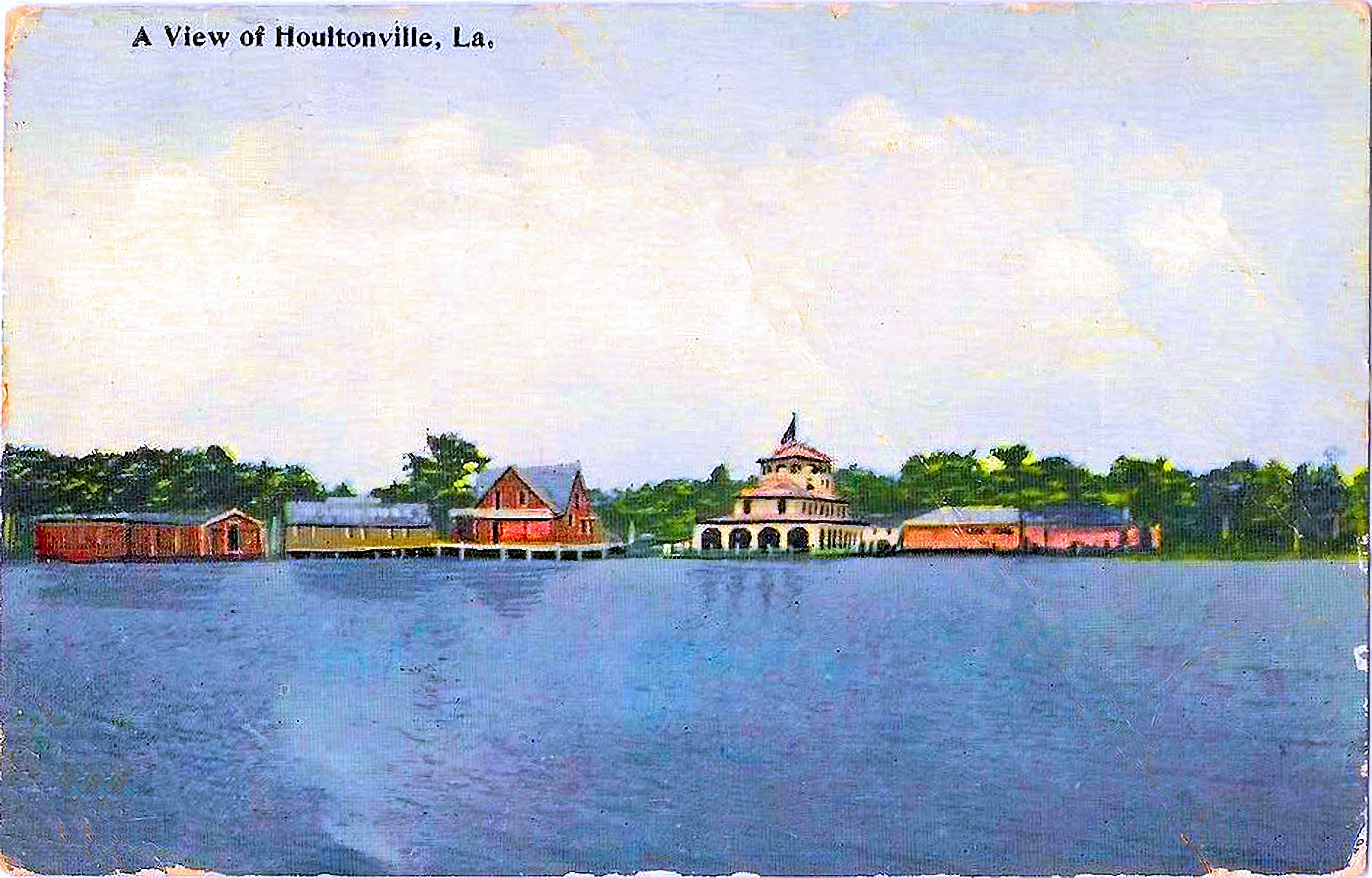
The Houltonville Pavilion

 Pineland Park upriver from Houltonville was a fun place in its day. It was on the east side of the Tchefuncte River, a little upstream from Madisonville. It featured a large dance hall, a restaurant, amusement places, boat houses, and vacation rentals. A ferry took people across the river in the days prior to the building of the bridge. 


Pineland Park Advertisement

In a letter to the St. Tammany Farmer in 1974 Charles J. Mugnier of Madisonville recalled that Pineland Park was several riverbends upriver from the town and was the terminal for the paddle-wheeled passenger boat The New Camelia.

That vessel brought folks from Milneburg (Pontchatrain Beach) in New Orleans each Wednesday and Sunday to Mandeville, Lewisburg, and Madisonville. 

Further down river from Pineland Park, and closer to Madisonville, was Houltonville, also known as White City. Its large gathering place was called "The Pavilion" while the building next to it was a general merchandise establishment, or company store for The Houlton Lumber Co.

The lumber company operated a huge sawmill employing most of the population of Houltonville, according to Mugnier. "This company, similar to many such company owned communities in the Southern states, paid workers in "script," which consisted of cardboard discs in denominations of one cent, 50 cents, and $1 pieces (equivalent to U.S. Coins of similar value.)"

The company employees had a special name for the funny money, referring to them as "squizzlums," Mugnier said. 

The Pavilion

The Pavilion operated for many years until the sawmill closed down around 1915 or 1916.The businesses associated with it were a restaurant, a saloon, and sleeping accommodations. "There was also a dance and  entertainment hall for mill workers," Mugnier said.


Music was popular, and the instruments included harmonicas, piano, and guitars. Mugnier stated that "the favorite drink quaffed by the merrymakers was red wine, spiked with grenadine, called "Sweet Lucy."

There was also a butcher shop furnishing beef, lamb and pork meats, all of which was slaughtered, placed in public cold storage and fully processed by the owner, Mugnier went on to say. "It might be sold at prices of 25 cents per pound for the choicest steak, with pork and lamb at even lesser cost," he noted. 

The entire business complex was owned, operated and managed by Eugene Mugnier, the  brother of Gus and Henry Mugnier, who operated the renowned Crescent Hotel (also known as the old Mugnier Hotel) located on the lakefront in Mandeville. 


Eugene Mugnier, to say the least, was a most enterprising individual, Charles stated. "He also, in conjunction with the Pavilion, operated the restaurant and saloon for many years on the steamboat New Camelia," Mugnier explained. 


See also:

Beau Chene Subdivision History


Tuesday, February 28, 2023

Christmas Boat Parade

 The Madisonville Christmas boat parade brought out a large number of folks along the riverfront. 


Click on the image to make it larger. 


Monday, June 13, 2022

Madisonville Video Photos - Part One

 In 2010 Rusty Burns put together an extensive collection of old photographs depicting the Madisonville area, all to be scanned and placed in production of a video to be shown at the 2011 Madisonville Town Bicentennial Celebration. 


The video contained dozens of old photographs of the shipyards, the buildings and the people of Madisonville over the past 100 years. The Tammany Family blog is presenting those photographs in a three-part blog series. Here is part one. Click on the images to  make them larger. 


The Madisonville steamer ran between Madisonville and New Orleans across Lake Pontchartrain for several years, then was used in military service in 1943, and later as a tourist boat in New York harbor taking people to the Statue of Liberty. 


The New Camelia docked at Madisonville and went all the way up to Old Landing near Covington. It was one of the more popular lake excursion vessels. 


St. Catherine's Catholic Church


To view the complete video that Rusty Burns prepared, it may still be available for viewing at the following link: 

CLICK HERE FOR VIDEO

Tomorrow we will look at more photographs from the Burns video, these pictures to deal with the Tchefuncte River lighthouse and the Jahncke shipyards. 

See also:

Madisonville Video Photos - Part Two

Madisonvile Video Photos - Part Three

Tugboats Clog The Tchefuncte River


Madisonville Mayors  


Madisonville in 1850


Building the Madisonville Bridge in 1935