
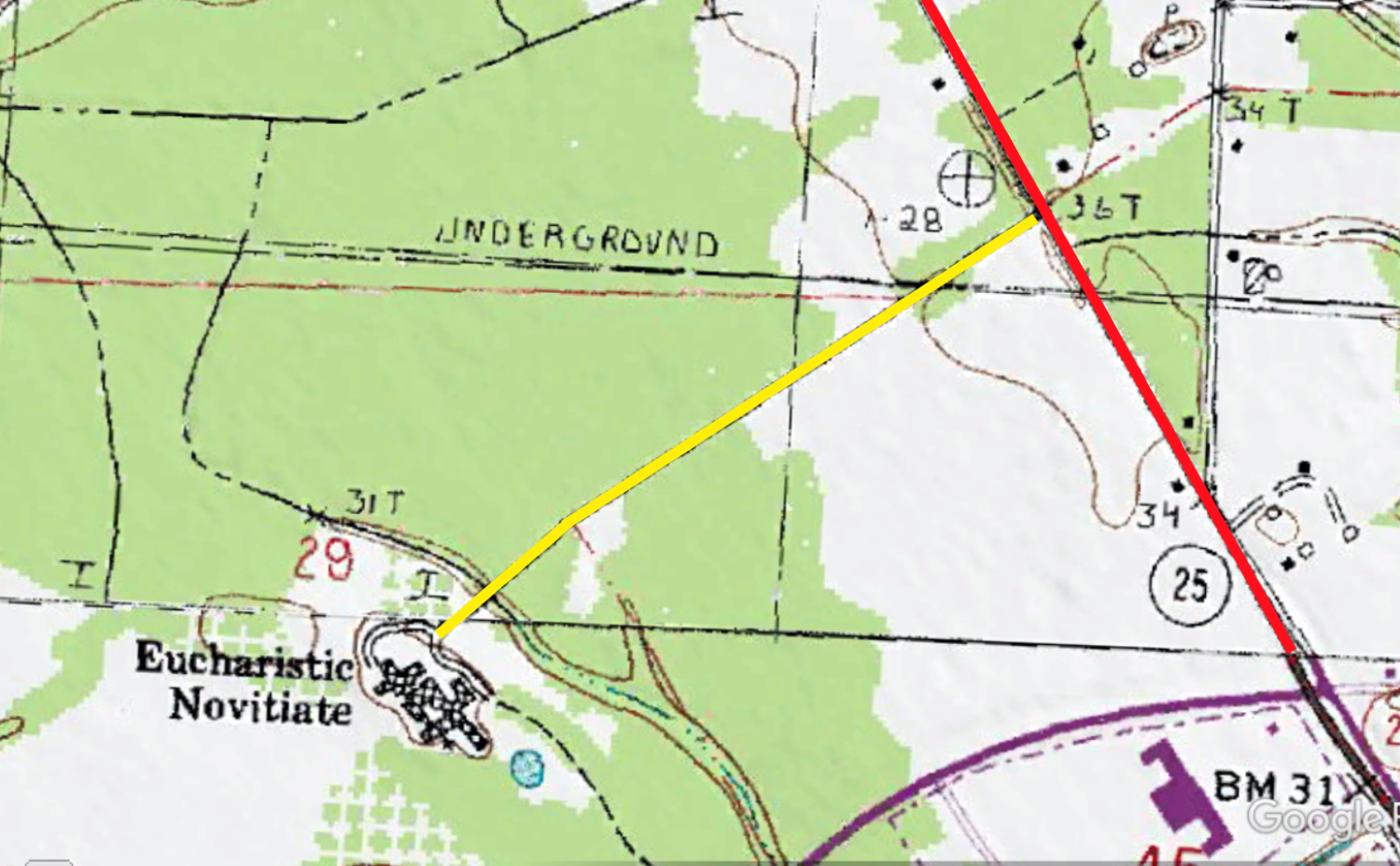
The Eucharistic Novitiate at Regina Coeli north of Covington was established in 1954. It was accessed through a road off of La. 25, the Folsom Road. The road is still there, named Regina Coeli Road. The Order of Eucharistic Missionaries of St. Dominic had been founded in 1938. The facility was staffed by Eucharistic Missionaries of St. Dominic with Sister M. Louise, O.P. as Superior.
When the facility was first started, it was located on an old rice planation north of Covington, the Clarion Herald newspaper reported. It operated a junior college that educated as many as 60 women at one time. The college was associated with the Catholic University of America.
In July of 1963 the newspaper reported that the group had dedicated two buildings at the location, which was then home to the Regina Coeli Junior College. In September of that year, fifteen girls entered the Novitiate. They came from New Orleans, New Iberia, Baton Rouge and as far away as St. Louis, MO, Kentucky, Arizona, and Houston, TX.
In New Orleans, fund-raising events were held to help pay
for the upkeep of the new Regina Coeli novitiate in Covington.
It became a favorite
place for picnics, given its tranquil setting and magnificent oak trees. The oak
trees were one of its most impressive attributes, in fact, the alley of two
rows of oaks were known throughout the area. Today those oaks are located in
the subdivision where Regina Coeli was located, a subdivision named Oak Alley.
In a 1980 article that appeared in the Clarion Herald
newspaper, Sister Paula Richard O.P., described her feelings while walking through
Oak Alley under those massive oak trees. “I began to look – I mean really look –
at the algae that grew around the base of the tree. It was summer. I was
attending classes at SLU in Hammond and living in Covington at Regina Coeli. Algae?
I had looked at it so often, but I had never before really ‘seen’ it. What made
the difference that day? Well, at SLU I was taking a course in which our
professor had motivated me to become interested in algae. It was a course in
biology, the study of the bios, of life.”
“Suddenly
I saw a different world around me. I remember looking at all the trees and
seeing them in a way I had never seen before. There were things about trees
and plants that I knew now that I had
never even guessed at before.”
In
studying algae under a micoscope at SLU, she had been introduced to the “marvelous
creation” of God, which is the plant world. The dramatic effect of the grounds at Regina
Coeli Retreat Center impressed upon many who stayed there the need to take the time to pause,
walk, and contemplate the beauty of the environment of St. Tammany Parish.
Perhaps that is one of the reasons
that the Catholic Church located many of its colleges, churches, convents, and
assorted other retreat centers in St. Tammany -- the same reason the parish
became a growing center for the landscape nursery industry, the tung oil tree
industry, and even the pine tree growing and harvesting industry.

In 1964 it was occupied by 7 professed religious, 9 novices, and 15 postulants. Superior was Sister M. Louise, O.P. By 1968, however, officials realized that dwindling enrollment in the junior college revealed a need to expand new services to the community. At one point there were only three nuns left at Regina Coeli, Sister Cathy was “the chief dishwasher for Regina Coeli, Sister Madeline Davis oversaw the property, and Sister Victoria Brown was the chief cook.
They took care of a plant that could sleep 40 and included classrooms, a church, an assembly hall, a cafeteria, library and 200 acres of grounds. “I love the tranquility out here,” Sister Cathy stated. “I realize though that many of our members wanted to be more closely involved in the communities where they are studying and working.”

According to the Clarion Herald, by 1973 many other novitiates in the area had fallen into disrepair and disuse. But the Regina Coeli Novitiate in Covington began bustling with activity. The reason was that it had become a coordinating center for the federal government’s HeadStart program. Now it was being “overrun by leggy, laughing, scrambling, squirming four-year-olds. The days of peaceful walks under the giant oak trees were no longer the same.
An article in the September, 1974,
edition of the Clairion Herald noted that “pint-sized chairs have replaced the
larger, roomier adult-sized desks. A popcorn popper and slide show on firemen
are now popular classroom tools. “
“The Regina Coeli Novitiate had
been transformed into the Regina Coeli Child Development Center. Instead of
training young women for a life of service to God, the center aims to train
young children for a life of… well, a life that they will like,” the article
concluded. It served 60 students at that time.

Regina Coeli had suddenly become a
coordinating center for 11 other area HeadStart programs as well. Its program for
four-year-olds sought to prepare them for entering the public school system the
following year. It made an effort to involve the parents in the education of
their children so that as the child progressed in the public school system, they
could be further encouraged by their own parents.

In the 1980’s the group was involved in housing projects in Covington, and starting a community program for youth called “The Bridge.” By 1983, the retreat center programs increased so much that the facility became known as the Reginia Coeli Retreat Center. It could house up to 76 people in its dormitory, offering a “piney, serene setting, “conducive to reflection.”
In May of 1981 the Regina Coeli facilities offered
Marriage Encounter program stressing improvements among spouses and their teenagers.
It was in 1983, Regina Coeli hosted a Parent-Teen-Young
Adult Encounter and also was the site for a “Handicapped – Encounter Christ”
retreat. It was the first of many retreats held there especially for the disabled,
mainly because the Regina Coeli Retreat House was one of the few retreats in the
area that had handicapped access. Also
in 1983, the facility held retreats for Catholic High School juniors and
seniors. Special attention was given to the topics of commitment, love and
reconciliation.
That same year the "Motherhouse" for the Order was located in New Orleans, but it was
sold and the sisters from that location were temporarily moved to Regina Coeli
facilities north of Covington.
By
1989 the Regina Coeli Retreat Center had become quite active in offering a wide
array of special events and retreats, including Days of Prayer, Beginning
Experience seminars, twilight retreats, as well as specialized offerings for
handicapped, families, the elderly and the divorced and/or separated.
In
1997, the facility offered a summer camp for deaf children. Transportation for
the participants was offered from Lakeside Shopping Center to and from
Covington, and meals were provided.


According to the Regina Coeli Child Development Center website, here is a history of the Headstart program in the Florida Parishes.
"About that time, the group received word that there were funds available in Washington D.C. for Head Start. The Council contacted Washington to inquire about some of these funds for a Head Start program in Covington.
"The first grant application was written by Dr. Suzanne Hill, a professor of Developmental Psychology at the University of New Orleans and Garic "Niki" Barranger, a local attorney in Covington. As a result of that proposal, the group received a $45,000 Head Start grant to operate an eight-week program in the summer of 1969.
"The group decided to use the name of the convent in its organizational name so that people would know where the program was located. That is how the organization became known as Regina Coeli Child Development Center. Regina Coeli is Latin for "Queen of Heaven". Other than using the convent as its first location, the organization has never been affiliated with the Catholic Church.
"It should be noted, however, that some of the Regina Coeli nuns gave great support to the Head Start program in its early years. Among those Eucharistic Missionaries of St. Dominic who worked hard to get the program going were Sister Stanislaus, Sister Madeline, Sister Victoria, Sister Barbara, Sister Cathy, Sister Carmel, and Sister Joan. Their continued support of Head Start over the years was greatly appreciated. All volunteered their time and energy toward making the program an early success.
"The Covington law firm of Barranger, Barranger, and Jones drafted the original corporate charter as an in-kind service for the group. On August 14, 1969, the Secretary of State affirmed that Regina Coeli Child Development Center was officially incorporated as a private, non-profit corporation.
"The first board members of the corporation were Curtis Thomsen, Dr. Walker Percy, Garic K. Barranger, Dr. Suzanne Hill, Henry Randle, Lester Dunn, Dr. Charles Hill, Helen Frick, Leroy Frick, Andrew Lange, Clarence Favret, Jr., Rev. Lawrence Tyson, William Butler, Rev. Nolan Pipes, Virgil Baham, Malcolm Byrnes, Herbert Anderson, and Russell Burton.
"Few Head Start programs in the country can boast of having a Pulitzer Prize winning novelist (Dr. Walker Percy), a Yale educated attorney (Garic Barranger), a university developmental psychology professor (Dr. Suzanne Hill), a Tulane Delta Primate Research psychologist (Dr. Charles Hill), a Baptist minister (Rev. Lawrence Tyson), and an Episcopal minister (Rev. Nolan Pipes) on their original board of directors. Others on the original board of directors were elementary school teachers, building contractors, social workers, local businessmen, and interested community members.

"The first teacher assistants were Imogene Heisser, David Schoen, and Les Landon, Jr. Sister Stanislaus directed the program for the first year. Karl Wood was the director from 1970-76, followed by Bob Hanisee from 1976-79, and Sharon Conroy from 1979-81. Judy Loyde was appointed to the position of executive director in 1981 and she served until her retirement in June, 2006.
"The board approached the Regional Head Start Office in Dallas and asked if the Covington program could be expanded to a full year program. Mr. Gerald Hastings, Regional Head Start Administrator, came from Dallas to meet with the board in the old Regina Coeli Convent Library on a hot summer evening. The air conditioning wasn't very effective in the library, and as he sweated in the south Louisiana humidity, he began the meeting by complimenting the board for running such a quality program on such little funding.
"He told the members of the board how impressed the Regional Office was with the way Regina Coeli was administering the program. Then he discussed the request to expand to a full year program. He stated that the Regional Office had recently withdrawn Head Start funds from the grantee known as "Tangilena Head Start", in the neighboring parishes of Tangipahoa and St. Helena.
"It seems, according to Mr. Hastings, that the grantee had problems administering the program in accordance with federal guidelines. He told the board if they would consider being the grantee for these two parishes, in addition to St. Tammany, that the Regional Office would approve the request to expand the Covington program to a full year program.
"There were some who said that Regina Coeli could not maintain the quality of the program if two other parishes were added. But finally, after much debate, the majority voted to take on the additional responsibility and try to do the best that they could in serving children and families from the other communities.
"A community needs survey of the Tangipahoa parents conducted in 1981 indicated that they really needed a ten month program, so the program was converted to North Tangipahoa Head Start. The direct operation of the program was delegated to a local community group instead of the school board. It opened in two locations – the old school building in the Town of Tangipahoa and an old store-front building in Amite owned by the Guzzardo family at the intersection of I-55 and Highway 16.
"That program is now known as Slidell Head Start. In 1988, the Archdiocese which had been providing the facility for a nominal annual rental fee, determined that they needed the building for church use. The Slidell Head Start program was temporarily relocated to the old KinderCare building at Kingspoint. In January 1990, a new facility was constructed for the Slidell program which relocated to Airport Road. Plans are currently in place to build a new Slidell Head Start facility on Highway 11 just north of I-12 in Slidell.
"The program attempts to serve children from a broad target area, reaching almost to Slidell on the southeast and beyond Mandeville on the west.
"In 1997, a grant was received from the State Office of Community Services to begin an infant-toddler program. Jane Moncrief, Regional Director of OCS was instrumental in getting these start-up funds for Regina Coeli. The program was first opened with eight children in one room and a closet (with the door removed) at Covington Head Start.
"On June 1, 1998, the first grant of $536,799 was received from Washington for the new Early Head Start program – designed to serve infants, toddlers, and pregnant women. A new facility was built adjacent to Covington Head Start and it was called the Covington Family Service Center. In 2002 the name was changed to Covington Early Head Start.
"First priority for enrollment is given to full-time students at SLU, but other community children are also served.
"In 2003 The Regina Coeli Board embarked on a very new venture. The board assumed the administration and operation of the Migrant Head Start Program in southeast Louisiana. The program had been operated for six years by the Community Action Program of Central Arkansas (CAPCA) located in Conway, Arkansas. On February 1, 2003 CAPCA delegated the authority for operating the program to Regina Coeli. The program serves children from birth to five years of age from migrant or seasonal farm-work families. The addition of the Migrant Head Start services in Amite and Franklinton has added a whole new dimension to the Regina Coeli organization as it attempts to make learning and quality childcare available to the children of a very hard working group of people who put food on our tables and flowers in our yards.
"In spite of this the majority of the Centers reopened to serve children on September 8, 2005. RCCDC served more children than at any time before, over 2300 children. Many of the children evacuated with their families from the New Orleans area to the parishes served by RCCDC.
"Regina Coeli would like to thank these dedicated volunteers for their prayers, their volunteer time and services, their financial support when needed, their words of encouragement, and their untiring assistance. This great community support not only helped the program get started but made it possible to celebrate many years of providing quality services to children and families.


