Here's a group portrait of several members of the Warren family of Covington.

Click on the image to make it larger.

Here's a group portrait of several members of the Warren family of Covington.

Wes Parker of Talisheek paints wall-sized renderings of birds and wildlife scenes, several of those for schools with mascots from the animal world. He's been doing this for more than 40 years and recently received recognition from his employer, the St. Tammany Parish School System, for his work in the maintenance painting department which includes his artistic endeavors.
While he says he didn't have any "formal" art training, his parents were both "artistic" in some respects, and his bi-weekly hour-long classes with the intinerant art teacher at Sixth Ward Junior High got him off to a good start. When he went to Covington High he continued with his art classes, impressing his teachers and gracing the school with several outstanding examples of his wildlife artwork, especially lions. He could make a lion look fierce for athletic programs or he could make it look knowledgeable as a "king of the jungle" for academic purposes, a former art teacher said.
His painting of a flying eagle with talons reaching out adorned the ceiling of his high school art classroom for years.

Now 53 years of age, Parker enjoys painting landscapes, especially with old buildings and wildlife, and his work has been well-received across the area. He started out as a child with pencil drawings, and often when in church his mother would give him a pencil and paper to help him stay quiet by drawing things. "That was when I was three or four years old," he stated.
While he steers clear of doing "portraits" where someone's likeness is sought, he does occasionally include a generic-looking person in some of his artwork. He is impressed when he sees an artist produce a portrait that does capture a close resemblance of someone, but in his own work, he prefers the wild environments, moss-covered trees with interesting bark textures. "And if you do portraits, there's always the chance that you might offend somebody," he laughed.
Parental Artistic Flair
He remembers as a child seeing his father sketching, primarily artistic doodles, but he also did some paintings for family members. "He had some talent, but he just never really did anything along those lines," Wes explained. His mother, he remembers, had art skills with using color and she was able to use somewhat advanced coloring techniques that impressed people.
"So I guess I got some of my artistic talent from my parents," Wes commented. He remembers how his dad designed a sign for a local store, first drawing it out small scale on paper, then transferring that design to the large-size signboard at the store. That's a skill that Wes has acquired and uses in some of his wall paintings today.
While his father was quite meticulous in his art projects, Wes says he kind of stays away from "straight lines." Sitting there doing art with a ruler would drive him crazy, he explained. His mother wanted him to go into architecture, but that involved pretty much all straight lines, so he stuck with the landscapes and wildlife renderings.
Gaining Recognition
As he continued with his artwork, showing it to his friends and teachers, he started getting some recognition for his skills around the third or fourth grade. People started taking notice of his artistic talents, and he began seeking ways to explore and improve his art.
He spent a lot of time just drawing. "I seemed to get better with practice," he said, "spending countless hours just sketching." He did a lot of things for his school, and he was always called upon and enjoyed doing projects that his classmates and teachers would ask him to do for them. He did flyers and special events posters and even painted a cardinal on the side of the Sixth Ward Junior High water tank.

When he got to Covington High his art teacher saw his skills, and he was able to bypass Art I classes and went directly into Art II. "That kind of gave me a jump start and helped me get into Art IV during my senior year," he explained. "That class enabled me to work on various projects of my own choosing, using a variety of media. Up to that time I was working with colored pencils and pastels, but there I was able to explore different painting techniques."
After he graduated from high school, he applied for a variety of art scholarships at various colleges and art institutes, but nothing became available. At that point he thought that going to Southeastern Louisiana University would give him a good background for an art-related occupation or especially art education. His art education experiences with grade school art teachers had influenced him to consider teaching as a career.
He was doing construction work during that time and had saved up almost half of his tuition. That line of work dried up, however, and after several months he did not have enough money to go to college. At that point, he decided to go into retail and spent more than 20 years in that industry with Eckerd's Drugs for four years and then 19 years with Walgreens.
The Retail Art World
While in the retail business he did have an opportunity from time to time to use his artistic talents when setting up various product displays. There was even some competition among setting them up. He would paint display backdrops and won several awards and even some cash prizes for his work in that area. "That was pretty cool," he said.
During those years in retail, he didn't really have time to do any other types of artwork, especially when he married and his family responsibilities grew. "Only in the past ten years have I started getting back into it and been doing a few things," he explained.
Some of his work is visible at Lee Road Junior High, Sixth Ward Elementary, and Fifth Ward Junior High. He has been asked to paint a bull dog at Fontainebleau High. Some of those projects required getting up on ladders and painting letters six foot high. That required a lot of pre-planning and layout work ahead of time so it was a matter of transferring the grid pattern on the layout sheet to the full-scale painting on the side of a wall. He would love to be able to do more of those school mural and mascot paintings, but the other demands of his job are pretty time-consuming.

While he has only done a few art projects for the schools, mainly paintings of school names and mascot renderings, he did produce a number of murals, one being a huge mural for the City of Bogalusa, a job that took him five months to complete.
The Challenge of Free-lance Artwork
A few years ago he set up a Facebook page called "Wes Parker Custom Designs" and that gave him a place to showcase his artwork and interact with friends and art admirers. When he left retail, he decided to try to launch his free-lance art design and paintings service to provide murals and stuff like that. He did a few murals in homes throughout St. Tammany Parish as well as a couple in Bogalusa and Franklinton.
The Bogalusa mural on Willis Avenue was painted on the retention wall around what used to be the armony. It measured 330 feet long and was 18 to 22 feet high in some places. Originally it was to feature the history of Bogalusa, but city officials gradually settled upon a wetlands landscape teeming with local wildlife. Oh, and also a big sawblade was included, a tip of the hat to Bogalusa's main industry. "That mural was by far the biggest thing I've ever attempted," he said. "It was the biggest challenge I could ever imagine, and even more."

The sheer scale of that project, along with working in the heat every day and painting up on ladders, made it a very unusual project.
He wound up picturing 42 different animals in the mural. Today that mural is fading in the daily exposure to sunlight, moisture and heat, a fact that saddens him. A better quality of paint that would have withstood the elements a little better was out of the price range of the project's budget and not available from the local supplier.
When he's doing mascots and murals for school board projects, he does use the specialty paint that lasts longer, and they are holding up very well, he reports.
It was always a challenge being a free-lance artist, figuring out just what to charge for his time and talent. "There was always the concern of pricing yourself out of a job, and sometimes it would turn out I was only getting a dollar an hour for a big complicated job," he explained.
The Steady Job Opportunity
While he enjoyed going out and doing art "on his own," and although he never had a problem with selling his artwork, he needed something a little more steady. His current job with the school system tasks him with a variety of standard painting assignments, as well as a few interesting artistic opportunities. Every day he is out either painting hallways, pressure-washing walls, striping parking lots, and any other a multitude of school building maintenance projects.
School System Award
His special skills were recognized January 19 when Superintendent Jabbia presented him with the "Impact" Award, a recognition for school system employees that go "above and beyond."

Jabbia said that Parker gets a painting job done with enthusiasm and professionalism, and on top of that, Wes adds an artistic touch and creates something special for a school community to enjoy. He congratulated him for winning the Impact Award saying that he was so talented and positive that the entire school system benefitted.
"Those schools are so proud of what you've done for them," Jabbia told him. "It's guys like you who make us feel so special. I've heard from parents and administrators, and they all tell me the same thing: they appreciate you."
Parker told Jabbia that he enjoys doing his artwork and being a part of the painting crew for the school system. "I have a good time doing it," he said. The job has been great for his family and a good fit for him.
Wade Gottschalk, director of maintenance for the school system, said that Parker is humble about his talent, and he gives his best efforts on every project that they give him. "When you put Wes on a job you know its going to be done correctly and efficiency is a top priority.
"When Wes was a student at Sixth Ward, he painted the original cardinal on the school's water tank. A few years ago when he heard that the painiting had gotten old and out-dated, he painted a new mural up there. It's a great improvement over the one he did when he was in the seventh grade, but he had also done a good job on the project back when he was in the seventh grade," Gottschalk stated.
Parker was surprised by the honor of receiving the award, but he has always known his work is appreciated. It wasn't always like that when he worked in retail.
Helping Others Through Art
His wife is a school teacher, has been for over 25 years, and he often helps her decorate her classroom. He always tells her that he really enjoys doing that kind of stuff, because he was so inspired by the many people who did that when he was growing up, people who were using their artistic talents to make life a little brighter for those around them. By sharing his talents, he hopes to inspire others, especially young people, to recognize and develop their own talents.
"If you like doing art, just stick with it," he says. "Keep working at it, and you will be rewarded." He especially likes doing random sketching and artwork as a way to pass the time. "It's nothing for me to sit down and just start drawing and four or five hours just fly by," he recalls.
A Talisheek Youth
He was born and reared right there in Talisheek, and he recalls that his dad's first job was at the Talisheek Service Station run by Mr. Pitt. "When I was growing up, we kind of knew everybody in the area, but these days you can go down one of these roads off the main highway, and it will open up and there'll be a dozen house back there, big houses," he explained.
His Art Will Last
He may not have taken the usual course for using his creative art skills, but he knows that in twenty to fifty years, people will see his artwork and his name at the bottom, and they will remember him. People in the future will appreciate his efforts to capture and immortalize in art Louisiana landscapes as well as help them recall fond memories of school mascots. "I have thought about that aspect of it," he concludes. "Maybe some of my artwork will outlive me, and that would be nice."


Both of his children are showing signs of artistic creativity, already enrolled in the school system's Talented Art Program, so they may continue the family line of expressing their observations of the world through art. "My daughter has already been recognized for some of the art things she has done, and my son really is into art," he explained.
"I seem to have gotten my interest in art from both my parents, and now my children are doing the same," he noted.

St. Tammany Parish being horse country was increasingly well-known in the 1970's, so much so that the local newspapers were writing articles naming the top stallions.


See also:
The event took place in Bogue Falaya Hall in the rear of Covington City Hall. It was sponsored by the Keep Covington Beautiful group.


Excitement ran high when The Village of Folsom decided to hold its first Mardi Gras parade in 1977 some 46 years ago. The afternoon event provided many with the last chance to see a parade that year.


The literary world was shocked in 1938 when one of its favorite writers died, a Covington resident by the name of Lucile Rutland. She was well-known for her poems, plays, essays and editorials that were published widely. She was friends with famous poets, songwriters, and Clara Barton, founder of the Red Cross. Miss Rutland was a longtime resident of Covington.


In 1906, she published a one-act play called "Light O Love," which has been deemed a classic and has been reprinted several times.


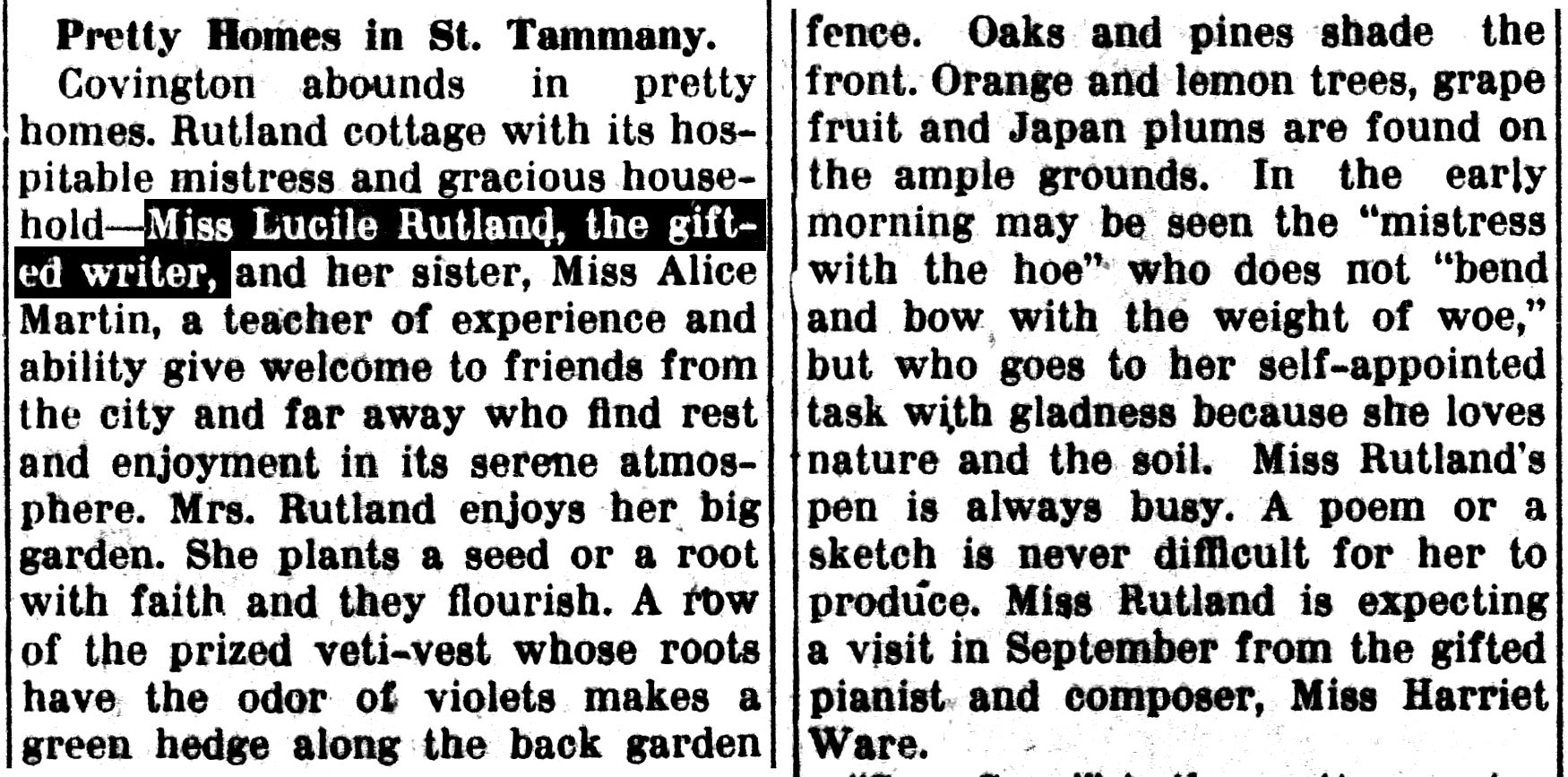


A Lucile Rutland short story that appeared in a San Francisco newspaper
Not only was she an author and a poet, but she put her scientific mind to the chemical make up of paper and came up with an interesting alternative way of making it. Sometimes we take paper for granted, but today's paper is the result of years of experimentation.
Miss Rutland was commended for formulating a new kind of paper, one that excelled in the properties that people need paper to possess. That paper was made from water hyacinth.

Her recipe for paper impressed a lot of people, especially since it used water hyacinth. That plant grows faster than pine pulpwood, thus enabling it to replenish faster than pine forests cut down for paper. Dr. W. L. Stevenson noted her accomplishment in a letter to the St. Tammany Farmer in 1938.


The Tavi Restaurant in the 300 block of North New Hampshire St. in Covington has opened. It is located between the Star Theater and the old courthouse. An attorney's office and barber shop used to occupy the building, but it was recently extensively renovated.
Here are some photographs and the menu.