Wednesday, December 21, 2022

The Memorable Meda Koepp

 One of Covington's most memorable personalities was Meda Koepp, who, in 1976 was named "Woman of the Year" by a local civic association. 


Click on the image to make it larger. 


March 22, 1973


December 16, 1976


--------------------------------------


May 1, 1975


----------------------------------


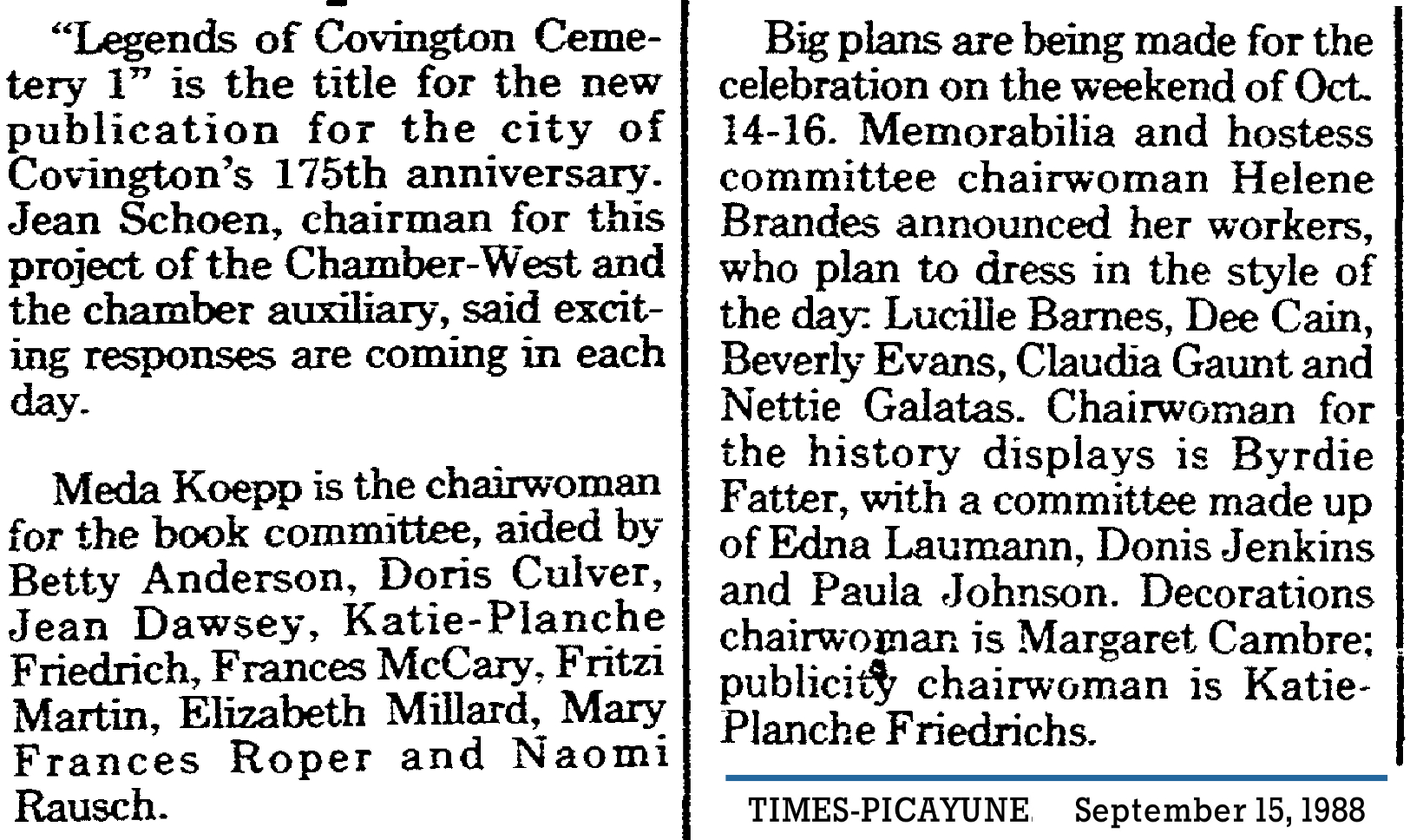
She was chairman of the book committee for the cemetery restoration in 1988


Her Obituary

Meda Adelia Koepp, age 92, of Covington, LA died on Friday, May 13, 2016, at St. Tammany Parish Hospital in Covington, LA. She was born on Thursday, April 17, 1924 in Covington, LA to the late George H. Koepp and Mildred Schoen Molloy Koepp. 

She was survived by her sister, Lurline Koepp Alexius, nieces, Mary Prieto Golden, Joan Prieto Doolittle, Kay Pennington Gotschall, Ruth Burns Joubert, Connie Reed Granthum, Carolyn Burns, and Ann Burns Sacco, and nephews, Giles Pennington, Walter Reed, Richard Reed, and Lindsay Reed. 

"Meda's life's work centered on the people of our community. She spent many years as a Child Welfare Case Worker for the State of Louisiana. Additionally, she was known as a community leader. She was part of the group that founded Playmaker's Theater in Covington, and she participated in many local organizations, some of which included the St. Tammany Business and Professional Women's Association, Covington Garden Club, St. Peter's Catholic Church Altar Society.

"At one time she was on the Board of Directors of Associated Catholic Charities. In her later years, Meda was an active member of the Greater Covington Chamber of Commerce Auxiliary, and worked tirelessly for the beautification of Covington, primarily raising funds to erect the decorative fence which surrounds Covington Cemetery #1. 

"Interment was in Garden of the Pines Mausoleum, Covington, LA. "

E. J. Fielding Funeral Home / The Times-Picayune May 15, 2016.


Napoleon's Soldiers Retired in Southeast Louisiana

 In June of 1974, historian Simone de la Souchere Delery presented to members of the St. Tammany Historical Society a talk about the area's interesting encounter with troops from Napoleon's army. Here is an article from the St. Tammany Farmer detailing her comments.

Historian Discusses Napoleon Before Historical Society

Simone de la Souchere Delery spoke to the St. Tammany Historical Society Friday night about the settlement of Napoleon's soldiers in south Louisiana. Author of "Napoleon's Soldiers in America," Mrs. Delery has traveled throughout the southern part of the state, including St. Tammany Parish, researching the places and people involved with the mass movement of former troops of Napoleon following the general's defeat at Waterloo.

She noted that several street names in Mandeville and place names throughout the Florida Parishes indicated the influence of Napoleon and his men on this area.
Her research work has taken her to numerous Louisiana cemeteries where she has been able to link the old French names with military records of Napoleon's army.

 Some of these tombstones are actually engraved in French, with the military rank of the man buried there testifying that he had actually been a part of the Napoleon force in Europe.

She recounted how two disasters had brought Napoleonic soldiers to the Florida Parishes, one being a native uprising in the West Indies and the other being Napoleon's defeat at Waterloo. The French soldiers sent to the West Indies to quell the uprising were driven out by force, taking whatever vessels they could find. 

With British ships blocking the way home to France, the ships full of soldiers headed for the Gulf of Mexico, eventually landing in Alabama and Louisiana.

After Waterloo, the population of France grew tired of the former Napoleon troops with nothing to do, so a great fund raising campaign to send them to America was started. Negotiations with Washington sent the shiploads of ex-Napoleonic soldiers to Alabama near Mobile where they were to take up grape farming and olive growing. This didn't last long, however, and the former soldiers finally wound up in Mobile and New Orleans.

Mrs. Delery told of the great admiration of New Orleans for the soldiers and Napoleon himself. When news of his death finally came in 1821, the city mourned his passing, joining with the hundreds of men who were formerly his soldiers and who had hoped that one day he might have made a comeback.

She explained how old family papers helped her trace the life of one particular Napoleonic lieutenant, who was also capable architect and engineer. In fact, the ex-soldiers distinguished themselves as doctors, lawyers, merchants and farmers once settled in their new land.

In one Louisiana town, they talked so much about the old days with Napoleon that they decided to name the community Napoleonville.

Some segments of the disbanded Napoleon army joined Lafitte and became pirates, while others joined a military colony in Texas near Houston, which was eventually routed by the Mexicans.

The historical society thanked Mrs. Delery for her thoroughly enjoyable talk. After the meeting, members met informally with coffee being served.


Mandeville Hospital Connection

According to the City of Mandeville website:  The building at the corner of Girod Street and Lakeshore Drive (1951 Lakeshore Drive) was built circa 1850. "In the 1860’s, it was part of a large complex of buildings known as the Soldier’s Home. Honore Dousan, émigré from France and a physician in Napoleon’s army, cared for Confederate soldiers there. "


According to an article in the Times Picayune, Girod Street in Mandeville was named in honor of Nicholas Girod, the fifth mayor of New Orleans (and wealthy merchant), who once hatched a scheme to rescue deposed French emperor Napoleon Bonaparte from exile and bring him to the area.

An article in the 1871 issue of the Times-Democrat newspaper in New Orleans noted Mayor Girod's reverence for Napoleon and went into great detail about Griod's personal financial bequest to the city of New Orleans. 


Girod even built a house in New Orleans and invited Napoleon to come out of exile and come to the Crescent City to live.  Part of Girod's financial bequest to the city was said to go towards building a home for orphans from French parents. 

The Plot To Rescue Napoleon

The plan to bring Napoleon to Louisiana was once again written about in the November 9, 1908, issue of the New Orleans Times-Democrat newspaper.

A reader asked about the "legend" of how early Louisiana people were hoping to make Napoleon "Emperor of Louisiana."

The editor replied:

"There was a large colony of Napoleonic refugees who made their home in New Orleans. It was not among the Louisianians born in the colony that the desire to invite Napoleon to Louisiana arose, but it has been stated that Nicholas Girod, Mayor of New Orleans in 1814, built the house on the corner of Chartres and St. Louis streets with the intention of presenting it to the Emperor.

"It is asserted that a number of Frenchmen in New Orleans and Charleston entered into a plot to liberate Napoleon from St. Helena (a south Atlantic Ocean island where he had been exiled), and they had built a fast clipper yacht, the "Seraphine," which was to bring him away at an appointed time. The conspiracy might have succeeded had not the Emperor's death prevented its being carried out," the newspaper article concluded.

St. Helena Parish

In 1803 Napoleon, in need of money, sold France's Louisiana territory to the United States.  That transfer of land did not include what is known as the "Florida Parishes" north of Lake Pontchartrain and east of the Mississippi River.  Those remained part of West Florida.

A year later, Napoleon's famous "Napoleonic Code" of law was officially enacted, and the state of Louisiana, although no longer belonging to France, adopted as its own code of law which continues to this day.

Since the Louisiana Purchase did not include the Florida Parishes,  St. Tammany was still part of West Florida after 1803. The "Florida Parishes" of Louisiana declared their independence in 1810, became a republic of its own for 72 days, then was annexed by the United States.

Meanwhile, back in France, Napoleon in 1815 was defeated at the Battle of Waterloo (just outside of Brussels, Belgium), was exiled to the island of St. Helena a few months later and died six years after that in 1821. A curious coincidence is that the Louisiana parish of St. Helena was created in 1811, four years prior to Napoleon's exile to the island of the same name. 


Powder Puff in Mandeville - 1976

In Mandeville, the Powder Puff football game in 1975 was played by these two groups. Click on the images to make them larger. 


Monday, December 19, 2022

Powder Puff Football in Covington- 1976

 In March of 1976, some forty-six years ago, the students of Covington High School enjoyed the annual Powder Puff football game, an event sponsored by the Beta Club. Here are some photographs. Click on the images to make them larger. 


The Seniors


The Juniors


The Sophomores


Saturday, December 17, 2022

Camp Salmen House

On March 17, 2006, the Camp Salmen House was nominated for a listing on the National Register of Historic Places. Here is some of the information that accompanied that application:

The Camp Salmen House is of local architectural significance as a rare and superior surviving example to represent St. Tammany's earliest architectural heritage (French Creole). Indeed, it is one of only 26 buildings in the parish dating from before the Civil War.

Historical Significance

Located on the north shore of Lake Pontchartrain, St Tammany was historically rural, although there were three good-size towns (Covington, Mandeville and Slidell) and several small ones. The earliest settlement was in lower St. Tammany (between today's Interstate 12 and Lake Pontchartrain). For many years the French dominated this area. They arrived in the 1720s and their influence continued well into the nineteenth century. For example, French Creole planter Bernard de Marigny de Mandeville subdivided his north shore plantation in 1835 to create the town of Mandeville.

 
Photos by Donna Fricker, February of 2006

Given the foregoing settlement patterns, one would expect the parish to contain a fair number of French Creole dwellings and buildings reflecting other pre-Civil War architectural influences. However, St. Tammany experienced rapid and substantial growth in the late nineteenth and early twentieth centuries due to the area's popularity as a health resort and the lumber, brick making and ship building industries.

Thus, the great majority of the parish's historic resources date from this later period. This is amply demonstrated by a comprehensive historic standing structures survey of the parish conducted in the mid-1990s. The survey identified some 2,336 buildings that were then 50 years old or older. Of these, only 26 are thought to be pre-Civil War and only 14 fully represent the French Creole heritage. (Later Greek Revival houses are Creole in form only.)

The Camp Salmen House is among this select number.

Moreover, it is noteworthy among the parish's French Creole dwellings for its substantial size and architectural presence. The typical surviving Creole house is modest, with a width of two rooms and a minimal cabinet-loggia range in the rear.

The Camp Salmen House is fully three rooms wide with large cabinets under a quite capacious Creole roofline. Among St. Tammany's few surviving Creole dwellings, it is of the first rank. The Camp Salmen House also retains a high degree of integrity when compared to most other French Creole houses in the parish.

Additional Information:

The structure is best known locally for its association with the locally prominent Salmen family and later as part of a Boy Scout camp. Salmen Brick and Lumber Co. acquired the property in 1901. The company sold 72.5 acres to the Boy Scouts of America, New Orleans Counsel in 1924. The Boy Scouts retained ownership until 1984. The present owner, St. Tammany Parish, purchased the property in 2001 for projected use as a nature preserve. The parish is committed to preserving the house as well.

The Camp Salmen House is referred to sometimes as the "old trading post." Conveyance records in 1885 and again in 1899 mention the nearby ferry landing (the shape of which still survives) and a store on the property. For the record, the candidate is clearly a residence.

Architectural Notes

The Camp Salmen House (built around 1830) is a medium size French Creole residence of brick and frame construction with transitional Federal/Greek Revival details. It overlooks Bayou Liberty in a rural setting on the former Camp Salmen Boy Scout property on the edge of Slidell. Modifications have been on the whole relatively minor; the house easily retains its French Creole architectural identity.

The front range of rooms, the core of the house, is of common bond brick construction. Behind it is a wood frame cabinet-loggia range. The generous attic and front gallery are also wood frame. This combination of bearing wall brick and wood frame is unusual. Some sources have suggested that the brick core is older than the rest of the structure.


However, the accessible architectural evidence does not support this. The base of the brick core is constructed to provide for the attachment of the floor beams of the rear rooms and the floor beams of the front gallery. Secondly, the decorative detailing and architectural work is consistent throughout. Finally, the three rear doorways of the core are configured in a way that is consistent with the attachment of the cabinet-loggia range.

The middle doorway (which opens to the loggia) has an original set of French doors. The side doorways (which open into the cabinets) are constructed as interior passages. In sum, the overwhelming weight of evidence is that the entire present house was constructed at the same time. The circa 1830 date being used for this nomination is based on the architectural evidence.

The brick core rests on an extremely thick foundation. The foundation consists of four walls laid up in common bond. Originally the core was divided into three roughly square rooms by wood frame partitions. Two of these rooms (the northern most and the middle) were heated by fireplaces served by the house's single interior chimney. A third room to the south was unheated.

In the twentieth century a partition wall was removed, creating a single room 30 feet wide. There is still a rough, unfinished, notched beam in the ceiling showing where the partition was. On the rear range, the cabinets are unusual, being both very large (the larger is 9' by 17') and of unequal size.

The house's capacious gable end roof has a fairly simple rafter and post structure. (An earlier French Creole house would have a much heavier, overbuilt roof structure.) The huge attic was never finished or inhabited.

The Camp Salmen House is well detailed. The ceilings all feature exposed beaded beams and beaded boards inside and out. (The ceilings in the cabinet-loggia range are largely covered at present, but it is clear that the exposed beaded beams and boards survive.)


The mantels in the previously mentioned heated rooms wrap around the chimney in the French manner. Both feature delicate pilasters and molded shelves. The one in the northern room also has a slight cornice marking the top of the chimney flue. The house's single surviving original French door set (in the rear center of the brick core) has ten lights to each door and is attached with ram's horn hinges. The thick board shutters (which also serve as interior doors) have decoratively molded battens. Shutters are attached using shaped strap hinges (affixed with screws).

The front gallery's chamfered posts are pegged into the plate. They are spaced irregularly. Two near the center are paired as if to mark an entrance. Oddly, the narrow opening they create does not line up (exactly) with the central front doorway. Of final note are the tiny vaulted openings that mark the base of the brick core on either side. These were, no doubt, for ventilation.

The house has sustained the following alterations (in addition to those mentioned above). The eight-light French doors in the three front doorways are mid-nineteenth century. They are patched-in and appear to be salvaged from another building.

Of the six front gallery posts, three are original, two are in-kind replacements (one at each edge), and one is a plain unpainted board. (The latter is placed a little to the side of the original slot.) In addition, "ghost marks" indicate that the gallery once had railings. In the twentieth century the cabinets were converted for a kitchen and a large bathroom.

This work involved installing lowered ceilings and recovering the walls. Finally, the loggia has been enclosed with plywood in a jerry-rigged fashion and the brick walls have been plastered on the exterior.

These alterations have not unduly diminished the Camp Salmen House's status as one of the primary surviving French Creole residences of St. Tammany Parish. It easily retains the bulk of its character-defining features and hence has a strong French Creole identity.

The structure was entered into the National Register on April 24, 2006.  

 See also:

 Salmen House Restoration

Lodge Restoration Updates 

Wednesday, December 14, 2022

History of Slidell Given To Study Club in 1936

 In 1952 the Slidell Times published the text of a history talk given by local resident Mrs. C. F. Duham to a "study club" 16 years earlier in 1936. Here is the content of that Slidell Times article, which told the life story of John Slidell, the man after which Slidell is named. 


The text from the article is presented below:

John Slidell's Romantic Life Revived in
Paper Prepared in 1936 By Local Woman
 for Presentation To Her Club

Slidell Times - June 13, 1952

The life and history of John Slidell, for whom the Town of Slidell was named, has been given piece-meal in The Slidell Times, with every "piece" interesting to present day readers.

John Slidell's personality, ability and drive is noted in many phases of his life, which are brought again to this newspaper through a biography mailed in by Mrs. C. F. Dunham of Slidell, who gave the story of his life in a program to the now extinct Slidell Study Club in 1936.

John Slidell was born in New York in 1793 and died in England, July 29, 1871. He came to New Orleans in 1819, where he established himself and became a bona-fide Southerner.

So much so, in fact, that he was selected as an ambassador to France by the Confederacy, along with John Mason, to seek financial aid from the French government in carrying on the War Between the States.

Slidell and Mason eluded Yankee blockaders and made the  West Indies, from where they tailed on an English ship, the "Trent," for France. The English vessel was stopped on the high seas by a Yankee gunboat and Slidell and Mason were taken off and imprisoned at Boston.

Great Britain protested this outrage to her neutrality, and upon England's insistence, Slidell and Mason were released. They continued to France, but failed to secure a loan of $15,000,000. They did, however, get a ship, the "Stonewall," for use by the Confederacy.

They were arrested late in 1861 and were released sometime in 1862.

John Slidell was elected to the U. S., Congress from Louisiana In 1842 and during troubled times with Mexico in 1945, he was appointed as ambassador to that country. He failed to be received there due to the tension that grew out of Texas' secession from Mexico and that state's annexation' to the U. S. in 1845.

Slidell was a U. S. Senator from 1853 to 1861, when in the year the Civil War started, he threw his choice with the Confederacy.

Slidell was graduate of Columbia College in New York and later came to New Orleans at a time when the tide of adventure was moving to the west.

In 1835, at the age of 42, Slidell cemented himself to Louisiana by marrying into a proud old family, taking Matilda Des-Londe as his bride. She attended school in New York and had come in contact with the Slidell family there.

Slidell was a self-elected exile, moving to England after the South was defeated, for apparently he could never knuckle down to the post-war outrages the South suffered. He returned to this country only once, with special permission of the president of the states  to settle affairs.

In  her article, Mrs. Dunham related that "All I know of a certain little village named after that man was told me by one Brick Dunham, who In April, 1885, landed at Indian Village coming from Pearlington with his mother,. brothers and sisters, by way of small tug boat.

"An earlier settler, Fritz Salmen, had already established himself here In a brick-making industry. Some other names familiar to the section at that time, were Brakefield, Cooper, Cherry, Decker, Dr. Dubose, Dittman, Foster, Frederic, Guzman, Hufft, Innerairty, Lawler, Mayfield, McCoy, Mandeen, Roumeaux, Snider, Pichon, Dubuisson, Galatas, Faciane, Cousin and other which I do not recall at the moment.

"There was generous conservation of 'folks out at Apple Pie Ridge,' or 'down at the village' -'on Herwig's Bluff,"  up at "Brown's Switch," etc. Below the small bayou near the White Kitchen was a spot 'known as Salmen Town; north of that was Slidell.

"There were two small school houses built by the townspeople, one just north of the present Catholic school and the other near what is now the Halley home."

Mrs. Dunham's story indicates that a post office was established there in 1884 with Jacob F. Hufft  as Postmaster. In the same year, a railroad station was established here.

She adds that it is likely the town was named for John Slidell because of his great services to his state, the South and to this area in particular.

Mrs. Dunham said rumor has it that John Slidell's banking firms in England and France were instrumental in obtaining large sums of money in organizing the New Orleans Northeastern Railroad Co.

"Whether or not this is authentic, I cannot say," Mrs. Dunham comments, "however, I do wish to state that I think it quite a singular occasion that I have been asked to present the life of John Slidell at this particular time, as January 7, 1936,  will mark a golden jubilee is the history of our town, and I wish it were possible  for this club to sponsor some event symbolic of that occasion."

Incidentally, the capture of Slidell  and Mason aboard the HMS Treat created one of this country's really historical episodes and it is I referred to in virtually any worthwhile encyclopedia you may use for reference.

End of Slidell Times Article

See also:

History of Slidell

Tuesday, December 13, 2022

The 72 Day Republic

On November 2, 1977, the St. Tammany News Banner published a lengthy article by Polly Morris giving her lively and detailed account of the West Florida Republic that the residents of St. Tammany Parish found themselves living in for two and a half months back in 1810.

 Here is her article. 

When St. Tammany Was Part of the 72 Day Republic 
By Polly Morris

There was a time when St. Tammany, as part of the Republic of West Florida, had a Flemish Countess for its first First Lady. It also had real life replicas of Betsy Ross, the Minute Men, and Paul Revere...

They all played their parts with sincerity, but time has turned the West Florida Rebellion into a rather wishful comedy. The time in 1810, and the place is Spanish West Florida, a sparsely settled area lying between the Pearl and Mississippi Rivers, and North and East of Lake Pontchartrain. Its boundary lines were indefinite, and therefore in dispute. It had not been a part of the Louisiana Purchase... Or had it?

The Spanish Fort

The curtain rises on a decrepit fort. Outside the gates stands a splendid coach with four liveried outriders. Inside the stockade sleepy sentinels lean against rusty cannon, and a red and yellow flag of Spain droops from its pole in the center of the parade ground. Inside the Commandant's office a huge handsome man in elegant clothing speaks in a soft, low voice.

"How contemptible you are, de Lassus. Giving me a permit, encouraging me to spend money on Montesano Plantation, then refusing to give me legal residency."

Commandant Carlos de Lanus squirms uncomfortably. If only this big hombre would roar like a bull instead of being so quietly furious. De Lassus put on a grieved smile. "I have not the authority and Havana is many kilometers from Baton Rouge. Besides I have been so simpatico with you Americanos that I have forfeited much of my power, temporarily of course. My heart  is often heavy, Senor Skeepwort."

Fulwar Skipworth, former Consul to France, flinches at the mispronouncement of his name. He glares at the Spaniard, then departs.

Sub-lieutenant Louis Antonio de Gran-Pre enters, salutes, and begins to speak rapidly. "There are more ugly rumors, Commandant. It is said that the French people are talking about fighting for Napoleon, should he covet this land. The English people may be planning to help Great Britain attack us. And the slaves are restless. The Americans are said to be on the march today and will attack ..."

De Lassus runs his hands through his oily hair and screams at Gran-Pre. "Madre de Dios! What can I do? I ask Havana for pesos to repair the fort. I ask Pensacola for troops to defend it. I get nada..nada." Gran-Pre looks at him coldly, so de Lassus continues. "The Americanos drive me loco, and it is all the fault of the goat heads in Spain. They should know that West Florida is like a bed of angry ants. First the Spanish explorers claim It. Then it is settled by France, traded to England, and given to Spain. It is important only because it is on waterways, and being thinly settled, easy to conquer.

"So those that have the brains of burro decide to give away land to Americanos to get them to live. The greedy Gringos take free land, then they want to keep Spain in the pantaloons. Have their own judges. I agree to keep peace. What more can I do?"

Gran-Pres says, "You can repair the fort without pesos. Stakes from the forest will fix the stockade. You can train the men  'to be soldiers. You can stop letting all the married men go home at night. You can save our low supply of powder by not saluting every boat that passes on the river."

De Lassus shrugs his shoulders impatiently. "It is good for morale. It is excitement in a dunghill of a fort which is in a town that is duller than the conversation of my mother-in-law. You say the Americanos may attack today. It is past midafternoon already, and tomorrow is Sunday. Nobody fights on the day of Dios. I missed my siesta, and I am weary. I will repair the fort manana.."

The "doggery" of Philemon Thomas is much busier that usual on September 22nd. Men come and go. Two crude signs advertise "Coughphy' fur Sail" and "Akomidashuns fur Man and Beest." Fulwar Skipworth stands aside and muses. This rebellion reminds him of American Revolution.

West Florida Rebellion

These men are the Minute Men of 1810. They were summoned here because Philemon Thomas caught a messenger with a note to Pensacola. Thomas read the note slowly then said, "That 2-faced yaller-belly de Lassus writ to the Commander of Pensacola, askin' fur troops to defend the fort.

"He also ask for the right to exycute Americanos troublemakers. We gotta fight now, or we all will be hangin' from a tree." Thomas Lillery and Phillip Hickey volunteered to ride around and get men together, like Paul Revere and Williams Dawes, shouting "The Spanish are coming."

Major Isaac Johnson is unwrapping a package. He proudly displays a rectangle of blue with a white star sewed to the center. "My wife, Melissa, said she  could not well ride with the Bayou Sara Horse, being a woman.

"But she bled for our cause anyhow. Her fingertips are raw from shoving a big needle through thick material. Gentlemen, she made us a flag." Our Betsy Ross, thinks Skipworth, and smiles.


The flag of the West Florida Republic

Philomen Thomas enters the room. This giant from Virgina is Commander in Chief of the Army, but he is not at all like the aristocratic George Washington of 1775.
Thomas is redhead with clear blue eyes. He is dressed in rough homespun and buckskins. He is a God-fearing Baptist, but the Almighty is all he was a-scairt of.

He likes to tell about when he was 17 and living in Orange County. He hankered to join up with George Washington but his pappy went plumb maggoty-headed, and took away all his duds and locked him up tight. But he broke out and joined up anyhoo. He had fought at Eutaw Springs, Guilford Courthouse, and King's Mountain.

Philemon says he had brought 44 men from Springfield. They are tuckered out from marching 40 miles in 13 hours, but they would rest a mite and be fitter than 44 fiddles. They are keepin' out of sight in the woods, until the Ste. Helene men arrived. They had to plan on how to attack yet anyhoo.

Skipworth says he has just come from the fort. Four cannon loaded with grapeshot were aimed at the gate. Entry there would be foolhardy.

Cows To The Rescue

Larry Moore from Kaintuck says, "I reckon I know how to git in that ole fort right easy. Just wait "till the cows come home." He explains that the yaller-bellies keep cows that run loose daytimes, but come back inside the fort at milkin' time. They git through the stockade somewheres. And a hole big enough for a cow is also a horse-size hole. Just set and watch the cows."

It is 4 o'clock in the morning, and the garrison is lightly manned and mostly asleep. A guard sees a movement on the river side at the edge of the parade ground. He yells, "Alerta! Gringos!" Gran-Pre gives the order to fire. So does Isaac Johnson. 

In a matter of minutes it is over. De Lassus is seized a block from the fort, and he sputters like a wet match. He was on his way... He makes an asinine and belated show of bravado by refusing to surrender his sword. Someone replaces the red and yellow flag with the blue and white banner and dishonors the Spanish flag by dragging it in the dirt.

It was not a glorious victory, for the Americans outnumbered the Spaniards over 2 to 1, plus having the advantage of surprise. They carefully looked away from 2 bodies that sprawled on the ground. Matamoros was only a soldier, and the brave Gran-Pre bleeds copiously from 4 bullet wounds. 

No one has been killed among the Americans, and the two deaths are regrettable and unnecessary. The men will march on to Madisonville and maybe to Mobile. But somehow the thrill is gone. Who enjoys crushing a butterfly with an iron hammer?

Meanwhile Madison

Dolly Madison wishes James would stop pacing the floor. If he does not stop, he will weigh less than 100 pounds.

James says, "Dolly, this is a dilemma. West Florida has proclaimed a Declaration of Independence. They have long written emotional letters begging me to take them to the Bosom of their Mother Country. To rescue them from the fangs of Bonaparte. To do this would risk a war with Spain. They are free now, but for how long?"

Dolly speaks. "You have been advised to say West Florida was a part of the Louisiana Purchase." James snorts. "Does it not seem strange them that we have permitted Spanish rule for 7 years? Half of those Americana are deserters or renegades or ruffians. I.isten to what Governor Claiborne writes.' There is in that quarter a great scarcity of talent, and the number of virtuous men to, I fear, is not as great as I could want."' 

The specific area of which he speaks is that of St Tammany, then known as Ferdinand.

Madison explains that West Florida is not too productive. Dolly says that it would then be a liability to Spain who was having enough troubles at home. So James scribbles a message to Claiborne - Take West Florida. The date is October 17, but news travels slowly.

Skipworth's Regrets

Fulwar Skipworth is talking with John Ballinger, the new commander of the old fort. His voice is hoarse with emotion.

"For 7 years the U.S. ignored us. We freed ourselves only because we wanted to be annexed to the U. S. without war with Spain. It has been 72 days since we seized the fort. We have heard nothing from Madison. Our dreams grew dim, and we decided to be a new and independent republic. We adopted  a Constitution, I was elected Chief Executive, and we had a Congress, a Navy, an Army, a medical society, a judicial system, and even a flag. We were beginning to feel proud."


A Map of West Florida

Ballinger shook his head in dismay. "Now without an announcement for negotiations, Claiborne has taken over our capitol. The St. Francisville people were too stunned to object. I wanted annexation, too, but not this way."

"He refuses to meet with me, or recognize me as Chief Executive. I sent him word that I would die in defense of our flag rather than surrender unconditionally. General Covington has already arrived with troops."

A messenger enters and says, "So has Governor Claiborne, as he is a most reasonable man. He says he will accord you proper respect for your position. There will be a ceremony befitting the solemn occasion..."

The Republic Is Annexed

The drums beat a tattoo and the blue and white flag is gently lowered. Some recall how the Spanish flag was treated and were ashamed. The emblem of the U.S. is raised and cannons fire a salute. The Republic of West Florida is ended after 72 days of existence. 

Fulwar Skipworth who had been its Chief Executive for 15 days moves his big well-formed body aside for the delicate President Madison. Pretty and plump Dolly Madison becomes the second First Lady.

But what of the Flemish Countess who was the first First Lady? Therese Josephine Vandenclooster Skipworth apparently cared little for public opinion and even less for her handsome husband. The records of 1834 mention her as the widow of William Herries, but Skipworth was still alive. The Countess must have divorced Skipworth and remarried. In the 1800's this was unpardonable and even sinful for any woman. Much less a First Lady.


See also:

Sunday, December 11, 2022

Abe Mathies Honored At Retirement Dinner

 In December of 1975, a special dinner meeting was held in Covington to honor the work of Julian "Abe" Mathies, a longtime member of the Louisiana National Guard unit. A number of area dignitaries turned out for the occasion, sharing stories of his work and accomplishments. 

He worked for a local soft drink distributor for years and was also active in the city's little league program. In fact, he helped start the Covington Community Center's recreational program. 

Here's a copy of that article. 


Click on the above image to enlarge the article.

Below you will find the text of the article shown above. 

Abe Mathies Is Honored At Dinner

Over 150 persons turned out last Thursday night to honor Julian "Abe" Mathies upon his retirement from service in the Louisiana National Guard. The get-together featured dinner at Covington Country Club and the retelling of several stories involving the Covington unit over the past 20 years.

Ernest Prieto served as master of ceremonies for the event, with Hank Ferrer assisting. Special guests for the affair included Mayor and Mrs. Ernest Cooper, Capt. and Mrs. John Creel, Captain and Mrs. Hunter Brannon, Mr. and Mrs. Fred Gardner, Mr. and Mrs. Louis Wagner, Coach and Mrs. Jack Salter.

Posters proclaiming that "Abe" is No. 1 decorated the room, and the event joined in  the celebration of the Covington high school Lions football team's ascending to the state finals. In fact Coach Salter arrived late and was given a standing ovation when he entered the room.

Hank Ferrer told of "Abe" Mathies' life, saying he was born in Covington in the early 1920's, graduated from St. Paul's School in 1941 and went into the Army in 1943 after working awhile with a soft drink distributor. He was trained in the Combat Engineer Battalion and was shipped to England. 

He took part in the first wave of troops to hit the Normandy beach on the D-Day invasion, Ferrer said, and he was wounded at the Battle of the Bulge.

Mathies was discharged in 1945 and went back to work  for the soft drink distributor. In December of 1948 the Covington unit of the Louisiana National Guard was formed, and Mathies was made permanent duty man. 


Here is a photo of the men attending that first organizational meeting of the Louisiana National Guard. Click here for names of men shown. 

After work Mathies would go over to St. Paul's and coach the football team. Among the players he coached there was Jack Salter.

During the 1950's, Mathies was one of the first coaches for little league baseball, and he helped form the Covington Community Center Inc.. and was
president of the organization later on. He was named "Outstanding Little League Coach of the Year" during the late 1950's.

Ferrer told how he had gotten the nickname "Abe", and how he had thrown a gift-wrapped television into  the air when members of his unit told him it was a snake. He had been snake-bit as a youth and has disliked snakes ever since, it was said.
Ferrer described Mathies as a friend to all who had known him.

Mayor Cooper told about "Abe's" service to the community and how he had set before young people an ideal of good living and sportsmanship. Coach Salter spoke on "Abe's" contribution to youth and recreation, telling how he was the "most unselfish person God put on this Earth."


Captain Creel commented on his being Mr. Louisiana National Guard in Covington and Sgt. Fred Gardner commented on "Abe" as the enlisted man's friend. "He helps turn people around," Gardner said, "helping them set things straight in their life.  Whenever you needed him. all you had to do is holler his name and he'd be there." Gardner also commended Mathies' wile, saying that behind every good man is a good woman.


Ernest Prieto then told several humorous incidents which occurred during the unit's stay at camp, including the nicknames given each individual.

Hank Ferrer introduced members of the Mathies family who attended the function, and he also aided in the presentation of a Spirit of '76 Award. Mathies was also given a large outdoor bar-be-que outfit for his retirement.

Mathies responded to the comments made about him by telling a few incidents of his own, including ones dealing with Louis Wagner, Dan Berlin, Jim Core, and Wallace Laird. He said that he had been fortunate, being associated with the Guard for so long.

End of Article

-------------------------------


His obituary in October 1997


See also: