What was going on 100 years ago this week? CLICK HERE for a link to the St. Tammany Farmer of December 28, 1918. The link is provided by the Library of Congress and its Chronicling America service. In this collection are items about Jahncke Shipyard activities, society news and Madisonville road reports.
Click on the sample images below to see a larger version.
When the history books are written about St. Tammany Parish, historians are going to think that there were two or three guys named Richard Tanner. That's because Tanner kept busy on several fronts, not only working in the school system but also serving on the St. Tammany Parish Council, as well as his fair association work, 4-H and FFA livestock show involvements, and real estate sales activities.
Richard Tanner getting an award from Chic Danna
Richard Tanner
He retired from the School System in 2002. He died on July 2, 2020, after a brief illness at the age of 78.
Several
years ago he was interviewed by Marian Arrowsmith on the School
System's television channel's "Reflections" program. Click on the video
play triangle below to see the interview.
Tanner was raised amid the strawberry farms of Tangipahoa Parish and graduated from Ponchatoula High School. An agriculture teacher there became his mentor, and as a result he decided to become a high school vocational agriculture teacher himself. It was a good all-around education, teaching a person a wide variety of skills, "because in agriculture you learned how to do everything on the farm," he said. He felt that becoming a teacher would enable him to help young people as his teachers had helped him.
He started LSU on a one-year Sears & Roebuck scholarship, then worked the rest of his way through college, earning a Bachelor of Science and Master of Science degree as well as
Education Administration from LSU, which he attended between 1960 and
1965. After college he became an ag teacher at Covington High School and taught there for six years. Then he became a "visiting teacher," moved up to Supervisor of Child Welfare and Attendance, then Director of Transportation. When he started that job there were only 60 buses, and when he left there were 176 buses. Now there are over 300 buses traveling over the parish each day. For 37 years and
four months, he worked for the St. Tammany Parish School System, eventually moving to the Central Office where he served as a Supervisor,
an Administrative Assistant Superintendent, and was even appointed as an
Interim Superintendent for a while.
He said that when he began teaching, there were only 8,000 students in the school system and now there are over 36,000. "We started growing when Michoud and Stennis Space Center opened up and Slidell took off," he said. He remembers when it took only five minutes to go from Covington to Mandeville.
In the early 1970's, he knew all 300 hundred teachers in the school system, he recalled.
"Back then the parish was much smaller, everybody knew everybody," he said. Even early in his career, he became active in the teachers association, started attending school board meetings monthly, and became involved in the St. Tammany Parish Fair association, becoming its general manager and even serving as president beginning in 1970. Although his work kept him pretty busy, he still found time to coach little league baseball with the Dixie Youth League in Covington, and he became active with the 4-H and FFA clubs in helping students learn how to raise livestock, bringing them to shows and selling them at community-supported auctions. In 1979, he ran for the newly-formed parish council and served in parish government for four years. After he retired from the school system in 2002, he had been selling real estate out of his Folsom office for several years.
Getting back into elected office after his retirement, Tanner served as District 6 Councilman for the St. Tammany Parish Council. He was selected chairman of the group in 2015.
The early years
Tanner was honored by Bureau of Governmental Research, receiving
the Keller Award for Outstanding Contribution to Efficient and Effective
Operation of a Government Institution
50 Years Ago at Covington High School
On the back row, right of center, with many other noted School System administrators.
Over his professional and political career, Tanner probably took part in more groundbreakings and ribbon cuttings than anyone else in the parish.
Tanner and his wife Cheryl
On the parish government website, St. Tammany Parish President Mike Cooper offered this reflection on
Mr. Tanner’s lifelong commitment to service to the people of St.
Tammany:
“Richard’s selfless service to the people of St. Tammany reached many
pockets of our community. From the children he taught and mentored, to
the athletes he coached in little league sports, to the citizens he
represented on the St. Tammany Parish Council, he truly devoted his life
to service. Having known him my entire life, I witnessed his desire to
make St. Tammany better and his tireless advocacy for citizens. He is
already sorely missed. His legacy will continue far into the future.”
Cooper went on to say, “Catherine and I, and the entire Cooper family,
join with so many in offering our prayers and condolences to all who
loved Richard, and to those whose lives he impacted immeasurably over
the years.”
Mike Lorino, St. Tammany Parish Council
Chairman, said, “He served in many roles over his lifetime and because he did,
he had a positive and lasting influence on many lives.”
A comprehensive record of early Land Grants given to the French along the north shore of Lake Pontchartrain was provided by Anita R. Campeau and Donald J. Sharp in a lengthy article in the July, 2008, edition of "New Orleans Genesis," the publication of the Genealogical Research Society of New Orleans.
To read the entire article, CLICK HERE to go to Don Sharp's History blog.
In this 1976 newspaper column by Polly Morris of Lacombe, she examines what the "first Christmas" in the new parish of St. Tammany was probably like.
Dec. 20, 1976
The First Christmas in St. Tammany by Polly Morris The newly-created St. Tammany Parish was only three days old on the Christmas of 1810. How did the people celebrate the first Christmas as citizens of the United States and the Parish of St. Tammany? There would have been very little special celebration for several reasons.
Many people would not yet have heard the news, for St. Tammany was then a vast wilderness that included the present Washington and Tangipahoa Parishes. Word traveled slowly by word of mouth up the bayous and along the trails, for there were no real roads at that time. Moreover a change in loyalty to country was quite commonplace to these stalwart citizens. Three months before they had been Spanish subjects. Less than a month before they had a flag of their own. Many were still living who colid recall the flags of Great Britain and France. All within half-a-hundred years. Now it was the young United States banner. What might tomorrow bring? In a few homes there would be talking and toasting to family and to the Stars and Stripes, for some of the settlers had come from the New England States.
But the real reason for the lack of high festivity for the 1810 Christmas was quite simple. Christmas at that time was not a stack of gaily wrapped gifts under a tinseled tree ablaze with lights. The idea of exchanged presents had not yet been introduced, for the commercialized Christmas was 50 years into the future.
Simple Joys
Christmas, 1810, was not filled with fun, fireworks, and festivities. It was merely a time for food and drink and friendship. . . and the story about the Babe of Bethlehem.
The people did not go to church because there was not a public place of worship. Their devotional services were held in homes. There was not even a town hall, for the only town was tiny Madisonville, a mere cluster cabins and houses on the Tchefuncte River. There was no place to go except to the homes of family, friends or neighbors.
Had there been prejudice there would have been a problem. A family who could trace their proud ancestors back to Merrie Auld Englande might live next-mile neighbor to a Creole whose ancestors came from sunny Spain, or were sent direct from the filthy streets of Paris. And a family from the Vaterland might live 2 miles south of a son of St. Patrick.
It was senseless in an untamed wilderness for nationality to make a difference, for they had a common bond between them- The hardships and isolation in a land shared with the original inhabitants. Christmas Day came early and the family had a small breakfast to save room for a large dinner that was served after morning devotions. They may have kept the traditional dinner of roast goose, roast boar, or fowl stuffed with oysters. Most likely they loaded the table with a variety of what was available. A haunch of venison, squirrel stew, baked turkey, rabbit pie, and possibly Cochon de Iait.
The vegetables would be those from their own gardens that would not be quickly perishable, or could be pickled, dried, or salted. Most desserts would be sweetened with honey or molasses or fruits.
The afternoon was spent visiting or holding open house, and everyone was welcome. The greatest excitement came from eating and drinking the different foods and beverages and talking about different customs. It was strange to see an evergreen tree that once grew in the forest sitting in a house, but it was a German custom. It was odd to hear Christmas called Weihnatchen, but everyone liked the little honey cakes called lebkutchen and the frosted gingerbread man that was given to each guest.
The homes of the Anglo-Saxons had a wassail bowl. Guests gathered around the bowl of hot spiced cider and watched the roasted oranges, studded with cloves, float on top of the steaming savory liquid. The host filled cups and handed them around, then offered a traditional toast of only two words, "Wes hal" which meant, "Be thou with good health."
In some of the English houses there was a bowl of syllabub. Made with cream and wine, it was much like eggnog. With this would be served Banbury tarts, plum pudding, and dough cake, a delicacy that was the forerunner of the fruit cake.
Even in the poorer homes the cabin door was opened wide and welcome. On a table made of logs cut in half were wooden bowls and spoons made of cow horn. There were hot golden sweet potatoes, blackberry wine, and chewey molasses cookies. The best thing was two pies. They were made by cutting a pumpkin in half and scooping out the pulp. After the seeds and fibre were removed, the pulp was mixed with milk, eggs, and molasses or honey and returned to the hull. It was then baked slowly on the hearth. For this simple fare, the host made no apology. He gave freely of what he had, and with justified pride. His wife made-do without butter, sugar, flour or oil. She had skillfully used handground meal, long-sweetening, and hog lard.
The Creole families always had the best-set tables, for they could make dishes fit for a king out of what other families would overlook. Except for the Indians, they had lived here longest and reaped the rewards of experience of many nations. Some of their dishes were delicately flavored with flower petals. Others were hot with peppers. Their cooking was like their legends. A sort of gumbo of delightful contributions from Spain, Mexico, and France. Nor did they ignore the arts from Germany, faraway Africa, or nearby natives.
When the dusk began to purple the pineclad countryside, the guests departed in pirogue or wagon. It had been a enjoyable day and everyone felt a little bit closer to their neighbor. Only the children chattered about the mysterious happenings that occurred between Christmas Eve and Christmas morning.
The Mysteries
There was a man named St. Nicholas who came down the chimney and filled the stockings by the fireplace with sweetmeats . There were three strangers who rode through the dark night on their way to Bethlehem. They had stopped when they saw small shoes stuffed with hay and laying neatly on a doorstep. They fed their hungry horses and, in gratitude, left goodies in the shoes for the good children who had been so kind.
At other homes two men had appeared. One was a kindly man named Bonhomme Noel who had a sack of gifts for good children. But he was accompanied by a skinny man with a long gray beard and flashing eyes. This man was named Le Pere Fouettartf, and he carried a basket of reeds. He left a switch at the home of a naughty child.
Riding through the cold night on a donkey was also the Christchild. At several homes there was a candle left in the window to light Him on His way. The door was left unlocked, too, and milk and meat were laid out on the table for Him.
It was said that He often came in disguise, to test the goodness of men. Could it be that the ragged old wanderer who shared their fireside last night was Him?
Christ in Christmas
The first St. Tammany Christmas was truly unique. Across the lake (in New Orleans) there were petty prejudices and politics. On the North Shore the people were yet untainted. There was no envy to speak of, for few had luxuries. No one had to worry about buying a proper gift, because there was no price tag on Christ at that time. The people shared their joys and sorrows and the fruits of a bountiful land. They still had faith, and hope, and charity.
St. Tammany was a small corner of earth where there was peace and good will toward men. And such was the first St. Tammany Christmas.
Below is a scan of the original article. Click on the image to make it larger.
---------------------------
Polly Morris joined the writing team at the Mandeville Banner in February of 1974.
In 1926, an extensive history of St. Tammany Parish "from the time of colonization of Louisiana by the French" was published in the St. Tammany Farmer newspaper. The people and places that led to the discovery and development of the northlake area are described in detail.
It is reprinted here for educational purposes. Click on the link below to bring up a PDF file with the text of the history.
The St. Tammany Retired School Employees Association spotlighted the educational career of Paul Bowman last week at its quarterly meeting in Mandeville. In an article written by Peggy Sharp and published to their website, the group told about Bowman, who has dedicated his
career to making sure his students were never bullied! Why? Because
he knows exactly what it feels like to be picked on as a child!
Paul Bowman was born in Frankfurt, Indiana. He was the 6th of nine
children. The first eight (Max, Dale, Glen, Rex, Mark, Paul, Karl, and
Gene) were all boys and Number 9 (Lois) was the lone girl! But at birth
Paul had a problem with the growth of his neck muscles which caused him
to develop a severe stutter. He became a victim of teasing and
bullying by other children.
Paul remembers he drew his strength from the singer Mel Tillis who
had a severe stutter when he spoke but could sing perfectly without
stuttering. This gave Paul hope, as well as the story that Moses was
also a stutterer. He figured if they could overcome obstacles, he
could, too! And with the help of several surgeries as a child, his
stuttering was virtually eliminated.
Following in the footsteps of his hardworking farming parents,
Paul’s first job was at age seven, mowing the grass of a retired school
teacher with a push lawnmower. At age eleven, he became a farm hand,
milking cows and driving a tractor for 50 cents an hour! In later
years, he became a laborer at a Firestone tire factory and an ammonia
company.
After high school, Paul left Indiana for Southeastern Louisiana
College in Hammond, LA where his older brothers Rex and Glen, who had
received a full basketball scholarship, attended. Paul participated in
track and field events and graduated from Southeastern Louisiana
University in 1970.
Although he returned to Indiana to teach science and physical
education for nine years, he eventually settled in St. Tammany Parish
where he taught for 30 years at Fifth Ward Junior High. During that
tenure, Paul taught life, earth and physical sciences as well as
physical education. He also coached football, basketball, volleyball,
track and served as the Athletic Director.
Retiring in 2011, Paul worked with five principals during his time
at Fifth Ward: Coyt Woods, Bruce Davis, Bill Bruggman, Brandon Clanton
and Jimmy Smith.
While Paul is officially retired from the school system, he is still
very much involved with many of the sideline activities he participated
in for many years. He has been a major figure in promoting the annual
Punt/Pass and Kick contests in this area where he was recently the Head
Official at the National Punt/Pass and Kick contest at the Saints
Facility earlier this month.
Paul is one of the main officials in Track and Field meets at LSU
and various universities as well as the high school championship meets.
He also coordinates, officiates and participates in the Louisiana
Senior Olympic Games.
And in his spare time, he drives a charter bus. He has been
a certified charter bus driver for 38 years and is also a tour director
for KOA Campgrounds. He is still a full-time driver during the summer
and on holidays and has been all over the United States.
When asked what was his favorite trip while driving the charter bus,
he said it was the school trips he would take with his students from
Fifth Ward exploring the historic sites in Philadelphia, New York City
and Washington DC. This was a tradition every three years for many
years at that school. He cherishes the note he received from a grown
man who thanked him years later for one of those trips because the man
had never gone out of state again.
This is also a very busy time of year for Paul because he creates
handmade wooden Christmas ornaments for family
members. From cutting the figures out of wood to carefully painting
each by hand, Paul celebrates the season with his own version of a
street car, a fleur-de-lis or the St. Louis Cathedral. He then
thoughtfully wraps each one and mails them to his siblings, nieces and
nephews just in time for Christmas.
Paul’s bucket list includes a trip to Alaska, one of the few states
he has yet to visit. Upon reflecting on the sixth son of a farmer in
Indiana, and what that young man with a stutter has grown up to
accomplish, there is no doubt that Paul will make it to Alaska soon. He will probably get there just in time to officiate a track
meet.
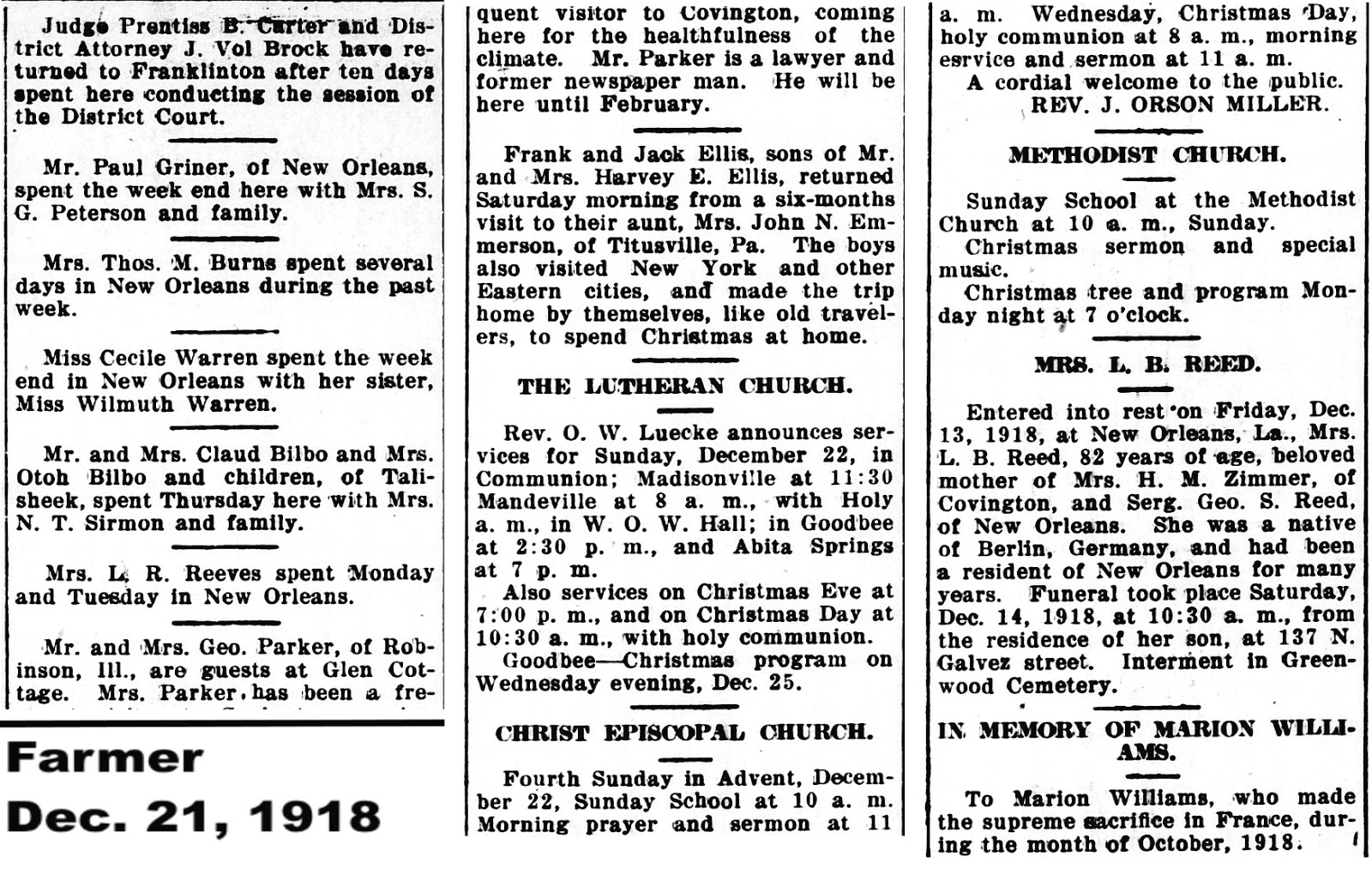
What was going on 100 years ago this week? CLICK HERE for a link to the St. Tammany Farmer of December 21, 1918. The link is provided by the Library of Congress and its Chronicling America service.
Click on the sample image below to see larger version.
The following newspaper clippings shared School News and Society Notes from a variety of spots in St. Tammany Parish in December of 1914, as reported in the January 2, 1915, edition of the Farmer. Click on the images to make them larger.