Monday, September 5, 2016

Courthouse History

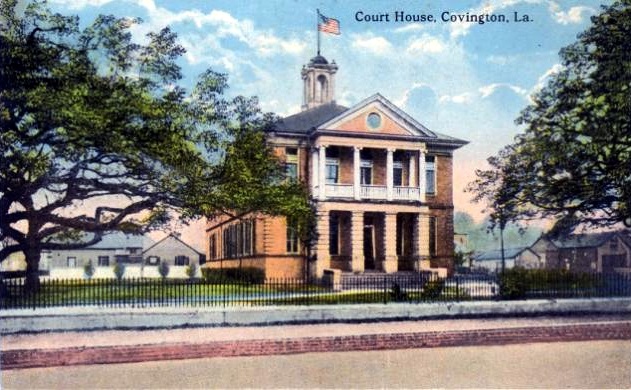
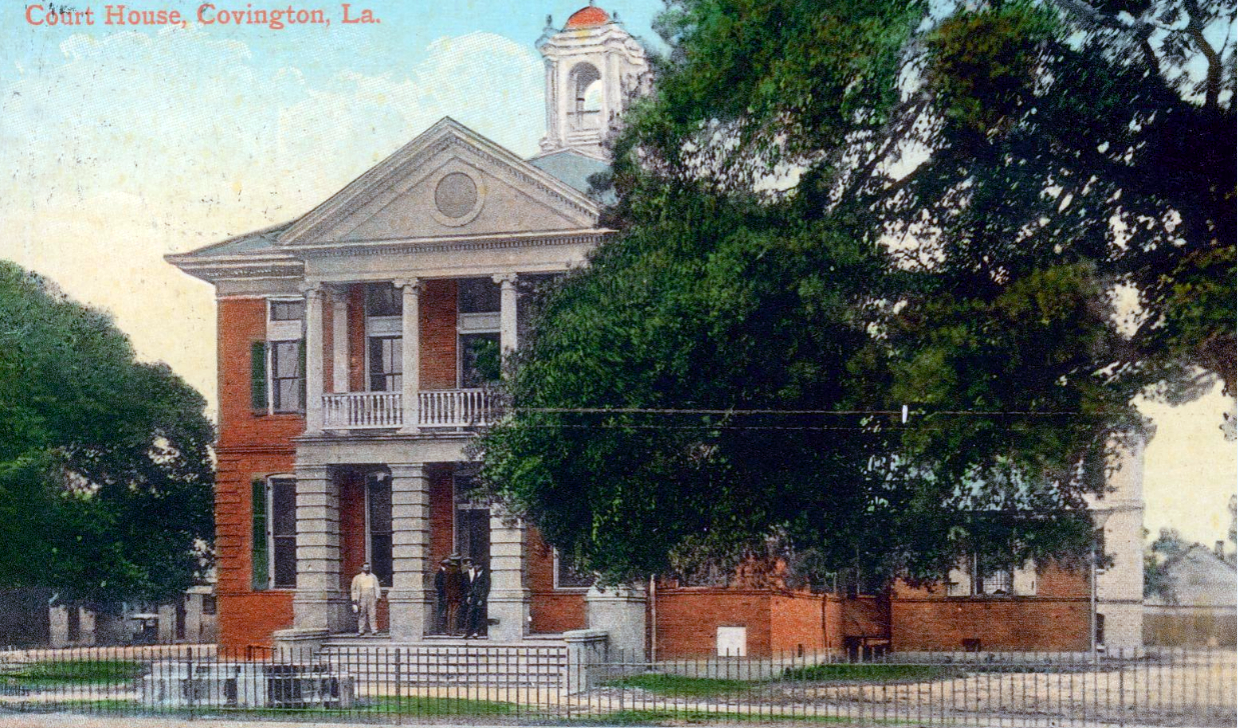
Here is the history as well as some photographs depicting four of the courthouses that have served St. Tammany Parish.

Prior to 1817, a courthouse serving both Washington and St. Tammany Parishes was located near Enon in Washington Parish in an area known as "Washington Fields." Records indicated that some soldiers were stationed there for the War of 1812. 

Click on the images to make them larger. 


An 1820 map showing the first courthouse near Enon, located at the top of the map

According to a publication of the Louisiana State Bar Association entitled "Louisiana’s Historic Courthouses: A Look at the Past and the Present," (Published in 2016) The St. Tammany Parish courthouse sprang from legislation signed by Louisiana's first governor, William Charles Cole Claiborne in 1813. The legislation called upon a local committee to  locate  a  courthouse site  "within three miles of the center of St. Tammany Parish,  which  at  that  time  consisted  of  Washington  Parish,  St.  Tammany  Parish and the portion of Tangipahoa Parish east of the Tangipahoa River."

Following those directions, the group established the first courthouse near the banks of the  Bogue Chitto River near Enon on property owned by Judge Thomas C. Warner, who was the first parish judge in St. Tammany  Parish.
 

 The historical marker for the first parish courthouse, located 4 miles west of Enon on Hwy. 16, when St. Tammany included Washington Parish.

The Bar Association's Journal went on to explain that four years after establishing the courthouse near Enon, another group was given the assignment of moving the parish seat. "The  Claiborne Company had purchased a portion of the Kleinschmidt Spanish land grant in 1813. In exchange for the commission naming the Town of Claiborne as the parish seat, the Claiborne Company offered some of its land and agreed to build a courthouse and jail for the parish, free of charge."

The  Claiborne Courthouse

"Robert Layton told them (the group seeking a parish seat) that he'd build a courthouse if they made Claiborne the parish seat," said retired Judge Steve Ellis, a parish historian. This resulted in the second St. Tammany Parish courthouse being built in the Town of Claiborne  just east and across the river from Covington. It cost around $20,000 to build.


That building, built in 1818, currently stands across the driveway from the Chimes Restaurant near the Bogue Falaya River. The structure was completed and opened for business on April 12, 1819.


CLICK HERE for an article about the above building. 


A Winky Chesnutt pen and ink sketch of the building


However, the bar journal account noted that "within  10  years  of  the  erection of the 1819 Courthouse, the Police Jury determined that the courthouse should be moved  to  Covington,  previously  known as the Town of Wharton."

Once the courthouse was moved across the river to Covington, the old 1819 building was sold to private individuals. Over the years it was used as a Catholic seminary, a private home, and as part of the "Claiborne Cottages " group of buildings. The other hotel buildings burned down in 1916, but the original courthouse building survived. It was later purchased by architect Bob Lobdell for his family home. 


Back to the courthouse calvacade, on June 5, 1837, the Police Jury purchased Lots 12-15 on the corner of Boston and New Hampshire Streets in Covington for use as a courthouse site, the bar journal stated.


The parish seat was moved from Claiborne to Covington in 1838. A courthouse was built on the corner of Boston St. and North New Hampshire St. In  1884,  however, the  Police  Jury  voted  to demolish  the  courthouse  located  at  that location. "During the demolition and rebuilding period, Covington Town Hall  was  used  as  a  courtroom.  The  new  courthouse opened two years later in 1886 and was used for 73 years, according to the bar journal account.

 The structure pictured above at that location was built in 1896, with the cornerstone of that building pictured below, as it looks preserved as a monument in front of the old courthouse site at the northeast corner Boston St. and New Hampshire St. 


Here are some additional pictures of that 1896 structure.


St. Tammany Parish School Board in front of the old courthouse around 1906. 


The police jury poses for a group portrait


In 1946 the parish government proposed a large three-story St. Tammany Parish Courthouse, but public reception for the scale and design was not good. 


In 1959 however, the time was right for a new structure, and the old courthouse was torn down. 


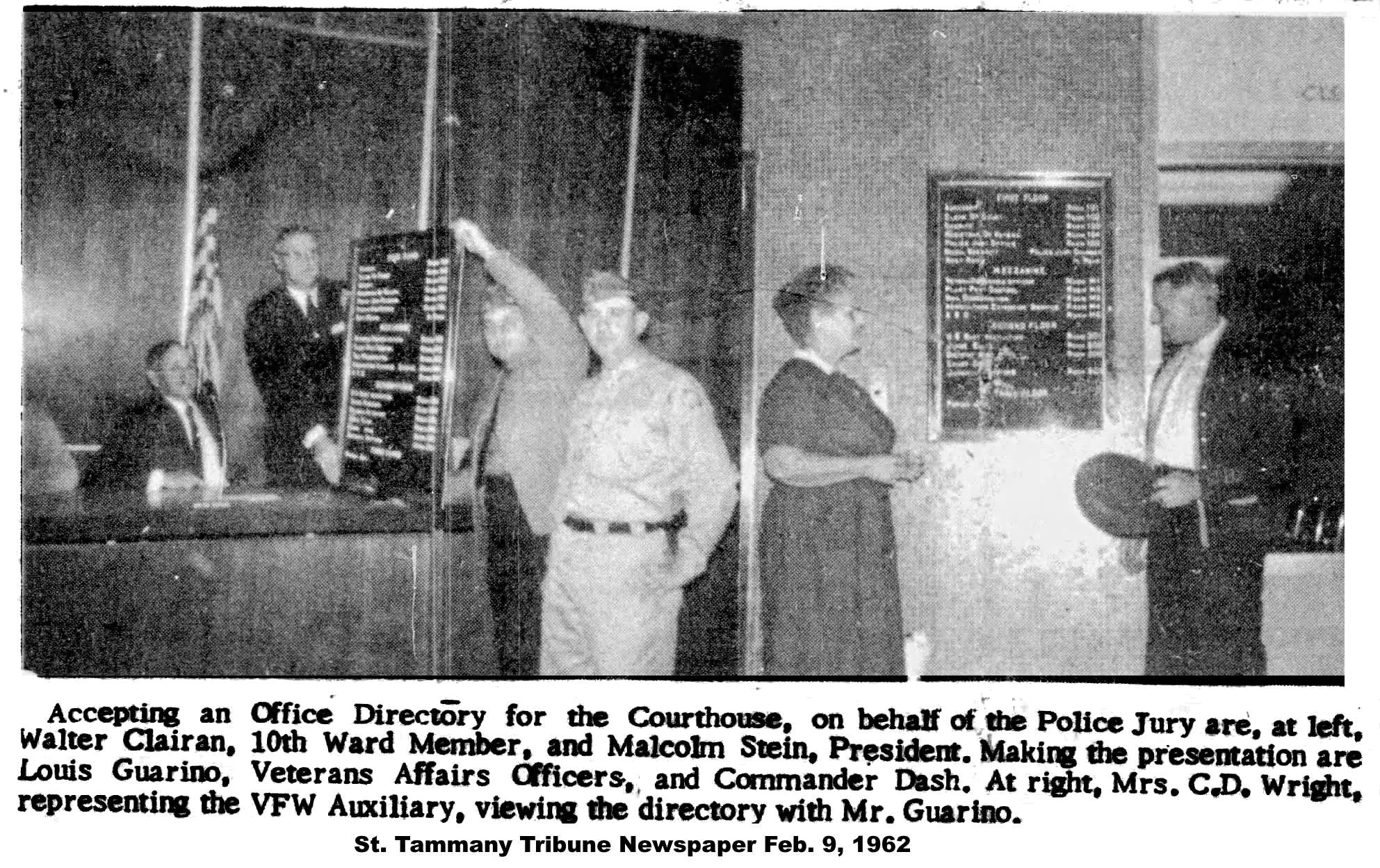
"The completion of the Lake Pontchartrain Causeway in 1956 magnified the need for a larger facility to conduct the parish’s business," the Bar Association article went on to say. "In 1959, the parish decided to build a new courthouse, completed in 1960. Within the year it took to complete the new courthouse, court was held in the gymnasium of the Jefferson Avenue  grammar  school.  The new courthouse shown below was opened in 1959 in the same location as the previous courthouse. It featured a jail on the third floor.


Here is the printed program for the ceremonies opening the new courthouse on June 1, 1960.


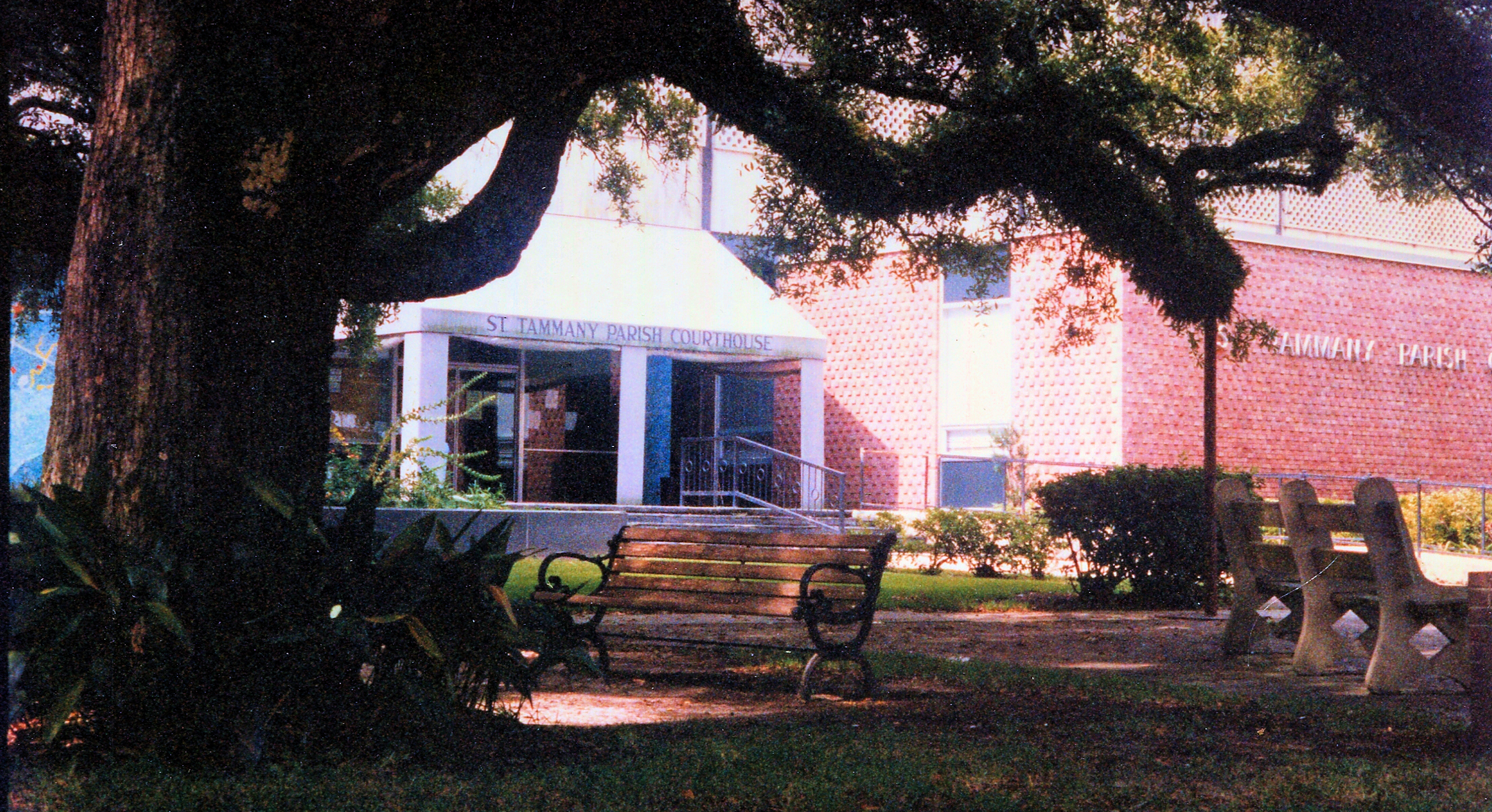


Fourteen years later, due to the parish's rapid growth, a larger courthouse was needed. The police jury held a number of committee meetings to discuss what to do about the growing space problems in the courthouse building.


Moving the courthouse was suggested.


The City of Covington didn't want the courthouse moved out of the city, so efforts were made to convince city officials to "annex" the site chosen down by the interstate.


  The police jury finally decided, despite objections, to build a new courthouse down near Interstate 12. 


The courthouse stayed in Covington, however, after some legal action by city officials noting that the courthouse had to be in the parish seat.


In an April, 1977, article in New Orleans Magazine, the status of the courthouse re-location was summed up as follows: " With all of those political squabbles going on, the sudden growth explosion on the north shore has only contributed to the turmoil. A longstanding friendly political rivalry between Covington and Slidell has been fanned into a burning feud by the influx of people and the resulting competition for money and power. Since representation on the parish police jury is proportionate to the population, the political weight has recently shifted to Slidell, which has used that advantage to challenge the 165-year-old parish seat in Covington.

    The parish seat flap arose out of a related controversy over where to build a much-needed new courthouse and prison facility. The original proposal was to construct the new courthouse complex where U.S. 190 crosses 1-12, just outside the Covington city limits. The plan was contingent upon the Covington City Council's agreement to annex the site in question so the parish seat would remain in Covington. But Covington businessmen raised such a howl about the economic setback they'd suffer by such a move, the city council refused to annex the 1-12 site.

    So the courthouse bond issue, which goes to St. Tammany voters April 16, (1977) will carry a referendum  question about whether the parish seat should be moved out of Covington."


For several years, in an effort to provide more space, there were a couple of courtrooms and judges offices in the building where the Southern Hotel is located today. The parish decided to buy the building and renovate it extensively for offices, a couple of courtrooms. It served as Parish Administrative Offices for several years, beginning in 1982, complete with a police jury meeting room. 


The parish chose to ignore the city's objections and built an office facility on Koop Drive off La. 29 near Interstate 12, moving its main administrative offices and several key departments to that location. 

Twenty years after the initial efforts, new  efforts in 1996 resumed to build a bigger courthouse, but within the boundaries of the City of Covington. The old P&W Salvage facility on Jefferson Avenue was considered.


In the February 25, 2000, edition of the St. Tammany News Mitchell Richard wrote that the clean up of the old P. & W. Industries site in Covington, home of the future St. Tammany Parish Courthouse, was essentially done, according to P&W president Harry Warner. This paved the way for the beginning of construction for the new courthouse.

It is interesting to note that the family name of Warner is the same as the first parish judge Thomas Warner, upon whose land the first courthouse was built in the community of Enon. So the Warner family has long been associated with courthouse sites. 

"The Covington site was the location of P. & W. Industries for over 30 years before the company's move in August of 1998 to its current location on U.S. Highway 59 located near Mandeville. P. & W. Industries is a steel recycling and sales corporation. The site, bounded by North Jefferson and North Theard Streets in downtown Covington, has been in use since 1912.

Bids for the 300,000-square-foot courthouse will open for contractors Wednesday, March 1, 2000, with a projected overall cost of $45 million.

"Richard Lambert, the courthouse's chief architect, was contracted two years ago to draft the plans for the complex, an overdue project designed to supplant the current facility on Boston Street in Covington. 

"The current courthouse is described by some who work there as cramped and no longer suitable for the purpose, particularly after a tornado tore through downtown Covington in October 1997, damaging the structure and hundreds of files and records.

"With no delays in construction the new courthouse will open its doors for business sometime in 2003, Lambert said."

According to the Bar Association article, "The 1960 courthouse was used until the St. Tammany Justice Center opened in 2003, which brought together many of the parish’s offices that were scattered throughout the city."
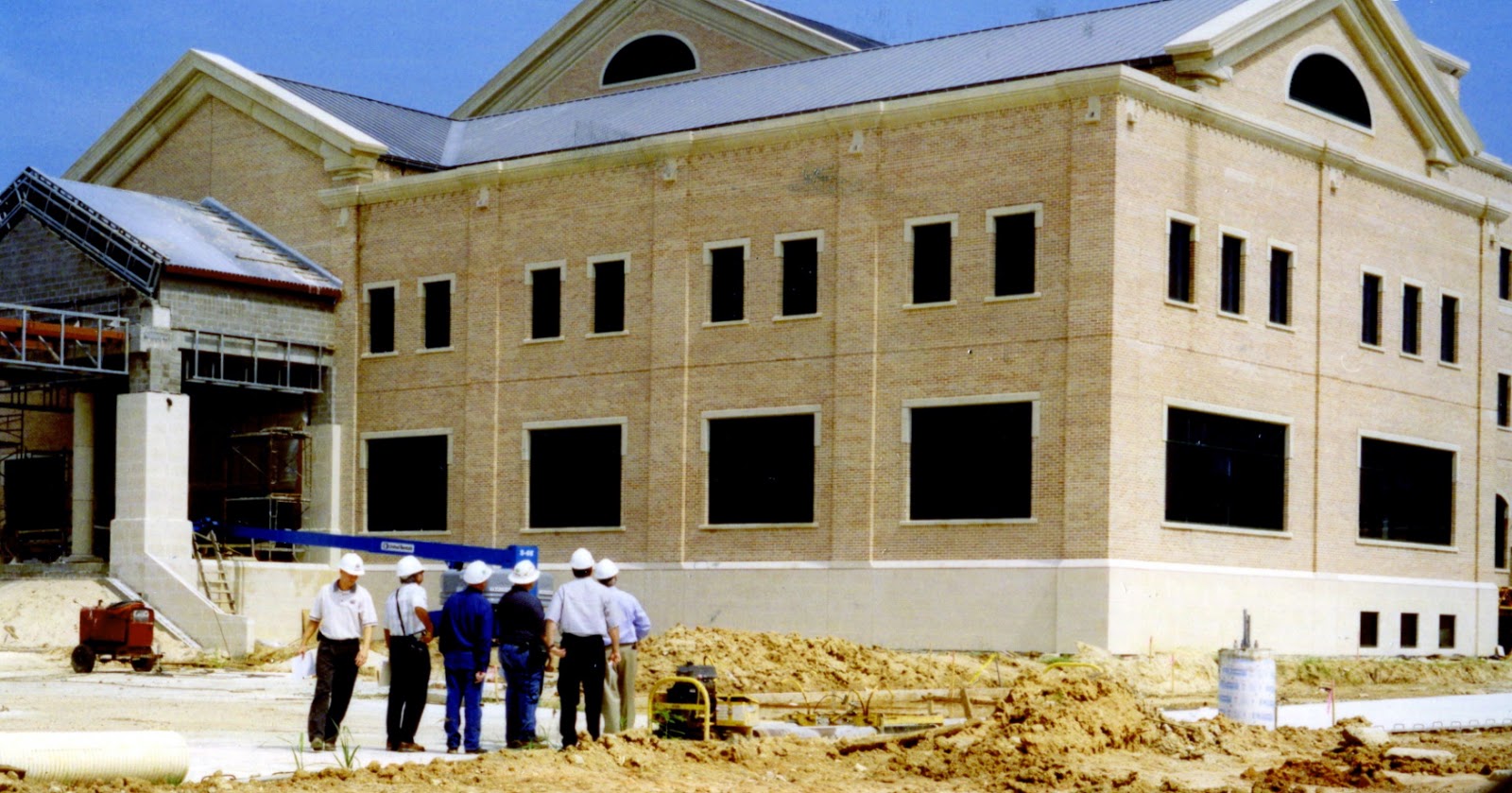


The new courthouse on the old P&W site.


"The St. Tammany Parish Justice Center, unlike  any  courthouse  in  Louisiana,  is  a 312,000-square-foot structure containing 22,000 cubic yards of concrete and 25,000 St. Joe bricks and housing 12 courtrooms," said the article. Here are some photographs of that building.


See also:

Courthouses of St. Tammany Parish


Sunday, September 4, 2016

A World Traveling Teacher's Life

Here is the text of a letter written by Ollie McGillivary, a St. Tammany Parish Public School teacher who traveled around the world, serving thousands of students in dozens of countries. 

Ollie McGillivary was born in rural St. Tammany on June 3, 1928. She walked about four miles daily to Pilgrim Rest School for three years before it became consolidated and was merged with Lee Road Consolidated School.

The parish line designated that for the fourth grade she attend the old Covington Grammar School in Covington (now the School System Central Office). She traveled by bus to the school and attended there from fourth through seventh grade. The bus she took was the only one picking up elementary and high school students at the time, since the area where she lived was not very populated, she explained in her letter. 

"After graduating seventh grade, I attended Elmer E. Lyon High School. While in high school, I was active in band, glee club, 4-H and drama club. After high school I received a legislative scholarship and attended Southeastern College. I borrowed money from the St. Tammany School Board to help me get through college, but the scholarship paid for textbooks only.

"I started college majoring in music. The only piano teacher I could find to teach me when I was in high school was at St. Scholastica.  I walked from Lyon High once a week to take the piano lesson, then I would walk to Columbia St. -Lee Road and catch a ride to my home.

"However, there were not many opportunities for music educators in the parish. After three years, I decided to switch my major to elementary education. Most of my hours could be used as a result. I only had to go an extra semester to become a certified elementary teacher. I graduated in 1951 certified in grades Kindergarten through sixth grade.

"While in college, I served on the Student Government, was president of the Future Teachers of America, active with Baptist Student Union center, serving on various committees, then was Louisiana State Editor for B.S.U. I was also a member of Alpha Sigma Tau and Phi Mu Alpha.

"After graduating from Southeastern I taught at Pearl River Elementary and Lee Road Consolidated. I decided to do graduate work and headed to the University of Vermont for a summer. Then, back to Covington. I didn't see many challenges, so I headed west, stopping in Denver, CO, en route to San Francisco.

"I did secretarial work for the Dean of the Law School at Denver University and met my future husband who was at S. U. completing his master’s degree.

"I returned to Covington in the fall and wed in January of 1953. My husband became a career officer in the U.S. Navy. Through his various military assignments and moves (some 28 times) I was given a multitude of opportunities to become active in community activities, churches and schools. This gave me a broad scope of all parts of the United States, Far East, Europe, Canada, Australia, and Mexico, etc.

"I helped with the Red Cross, Navy Relief, March of Dimes, Ombudsman, sponsored a "boat family" of 13 from Vietnam (while my husband was Commanding Officer in the Bay area.) I worked with abused family groups and helped teach on Indian Reservations in Oregon and Washington State. I also substituted in public schools in Washington State, California, Pennsylvania, Rhode Island and Florida.

"When there was a need, I directed choirs, led church groups of young people, was in charge of Brownies and Boy Scout clubs. While my husband was at the Naval War College, I taught the Laubach method of learning English to foreign officials wives.

"In my travels I visited public schools in Europe and Australia. I also volunteered as a teacher in the National Schools of P. I., and I taught third and sixth grades for the Department of Defense while in the Far East.

"Because of my husband's duties, there were opportunities to entertain senior military officers and their wives, local mayors, politicians, dignitaries from foreign countries and embassies. While a naval officer's wife I taught full time in Pennsylvania for four years. We had two different deployments in this state. I did graduate work at Shippensburg State College. I taught fourth, fifth, and kindergarten in Pennsylvania and in Florida I taught first grade. For the Department of Defense, in the Far East I taught third and sixth grades for two years.

"I also took graduate courses from the University of Maryland. For two years, I attended the University of California-Berkley doing graduate work.

"Throughout our military life we were blessed to see great museums and explore many wonders of the world. With our two children we availed ourselves of the multitude of cultural activities, situations and opportunities on whatever base or surrounding area we were stationed.

"I returned to Covington in 1982 and became a kindergarten teacher at Lee Road Junior High School. Then I taught kindergarten, first and T-1 at Folsom Elementary.

"It has been my privilege to work with the Folsom community, Franklinton Heritage Manor, church and school.

"After Hurricane Katrina, I was gratefully given some 26 large trees to help replace the many trees lost on our school grounds. I put these things down in writing because God has so richly blessed me to have become a teacher, educator, wife and mother.

"My first teaching job was as a 10 year old in a country church teaching beginners four and five years old. I discovered then that somehow I was able to get the subject matter across to little ones. Thus, throughout my life so it's been. Let the student know you really care for them and that they can understand and learn. If you were successful with that concept, you were most likely going to be successful with the students (class) and have high achievers. It worked," she wrote.

"My life has been an amazing one for me. I am so grateful for having the opportunity of being blessed by God with good health and the opportunity afforded me by the St. Tammany Parish Public Schools in 1920-1921."

She was nominated for Teacher of the Year for the State of Pennsylvania, Florida and Louisiana, and was a Master Teacher in Pennsylvania and Florida. Her mother was also a teacher, serving at Pilgrim's Rest School in 1920 and 1921.


Saturday, September 3, 2016

Moss

The first thing many visitors from out-of-state notice in St. Tammany Parish is the moss draped over many oak tree limbs. In fact, movie location scouts often seek out places where the Spanish moss is just dripping off the oak trees as an "immediate" scene clue that the movie is actually being filmed in Louisiana. 

Click on the images below to make them larger. 


Spanish moss, which is not really a moss (it's a member of the bromeliad family) has had its ups and downs in the area. It takes its moisture from the rain and its nutrients from the air, so it's not a parasite to the tree as believed by some. It was once called "the air plant" and is believed to be a bioindicator of problems in air quality.


For commercial purposes, it has been used as insulation, mattress and upholstery stuffing, mulch and even in evaporative coolers, the forerunners of air conditioners. 

I remember a movie being made near Madisonville where the director called for more "moss" on the trees in the background, so truckloads were brought in and the set decorators went to work hanging the moss. Nothing says "Deep South" like moss swaying in the breeze over your actors' heads. 


In 1920 Covington had its own mattress factory that used moss as the stuffing. 

Here are some photos of the moss hanging out.


For more photos of moss, CLICK HERE.

Friday, September 2, 2016

100 Years Ago This Week

What was going on 100 years ago this week? The following link is provided by the Library of Congress and its Chronicling America service. CLICK HERE for a link to the St. Tammany Farmer edition of September 2, 1916. Some of the headlines are Public Schools Open Monday, Fire Destroys Burris Hotel in Franklinton, and Lewis Tells of Benefit Trip (To MIdwest )Will Be To Parish. 


Click on the image for a larger view.

Thursday, September 1, 2016

Madisonville Bank Building

According to area residents, the old bank building in Madisonville, located at the corner of  La. 21 (Covington St.) and St. John St., has over the years housed a bar, a real estate office, flea market, a residence, a hospital, a library and even a police station. 


The building has been listed since 1983 on the National Registry of Historic Places. Its address is 400 Cedar Street. 


1983

More recent photos...


Building History


In 1937 workers with the WPA (Works Progress Adminstration) dug a new waterline across a Madisonville street, right in front of the Madisonville branch of the Covington Bank. Above is a photo taken during that project. Click on the image to make it larger.

In the application written in 1982 for placing the structure on the National Register of Historic Places, the following description was offered:

     "The Madisonville Bank, located on the corner of Cedar and East St. John Streets in the small town of Madisonville, is a two-story frame commercial building with an exceptionally detailed classical facade dating from 1919. It now houses an art studio, a small apartment and offices and has received some modern alterations, but it retains the features that make it the commercial landmark of Madisonville and one of the town's two most architecturally significant structures from the 1890-1920 era.

     "Originally constructed c.1900, the building received a new facade in a major renovation undertaken in 1919. When first built, it was a two-story three-bay gable-front clapboard building with a very simple shopfront and corner entrance. The 1919 renovation so altered the facade that the only decorative feature remaining from the c.1900 building was the gable end with its boxed cornice and frieze. The c.1919 wraparound shopfront extends two stories and is topped by an overhanging cornice and entablature. 

     "The shopfront also features square pilasters with Corinthian capitals delineating three bays of the facade and three bays on the north side of the bank lobby. On the panel separating the first and second stories are three molded garlands with cartouches. One of the cartouches bears the date 1919; the other two have the initials "MB." The windows on the first floor are plate glass with multi-paned transoms; those on the second floor are paired with two over two double hung sashes. The corner entrance has double glass panelled doors with egg and dart molding.

     "Original interior features include:
(1) an elaborate pressed tin ceiling, cove moldings and cornice;
(2) a bank vault;
(3) window surrounds with cornerblocks in the lobby;
(4) molded baseboards and doors with plain surrounds and transoms in the second floor rooms; and
(5) beaded board siding in the rear stair hall.

     "Alterations since the 1919 renovation include the following:
(1) the apparent sandblasting of the doors on the facade;
(2) the removal of the teller's counter;
(3) plywood panelling on the walls and linoleum on the floor of the lobby;
(4) construction of a kitchen, bedroom and bath in what were first floor offices; and
(5) linoleum flooring on the second floor.


Statement of Significance

     "The Madisonville Bank is locally significant in the area of architecture because it is the_ landmark commercial building of Madisonville. It is also important as one of the town's two most architecturally significant buildings of the 1890-1920 era. The bank, with its two-story wraparound shopfront, is the most significant commercial building in town. There is no concentration of historic brick party wall commercial buildings in Madisonvilie like there is in most other small Louisiana towns that were developed during the nineteenth and early twentieth centuries. 

    "Instead, there is a scattering of a dozen or less nondescript pre-1933 commercial structures located along Louisiana Highway 21 and the west bank of the Tchefuncte. The pretentiousness and ambition of the shopfront that was added to the c.1900 bank in 1919 and the building's ornate pressed tin ceiling are clearly unequalled in the town.

     "The building is also significant as one of two architectural landmarks dating from Madisonvilie's late nineteenth-early twentieth century economic boom. Although the town was incorporated in 1817, the majority of the town's building stock appears to date from the C.1890-C.1920 period of prosperity or later. 

     "During the early and mid nineteenth century, the town's small economy was based on trade, small industry (brickmaking, lumbering and shipbuilding) and Madisonvilie's place as one of Lake Pontchartrain's North -Shore resorts. In the late 1800's, the lumbering and shipbuilding industries grew substantially. Two sawmills, one in Madisonvilie and the other in nearby Houltonville, operated until 1920 and 1916, respectively. Initially there were several small shipyards, but during World War I, the Jahncke Shipyard expanded tremendously until it employed over 2000 workers at the height of its wartime activity."

Photos taken in May, 1983, from the application for Historic Places designation:


-------------------------


In 2023 it became the Reneux Wellness Spa


See also: