Sunday, March 10, 2019

Kelly Kicking Cancer Shamrock Sprint

Downtown Covington hosted the "Kelly Kicking Cancer" Shamrock Sprint race Saturday morning. An awards ceremony was held afterwards at the Covington Trailhead Stage. 

There was a 5K run and also a 1 mile fun run. Here are some photographs. 


A number of fitness and other vendors were on hand


On stage entertainment was provided


Saturday, March 9, 2019

Burns Furniture Ad 1930

Here's an advertisement that appeared in the August 2, 1930, edition of the St. Tammany Farmer telling about the latest items for sale at Burns Furniture Store. Click on the images to make them larger. 


Friday, March 8, 2019

100 Years Ago This Week

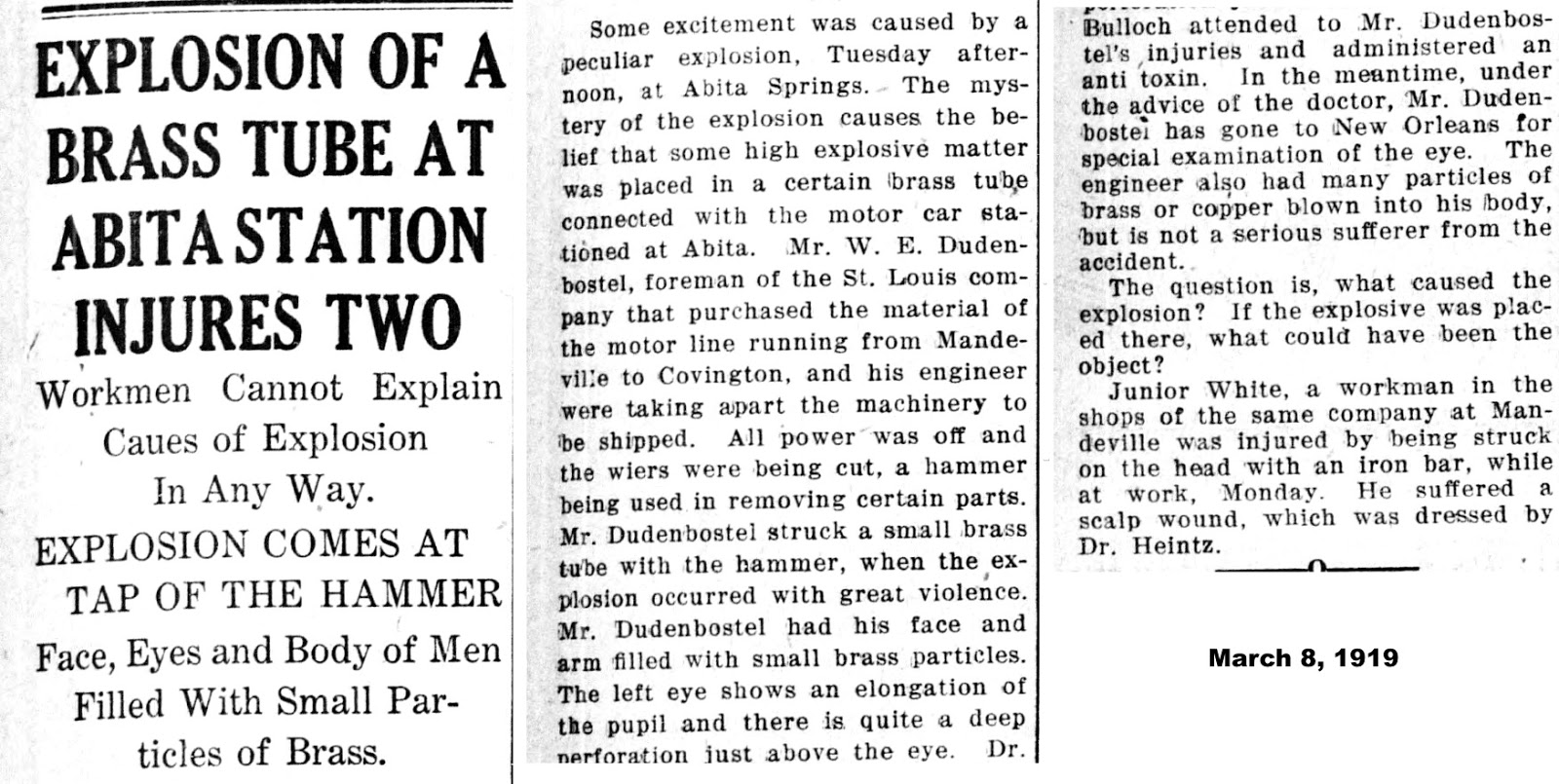
What was going on 100 years ago this week? CLICK HERE for a link to the St. Tammany Farmer of March 8, 1919. The link is provided by the Library of Congress and its Chronicling America service.

Click on the sample images below to see larger versions.


Obits


Shipyard Workers To Be Laid Off

Thursday, March 7, 2019

Barging in the House

When the Lake Theater in Mandeville was torn down at the corner of Girod St and Lakeshore Drive, the new property owners decided to bring in an old plantation house known as the Justine Plantation from the New Iberia area. In 2003, the house was put on a barge near New Iberia, floated down Bayou Teche, around New Orleans, and into Lake Pontchartrain where it was parked for a while at the Mandeville harbor.


Then it was moved into place at the seawall near the end of Girod Street where somehow crews lifted it up from the barge, rolled it across the street, and jacked it up into the air to give it that old Mandeville elevated house look. 

Here are some pictures from several Mandeville area residents of that operation. Thanks to Mark Frosch Sr. for his photos.


Above photo by Lynn Mitchell (Coastal Contractor Magazine)

According to the Justine Plantation website, "Justine Plantation was built by Don Martin Navarro in 1786 as a wedding gift for his only daughter Adelaide. A native of Spain, Navarro was appointed as treasurer of the Spanish Province of Louisiana by King Charles III in the period prior to the province’s return to France and subsequent purchase by the United States. Justine was built on land along Bayou Teche near Centerville, Louisiana granted by the Spanish to Adelaide and her new husband Louis George de Maret.


According to Coastal Contractor magazine the structure was used as a plantation house on Bayou Teche in 1822, then was renovated in the 1840's. 

Justine was operated as a sugar plantation home during the 1800’s and early 1900’s. "Throughout her history, her majesty and grandeur has helped her survive the ages. The structure was built entirely of Louisiana cypress, a feature that has helped her withstand the environment of south Louisiana," according to the Justine Plantation website. . In 1965, Justine was purchased by Mrs. Aleen Yeutter who moved the structure by barge fifty-four miles down Bayou Teche to a new location. She rested here for thirty-eight years before moving once again."


After the structure was moved to Mandeville in 2003, it was placed on twelve-foot columns and a double curved front staircase was built in front of it to help it weather high water and storm surges. The 220-year-old structure survived relatively unscathed through the devastation of Hurricane Katrina in 2005, it was reported.  The building owners were commended by FEMA for following "best practices" in flooding mitigation for raising the structure high enough off the ground to escape Katrina storm surges with only minimal damage. 


See also:

Rebuilding the Gulf Coastal Contractor Article PDF File


Wednesday, March 6, 2019

Southern British Colonies Map - 1776

This map from 1776 shows the southern British colonies in that new North American place. Too bad the following year this map was out of date, given the American Revolution and all. 

Click on the images to make them larger. 


A close up of St. Tammany's part of British West Florida

Here is another map showing the "Province of West Florida"


Tuesday, March 5, 2019

Aerial Photo of Beau Chene - 1965

Here is an aerial photo of the area which was to be Beau Chene subdivision between Mandeville and Madisonville. The photo was taken in April of 1965 and shows La. Hwy. 22 and its junction with West Causeway Approach. Click on the image to make it larger. 


The Tchefuncte River is in the upper left corner, and Covington Country Club is in the upper right corner.  

See also:

Beau Chene Subdivision History


Monday, March 4, 2019

1798 Map of St. Tammany Shoreline

This map of the north shore of Lake Pontchartrain, showing features from Bayou Lacombe over to the Tchefuncte River, was published in 1798, some two hundred and twenty-one years ago.

Click on the image to make it larger. 


Sunday, March 3, 2019

Folsom Civic League

The charter of the Folsom Civic League was published in the Dec. 9, 1922, issue of the St. Tammany Farmer. 

 The Folsom Civic League, of Folsom, La., was incorporated on Oct. 16, 1922. The corporation was set to be a charitable institution, and its purpose was to promote charity and to foster the community spirit of the Town of Folsom, La. It's goals were to erect, construct and operate parks, playgrounds, public assembly halls, swimming pools, community club houses, and to do all things which were part of the conduct of a successful Civic League.

The group pledged to assist and encourage the advancement of the material prosperity and progress of the Town of Folsom, and to aid any and all charitable purposes conducted for the general welfare of the community. The Civic League was led by a managing committee, composed of six members appointed by the President, from the active members. The first Managing Committee consisted of J. W. York, president; J. D. McLain, first vice-president; H. N. Fendlason, second vice-president; P. M. Reed, secretary; Miss Barbara McGowan, treasurer, and I. W. Stevens as member ex-officio, whose first term of office expired on 20th day of September, 1923

The membership of the said Civic League was based upon a system of dues or contributions, with the first membership dues fixed at fifty ($0.50) cents for each member, per year.

The organization was officially created by Notary Public J. C. Cappel with Victor E. Flanche and M. A. Lancaster serving as witnesses. Persons present at the incorportion ceremony included J. W. York, J. D. McLain, D. H. Carroll, B. T. Spring, Mrs. J. D. Mc­Lain, P. M. Reed, Mrs. P. M. Reed, H. N. Fendlason, G. W. Varnado, I. W. Stevens, Mrs. I. W. Stevens, Mrs. J. W. York, Mrs. W. T. Wallis, Mrs. B. T. Spring, Gertrude Mandart, Bar­bara McGowan, N. P. Raider, Mrs. D. H. Carroll, Fred. R. Jonfes, M. D., Mrs. Thos. Gusman, Lena Moran, Mrs. M. Reed, Marshall Reed, Louise Verger, Belvia Core, Ellen Pittman, Mrs. H. N. Fendlason, W. E. Core, J. Y. Mapes, Mrs. J. Y. Mapes, Hilda McLain, all of Folsom, St. Tammany Parish, State of Louisiana. 


Click on the image below to read the complete notice. 


Saturday, March 2, 2019

James Rumsey Invents A Steamboat

For more than 40 years historian Donald J. Sharp has been pulling together information about the Tchefuncte River, St. Tammany and Livingston Parishes, and southeast Louisiana. His work includes gathering facts about inventor James Rumsey who was active here during the time just prior to the American Revolution. It was Rumsey who kept "The Secret of Pearl River Island."

James Rumsey
Famous American Inventor 

A mechanical engineer, Rumsey was working on several things, but the most interesting were his efforts to propel a watercraft upriver, against the current, using steam engine power. According to Sharp, Rumsey was born in England, came to America, helped set up fur trading posts with the Native Americans in Illinois, then came to Natchez, New Orleans and eventually Bayou Lacombe.

He secretly worked on his steamboat design while living on Bayou Rouville, off of Bayou Lacombe at first, and then on Pearl River Island near the Rigolets. He moved to Baltimore, Maryland, to finish his work on the steamboat, and demonstrated it in 1787 in the Potomac River at Shepherdstown, West Virginia.

Click here for a link to a brief overview of Donald Sharp's research into the legendary James Rumsey. 

Rumsey worked hard at keeping his invention a secret, as was the usual practice among inventors, given that ideas were often stolen in the days before the patent office. When his Lacombe location became too exposed to locals and passersby, he moved the operation to the isolated Pearl River Island location. While there he helped a well-known naturalist recover from illness acquired while he was traveling along the Gulf Coast. According to Sharp, that naturalist was William Bartram, and he mentioned in his journals his time spent recuperating in the Pearl River swamp and the Englishman who was working on something secret there.

Did Rumsey's invention ever get finished? Well, yes, and many historians report that he succeeded in inventing the first steamboat, a watercraft propelled by steam engine. Credit is usually given to Robert Fulton, however, who in 1807 developed the first commercial steamboat.

Several people were working on coming up with a viable steamboat design at around the same time, so the race was on to build a working prototype and secure the patents needed to protect the invention from theft. An organization was formed in 1788 to honor Rumsey and his work. According to The Rumseian Society website "The Rumseian Society was first created in Philadelphia, in 1788, to further the inventive career of James Rumsey, and was disbanded with his death, in 1792. It was re-created in 1903 in Shepherdstown, to build the Rumsey Monument that still stands overlooking the Potomac, and was re-created again in 1984 to build the Rumseian Experiment, a replica of James Rumsey’s 1787 steamboat."

In 1915, a monument was dedicated to Rumsey on the banks of the Potomac River in Shepherdstown to celebrate his contributions to steam-powered watercraft. According to the C&O Canal Trust website, "The James Rumsey Monument and Park overlooks the Potomac, the very river on which Rumsey demonstrated the first steamboat. 


"Shepherdstonians began discussing a monument in the 1830s – undoubtedly to overshadow Robert Fulton, who often received recognition for being the ‘inventor’ of the steamboat. Completed in 1915, the 75-foot monument sits in the borders of its own park. A plaque mounted on one side of the monument reports how Rumsey “made the first successful application of steam to the practical purposes of navigation.”


The Rumsey Monument in West Virginia

The demonstration shocked many local citizens. What is a “canoe powered by a teakettle?” they asked. The C&O Canal Trust website says it was the first steamboat.


"The eccentric inventor James Rumsey shocked Shepherdstown during a December 3, 1787, demonstration when his boat – without traditional sail or oars – actually left the dock here on this stretch of the Potomac River.

“She moves, by God, she moves!” exclaimed one particularly doubtful veteran. The steamboat traveled about half a mile upriver and returned to the landing. During a second test eight days later, the innovative craft reached speeds of 4 miles per hour.


 "Though Ramsey’s steamboat was first, many credit the invention to Robert Fulton, the man who mastered the production of the steamboat. But no matter whom the original inventor, the steamboat opened new worlds of navigation for the people of Shepherdstown, making opportunity and commerce easily accessible," concludes the C&O Canal Trust website. 

And Donald Sharp was able to pinpoint where Rumsey carried out the early major design work for his steam-powered watercraft, near Bayou Lacombe and at the mouth of the Pearl River in St. Tammany Parish. 

As soon as steam-propelled watercraft became available, riverboats became a principal transportation mode for river trading. And although Rumsey was working on backward thrust steam propulsion, the groundwork was laid for stern-wheeler and side wheeler steamboats as well as propeller driven watercraft. 

Within a few decades of Rumsey's successful steamboat prototype, steamboats began plying the waters of the Mississippi River from New Orleans all the way northward. 


St. Louis, Missouri, 1850

It's good to know that St. Tammany played an early part in the invention of the steam-driven watercraft. Today's version of the backward thrust boat propulsion system? Jet-Skis and Wave Runners.


See also: 

The Rumseian Society Website

James Rumsey Wikipedia Article

James Rumsey Monument Facebook Page

The Shepherdstown James Rumsey Museum 

Books:

James Rumsey: The Inventor of the Steamboat

James Rumsey: Pioneer in Steam Navigation


Some of Rumsey's early history is recounted in the book "Trade and Politics 1767-1769" by Clarence Alvord and Clarence Carter, published in 1921 and re-published in 2008. 


Friday, March 1, 2019

100 Years Ago This Week

What was going on 100 years ago this week? CLICK HERE for a link to the St. Tammany Farmer of March 1, 1919. The link is provided by the Library of Congress and its Chronicling America service.

Click on the sample images below to see larger versions.