Thursday, March 29, 2018

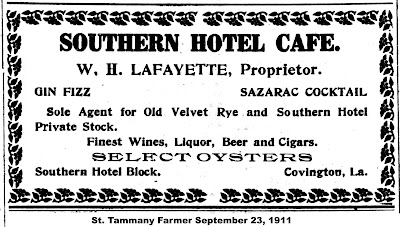
W. O. Ramos Famous for Gin Fizz

In 1937 W. O. Ramos died at his home in Covington at the age of 79. He first came to Covington in 1930. A few years earlier, in 1888, his brother Henry had invented the "gin fizz" drink in New Orleans, and W.O. "Otto" Ramos was the first person to drink one. 


They went on to work together on promoting the drink throughout New Orleans. Although it was a difficult and time-consuming drink to make, it became legend. It involved mixing gin, egg white, lemon, lime, cream and seltzer, then shaking it all for a minute or two. 

As its reputation grew, visitors to New Orleans all clamored for the Ramos Gin Fizz whenever visiting. It was nationally recognized as the drink you had to have when you went to New Orleans. 

Gov. Huey Long had a particular fondness for the cocktail, and it is rumored that he once flew a New Orleans bartender to New York to teach the bartenders there how to make the intoxicating beverage. 


  Click on the image below for for a New Orleans Item newspaper article transcript with all the details.


There is a Ramos Avenue in Claiborne Hill, located behind the shopping centers east of U.S. 190 Business. The St. Tammany Council on Aging Office is located on Ramos Avenue

For more information, click here. 

http://www.ginfoundry.com/cocktail/ramos-gin-fizz-cocktail/

Click here for photos.

Wednesday, March 28, 2018

East St. Tammany Aerial Photos

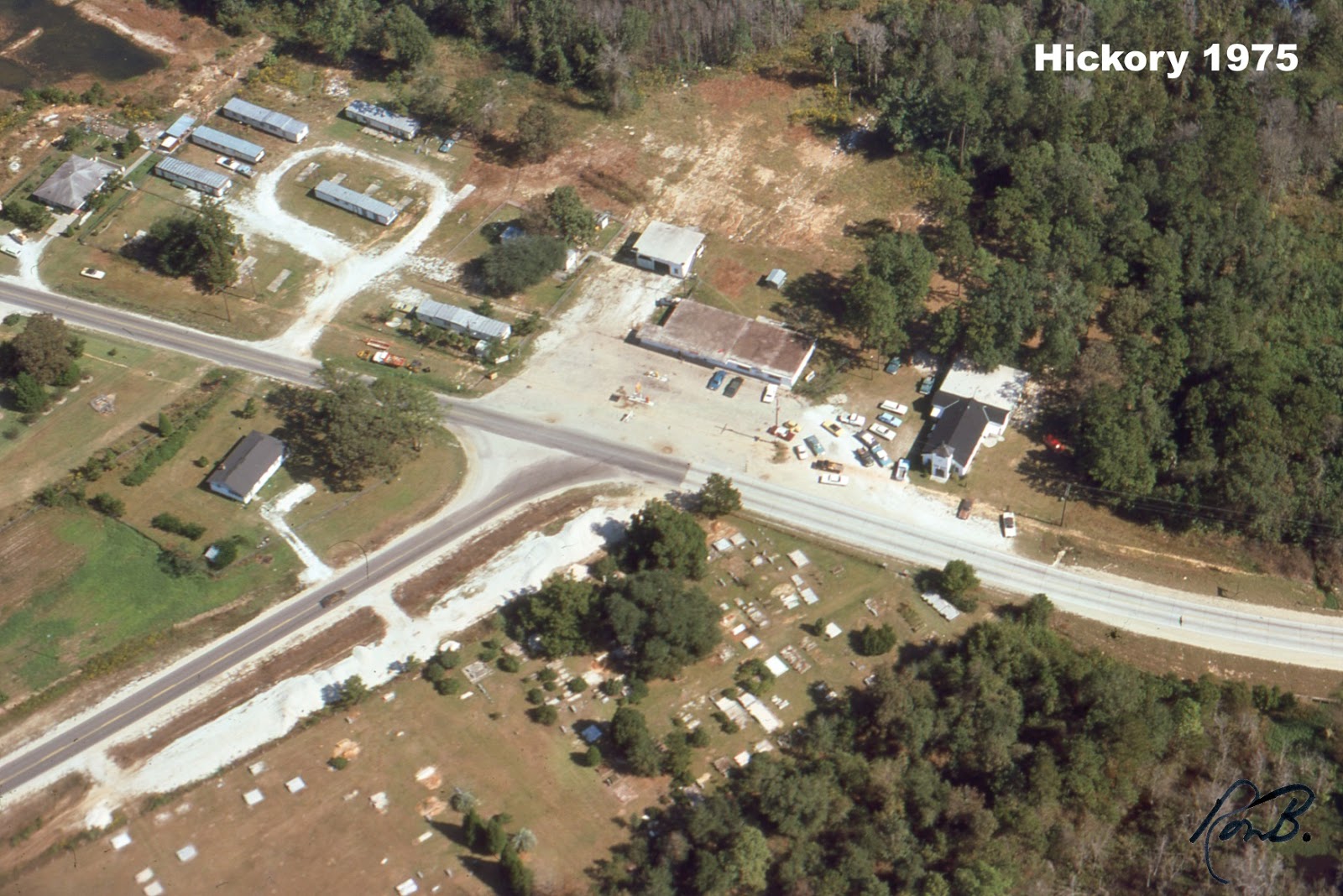
Here are aerial photographs, taken in 1975 (43 years ago!), of three eastern St. Tammany communities on La. Hwy. 41. The first two show Talisheek, view looking north, and then Evans Creek. Click on the images to make them larger.


 The second photo, below, shows Evans Creek, view looking eastward. 


Evans Creek


Charter Oak 1975


Hickory Intersection, La. Hwy. 41 at La. Hwy 36


Sixth Ward Jr. High School on La. Hwy. 41 - 1975 


Sixth Ward Elementary School, 2018, from Google Maps

The Old Goodbee Ford

Here is a 1909 color postcard of the "Old Goodbee Ford" across the Tchefuncte River near Covington. Click on the image to make it larger. 


Monday, March 26, 2018

Gold Coins Found in Honey Island Swamp

Excitement ran high when, in 1907, a cache of gold coins was found buried on Honey Island in the Pearl River Swamp.


 Here is a transcript of the article that appeared in the November 23, 1907, edition of the New Orleans Item newspaper. 

Old Coins Found in St. Tammany
More Than $1000 Dug Up on Honey Island: Pieces Dated 1827

     More than $1000 in gold coins has just been dug up on Honey Island, in St. Tammany Parish, about 40 miles from New Orleans. The discovery of the golden treasure was made by Messrs. Monroe Tally and James Culbert, who expect to dispose of the coins in New Orleans.

     Mystery attaches to the hiding of the coins. Most of them bear the date of 1827 and are in excellent state of preservation. Those persons acquainted with the early history of the parish can advance no theory as to who buried the money. There are no persons in the vicinity of Mexican descent or contraction, which makes the incident all the more inexplicable. 


     Mr. K. McComb of Pearl River has written to New Orleans asking if there is any premium on the coins. Local numismaticians prefer to see one of the coins before placing any value upon them in excess of the value of the actual gold contained in them. 


 Click on the image to make it larger.


Put There By Pirates?

How likely is it that pirates buried gold in the Honey Island Swamp? Actually, pretty likely, since there were lots of "pirates" engaged in illegal activity in New Orleans and then escaping to the swamp. One of the better known was Jean Lafitte, but there was also Pierre Rameau and his Chats-Huants.

A passage from the book "Gumbo Ya-Ya: Folk Tales of Louisiana" notes that "Pierre Rameau and his Chats-Huants (Screech Owls), a notorious band of buccaneers, had their base of operations at Honey Island."


"It is believed much treasure was buried on Honey Island by the Screech Owls, and one or  two hunters stumbled over an iron chest filled with Mexican money dating from 1827, and worth about $1000." After a frantic additional search of the area, nothing else was found, according to the book.

Meanwhile, in a book entitled "The Boys With Old Hickory," it is recounted that Pierre Rameau was just one of several pirates hold up in the swamp. "There are a lot of desperate fellows who have their headquarters up in the lagoons or swamps or bayous on the other side of town," says one area resident. "From all I could hear I should think they're a good deal worse than the Baratarians. They're just cut-throats and thieves."

The account goes on to conjecture that the desperadoes are somehow organized, even with their own secret society, that are somehow "protected" from the officers of the law by the members of that society. The Chats-Huants were identified as one of those societies.

"They'd helped Pierre Rameau out of more than one bad scrape," the book stated. "It seems that Rameau goes right into the town and into their meetings, too." But the society members have been known to help him escape the law, even when he is surrounded and almost arrested.

In the Deep South Genealogical Quarterly of 1965, it is said that as Jean Lafitte gathered around him the Baratarian smugglers and built a pirate empire on Grand Terre a hundred miles below New Orleans on the Gulf, so did Pierre Rameau gather about him the reckless and the lawless, who came to be known as the Chats - Huants (Screech Owls) and created a Robbers' Roost on Honey Island up the Pearl River, an inaccessible and now almost forgotten area of Swampland ideal for concealing criminal activities. 


See also:

Pirates In St. Tammany

Pirates: Part Two -The King of Honey Island

 Honey Island Swamp Wildlife History

Notable People of Covington

In 2011 Robert Mendheim placed a list on Facebook denoting the "notable people of Covington." Here is a copy of that list. 
 

  • Ernest Angelo, Texas oilman and Republican politician, was reared in Covington.
  • Jack Donahue, current state senator from St. Tammany and Tangipahoa parishes; resides in Mandeville
  • Frank Burton Ellis, state senator (1940-1944), U.S. District Court judge, 1962-1965
  • Elizabeth Futrall, an opera soprano, was reared in Covington. Her father was minister of the Covington First Baptist Church for many years.
  • Robert Higgs, a prominent American economist, currently resides in Covington.
  • Blanche Long, the First Lady of Louisiana from 1939-1940, 1948-1952, and 1956-1960, was born in Covington in 1902.
  • NBA all-star "Pistol" Pete Maravich lived in Covington until his death in 1988.
  • Lee Harvey Oswald, assassin of U.S. President John F. Kennedy, attended school at the C.J. Schoen Middle School, formerly Covington Elementary School, located in downtown Covington.
  • Author and essayist Walker Percy moved to Covington in 1950 where he and wife Mary "Bunt" Percy reared their two daughters. He wrote most of his works there until his death in 1990. He is buried at St. Joseph Abbey, a monastery north of Covington.
  • Philip Granville "Phil" Short is a former Republican member of the Louisiana State Senate, who served from 1996 until his resignation in 1999. Short, who grew up in Shreveport, unseated the legendary B.B. "Sixty" Rayburn, Sr., in the 1995 general election. He subsequently moved to Spotsylvania Courthouse, Virginia.
  • Nilo Silvan, played professional football for Tampa Bay Bucs; born and raised in Covington.
  • Ian Somerhalder, actor/model was born in Covington.
  • Michael G. Strain, the commissioner of Agriculture and Forestry. Having won the seat from 28-year incumbent Robert Fred "Bob" Odom.
  • Diane Winston, businesswoman; member of the Louisiana House of Representatives from St. Tammany and Tangipahoa parishes (1996-2008)
  • Isiah "Butch" Robertson, raised in Covington, pro football player with LA Rams in 1970's.
  • Hank Stram, Saints Football Coach, was added to the list. 
See also: https://tammanyfamily.blogspot.com/p/people-and-families.html


Note: I am beginning to post some pictures and information from various older Facebook pages because not everyone has access to Facebook and even those who do may not be aware of or members of the pertinent St. Tammany history pages. So this information needs to be preserved somewhere outside of Facebook, especially if Facebook becomes defunct.

Sunday, March 25, 2018

Sunnybrook

In the mid-1880's, a plantation-style home was built on "Military Road" (La. Hwy. 21) about four miles north of Covington. It was called "Sunnybrook," and its classic representation of  plantation style architecture earned it a spot on the National Register of Historic Places in 1979. 


According to the National Register application written in 1978, some 40 years ago, despite its architectural modifications over the years, Sunnybrook "retains the form and most of the other characteristics of a Louisiana raised plantation house. It is one of only about two or three examples of raised plantation houses in the Covington area. 


Click on the images to make them larger.
 
"The builder of the house was apparently a German immigrant named Fritz Buchin. In 1877 he purchased 150 acres of land, including the site of the house, from David Warrell in return for a consideration of $200. Buchin had arrived in America about fifteen years before and had gained U. S. citizenship in 1868. Application for citizenship by Fritz Buchin dated October 10, 1868, was filed in St. Tammany Parish Courthouse.


"In 1885, Buchin sold a hundred acres of this tract (including the house site) to Mrs. Catherine Jones of New Orleans for $900. Since the selling price of the land had risen from about $1.34 per acre when Buchin bought it in 1877 to $9.00 per acre when he sold it in 1885, it is logical to assume that he built the house sometime during the period of his-ownership. 


"Such a conclusion is also consistent with the architecture of the houseCensus records from 1880 reveal something about Buchin and his farm. In 1880, Fritz Buchin was listed as a 45-year-old "farmer" who had been born in "Meclinberg." His wife Caroline, aged 23, and their two young daughters resided with him. According to the agriculture census of 1880, Buchin owned 140 acres of land, of which ten acres were tilled and 130 acres were woodland. 

"During the previous year, his farm had produced 200 bushels of corn, 200 bushels of sweet potatoes, and 20 bushels of Irish potatoes. Buchin also owned $300 worth of livestock, including two horses, one mule, six oxen, one cow, 20 swine, 25 poultry, and, most important, 200 sheep. During the previous year 150 lambs had been "dropped" and 200 fleeces had been shorn, which weighed a total of 300 pounds. The estimated value of all of Buchin's farm production for the previous year was $150.


"Mrs.  Jones,  the  woman to  whom Buchin  sold  Sunnybrook  in  1885,  did  not  own the  property  long,  for  in  1886  it.was  auctioned  at  a  sheriff's  sale  to  Frank Columbus.  In  1892  Columbus  sold  the  property  to  William  H.  O'Beirne,  who held it well into the twentieth century. 

 Sunnybrook is set on 18 acres of flat ground, amid a grove of large live oaks, six of which are registered with the Live Oak Society. Several of the oaks are on the order of 300 years old. The present 18 acres provides a plantation-like setting from which the property derives much of its character.


Click on the images to make them larger

 
"The house itself is a raised plantation house, with a central hall plan both upstairs and down. Both the upper rooms and the upper hall are 14 ft. wide and both have 12 ft. ceilings. "Originally the ground floor consisted of frame partitions set between brick piers which, supported the main floor. The present partitions and exterior walls are of brick. The only change in plan on the ground floor has been the creation of one large room on the south side where originally there were two. 


"A chimney has been added on the south wall to provide for a fireplace in this larger room. The original chimney still provides for fireplaces in both the upper and lower halls. Originally there was a full front and rear gallery both upstairs and down. These galleries all remain with the exception of the upper rear gallery which has been enclosed to accommodate two bedrooms and a bathroom. This rear gallery enclosure cannot be regarded as a significant loss of integrity because a great many plantation homes have lost their back galleries to room expansion. Also, the enclosure cannot be seen from the main facade.

"Sunnybrook is a raised plantation house, five bays wide, with thin spindle- like columns in the upstairs gallery and heavy brick pillars in the lower gallery. At one time there were small brackets on the upper gallery columns, but these have been removed. However, the original Renaissance Revival upper gallery front door and lower gallery rear door remain, as do the upper gallery 6 over 9 front windows, whose sashes recede into the upper wall, and the gallery columns and ballustrades.


"Covington is an area which developed largely as a result of the lumber industry in the early twentieth century. Because there is very little in Covington that predates the year 1900, any substantial building that does so should be considered locally significant. Sunnybrook is a substantial structure that considerably predates the year 1900. As such it represents, as few extant buildings do, the early history of the area. Secondly, it represents an old Louisiana architectural form which is locally rare."

"In addition, its plantation-like setting amid a grove of ancient live oaks is unrivaled in the vicinity. Given the late date of its construction (between 1877 and 1885), it represents the last generation of raised plantation houses before the Queen Anne Revival swept all before it. Sunnybrook is a good representative of rural Louisiana architectural history because it shows the strength of the state's raised cottage tradition, an eighteenth century form, which continued to be built almost unchanged well into the late nineteenth century.


Click on the images to make them larger


Saturday, March 24, 2018

1941 Covington Grammar School 7th Grade Graduating Class

This is a photo of the 7th Grade Graduating Class at Covington Grammar School in 1941. Click on the image to make it larger.


According to Darlene Wagner Creel‎ on the "Remember Covington the way it was" Facebook page, the photo was provided by her aunt, Aileen Faucheux Keen. On the front row, left to right: unidentified, unidentified, Etoille Davenport, Velma Cox, Carrie Lee Dawsy, Kathryn Toups, Gladys Dutsch, unidentified, unidentifies, Clara Mathies and unidentified.

On the second row: Logan Badon, Harvey TAylor, Hodge Keifer, Alson Achee, Raymond Leonard, James Carey, Albro Blair. On the third row: Bobby Bryant, Billy Burns, Bobbye Trigg, Douglas Callihan, Norma Cooper, Shirley Warner, unidentified, unidentified, Betty Sue Taylor, Pat Gunther and unidentified. 

On the fourth row: Alton Revere, Dorothy Heath, Eileen Ford, Betty Bourgere, Ralph Menetre, Jo Ellen Heintz, Margie Stidman, OG Price, Evelyn Baron, and unidentified. 

On the fifth row: Winifred Heintz, Eileen Overby, Grace Meyers, Cyprian Schoen, unidentified, Whitey Fauries, Aileen Faucheux, Russel Bruhl, Merle Crockett, Paul Vergez, Ollie Mae Rushing, and Vernon Huval. 

On the top row: Estelle Payssee, Ernest Cooper, unidentified, Vera Booth, Joe Courtney, Bufford Wright, Fred Terry, Annie Mae Raiford, Gred Gunter, Elma Lee Husser, Jerry Renfro, and Hazel Mc Duffie. 


Friday, March 23, 2018

100 years ago this week

 What was going on 100 years ago this week? Bank statements, chamber reports, daylight savings time begins (for the first time), income tax collections begin (for the first time) and society notes.

CLICK HERE for a link to the St. Tammany Farmer edition of March 23, 1918. The link is provided by the Library of Congress and its Chronicling America service.

Click on the images below to see larger versions.


Thursday, March 22, 2018

Lyon High Graduating Class - 1931

This picture shows the graduating class of Lyon High School, Covington, LA, for 1931. Click on the images to make them larger. 


Below is the 1937 Freshman Class at Lyon High School


Wednesday, March 21, 2018

Southeastern Class Schedule - 1952

Thousands upon thousands of St. Tammany Parish residents have attended Southeastern Louisiana University in Hammond over the years. Many lived on campus, many drove themselves, and many rode the commuter buses.

Here is the class schedule for Southeastern (Louisiana College) the way it was back in 1952, some 66 years ago. Click on the images to make them larger.