Thursday, October 6, 2016

History of Playmakers

Pulling together the history of Playmakers is relatively easy. There are a lot of documents (playbills, ticket stubs, programs), verbal narratives (tall stories, short stories, gossip), and a variety of miscellaneous ways to fill in the authentic historical details (newspaper articles, magazine articles, and personal memoirs written down through the years.)

My newspaper article written to tell Playmakers story is below. It was written in 1973 from many of the aforementioned sources, mainly though just through friends of mine who like to share their involvements with the area's premiere little theater effort. 

Click on the images to make them larger.


Page One


Page Two


The "King and I" Program


"The Gazebo" in 1966

-----------------------------------


A block woodcut for letterpress to create a frame around ads


In 1978, the following press release was sent out by Playmakers, Inc.

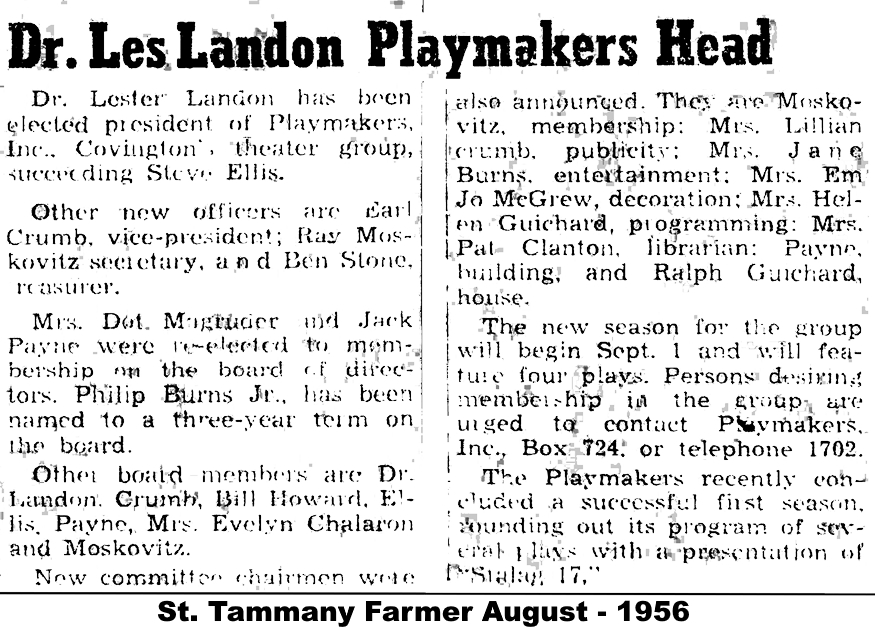
Playmakers Inc. was chartered in 1955 as an all-amateur, non-profit community theater serving the Covington area. In the past 28 years, it has grown to include members from all over the southern half of Louisiana, but has never operated for profit or maintained a hired staff, making Playmakers perhaps the oldest continuously operating all amateur theater in the United States.


The original old Barn (Photo by Ron Barthet)

It has been traditional for Playmakers to produce four plays during the year, one of which is a musical.


In  May,1963 a cigarette caught a curtain on fire, but it was quickly extinguished.

Then came the actual fire.

 In July of 1976, while in rehearsal for Guys and Dolls, a fire destroyed the Playmakers theater, a 75 year old dairy barn near Covington. 


The fire's aftermath. (Photo from Doug Harrison's Facebook Post)


On June 2, 1978, Playmakers poured the slab for a new theater on the same site as the old "barn." The new building, designed by architect Arthur Middleton, retained the rustic atmosphere of the "barn," and yet was a thoroughly modern theater with seating for 175 playgoers. No one in the audience is seated more than 30 feet from the stage, creating a truly intimate setting for the group's plays.

The 1978 press release stated that the cost of the new theater will be approximately $125,000. "To raise this much, Playmakers is continuing its fundraising drive and is launching its membership campaign for the 1978-1979 season. Playmakers would like to thank the following groups and individuals for their unsolicited donations of materials and labor, which are making the dream of a new theater in Sans Souci Forest a reality:

  • Construction Materials Inc. of Baton Rouge
  • Atlas Steel and Wire Co. of Harahan
  • Core Contracting Co. of Covington
  • Prestressed Concrete Products Co. of Mandeville
  • Patterson and Yeary Steel Co., of Mt. Hermon, LA
  • Parish Concrete of Covington
  • Louisiana National Guard
  • Malcolm Maginnis Jr.
  • Terry Goodger
  • Arthur Middleton, III

A happy group of Alvin Award winners, mid-1970's


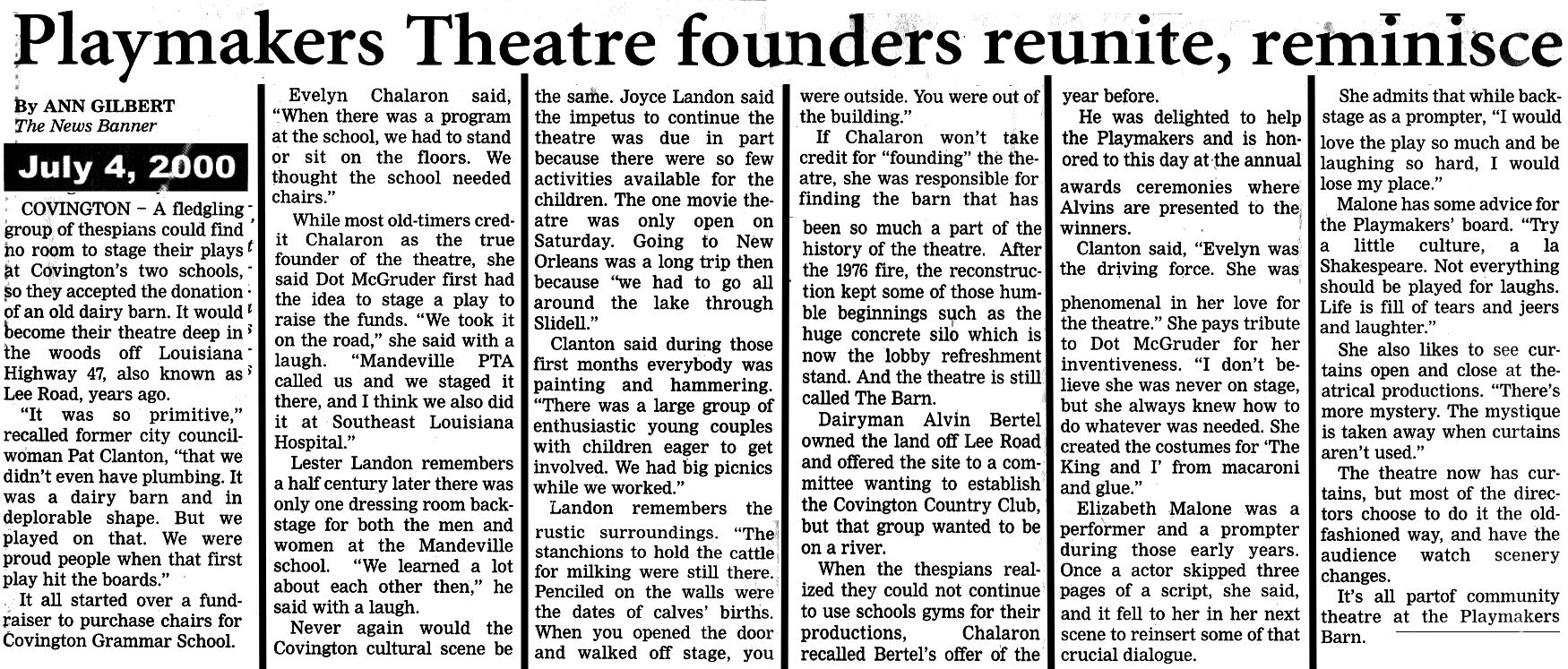
Text from the article above

Playmakers Theater Founders Reunite, Reminisce

By ANN GILBERT    The News Banner July 4, 2000

(Editor's Note: Frank Levy is doing a series of interviews in preparation for the publication of a book on Playmakers' Theatre, said to be the oldest continuously operating community theatre in the country. This article was taken from a videotape of those interviews shown at the May party during which the founders received medallions.)

COVINGTON — A fledgling group of thespians could find no room to stage their plays at Covington's two schools, so they accepted the donation of an old dairy barn. It would become their theatre deep in the woods off Louisiana Highway 47, also known as Lee Road, years ago.

"It was so primitive," recalled former city councilwoman Pat Clanton, "that we didn't even have plumbing. It was a dairy barn and in deplorable shape. But we played on that. We were proud people when that first play hit the boards."

It all started over a fundraiser to purchase chairs for Covington Grammar School.

Evelyn Chalaron said, "When there was a program at the school, we had to stand or sit on the floors. We thought the school needed chairs."

While most old-timers credit Chalaron as the true founder of the theatre, she said Dot McGruder first had the idea to stage a play to raise the funds. "We took it on the road," she said with a laugh. "Mandeville PTA called us and we staged it there, and I think we also did it at Southeast Louisiana Hospital."

Lester Landon remembers a half century later there was only one dressing room backstage for both the men and women at the Mandeville school. "We learned a lot about each other then," he said with a laugh.

Never again would the Covington cultural scene be the same. Joyce Landon said the impetus to continue the theatre was due in part because there were so few activities available for the children. The one movie theatre was only open on Saturday. Going to New Orleans was a long trip then because "we had to go all around the lake through Slidell."

Clanton said during those first months everybody was painting and hammering. "There was a large group of enthusiastic young couples with children eager to get involved. We had big picnics while we worked."

Landon remembers the rustic surroundings. "The stanchions to hold the cattle for milking were still there. Penciled on the walls were the dates of calves' births. When you opened the door and walked off stage, you were outside. You were out of the building."

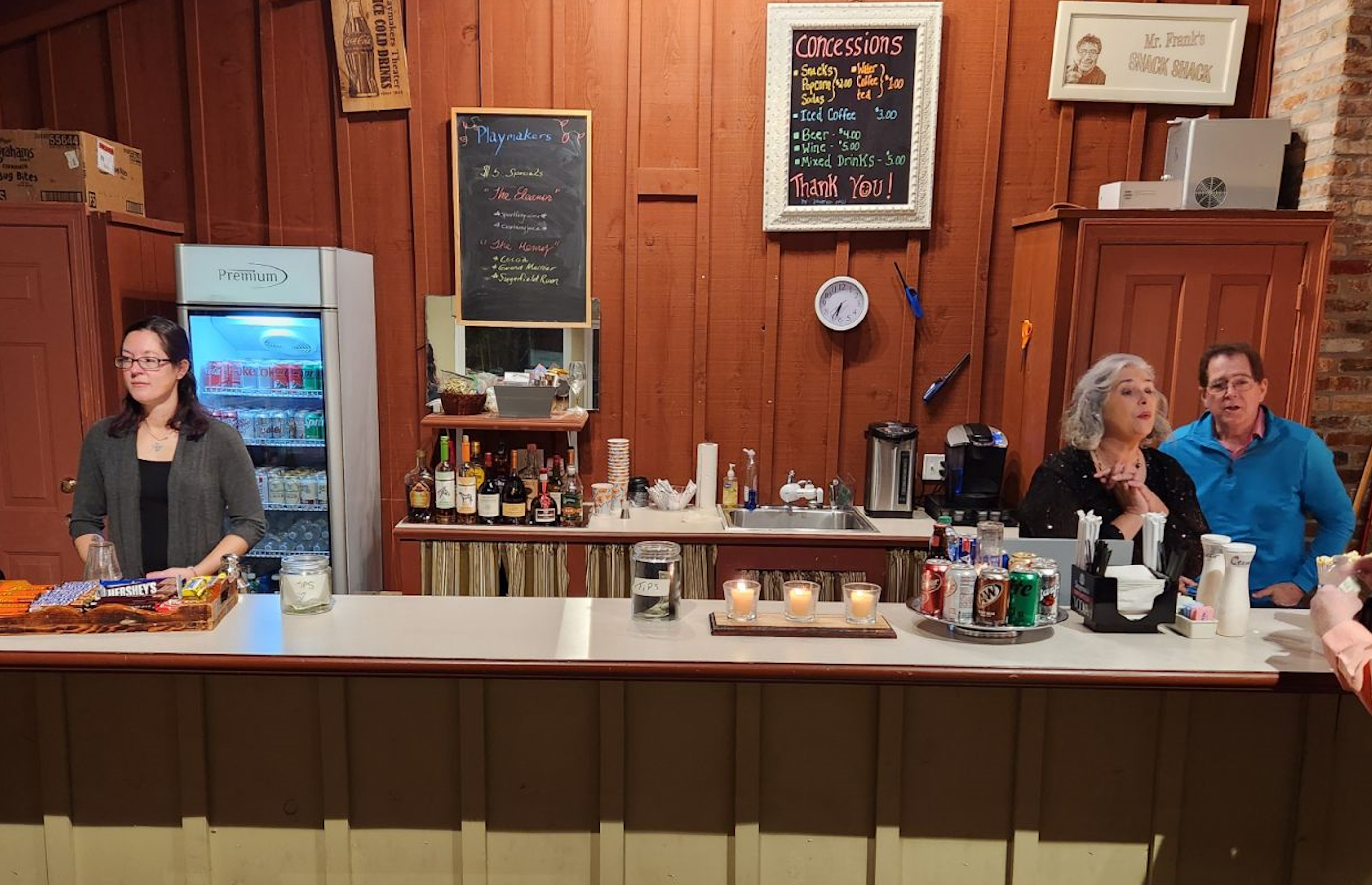
If Chalaron won't take credit for "founding" the theatre, she was responsible for finding the barn that has been so much a part of the history of the theatre. After the 1976 fire, the reconstruction kept some of those humble beginnings such as the huge concrete silo which is now the lobby refreshment stand. And the theatre is still called The Barn.

Dairyman Alvin Bertel owned the land off Lee Road and offered the site to a committee wanting to establish the Covington Country Club, but that group wanted to be on a river.

When the thespians realized they could not continue to use schools gyms for their productions,Chalaron
recalled Bertel's offer of the year before. He was delighted to help the Playmakers and is honored to this day at the annual awards ceremonies where Alvins are presented to the winners.

Clanton said, "Evelyn was the driving force. She was phenomenal in her love for the theatre." She pays tribute to Dot McGruder for her inventiveness. "I don't believe she was never on stage, but she always knew how to do whatever was needed. She created the costumes for 'The King and I' from macaroni and glue."

Elizabeth Malone was a performer and a prompter during those early years. Once a actor skipped three pages of a script, she said, and it fell to her in her next scene to reinsert some of that crucial dialogue.
She admits that while backstage as a prompter, "I would love the play so much and be laughing so hard, I would lose my place."

Malone has some advice for the Playmakers' board. "Try a little culture, a la Shakespeare. Not everything should be played for laughs. Life is fill of tears and jeers and laughter." She also likes to see curtains open and close at theatrical productions. "There's more mystery. The mystique is taken away when curtains aren't used."

The theatre now has curtains, but most of the directors choose to do it the old-fashioned way, and have the audience watch scenery changes. It's all part of community theatre at the Playmakers Barn. 

End of newspaper article


One of the first plays


A special production for the Covington Bicentennial

Below is a link to a PDF file containing a number of Playmakers printed programs over the years...


The Summer Camp

No history of Playmakers would be complete without a mention of Frank Levy's Summer Theater Children's Camp. For years Frank put together a cast of all young people and in just a very short time, they put on a theatrical production for their parents, sisters and brothers ( with a few aunts and uncles). It was always a blast for the young folks, and using the Playmaker's Barn gave it a real air of authenticity. 

The Flood

High flood waters from the nearby Little Bogue Falaya River caused significant damage to the theater in 2016, and Hurricane Ida dropped some trees on the structure in 2021, but the organization continues to bounce back stronger. It's an ongoing challenge, since much entertainment has now gone online, but the little theater that has survived going on 68 years through fire, flood and pestilence (CovID 19) continues to raise the curtain.


Photos of the new Playmakers Theater "Barn" from 2023


See also:

Playmakers Inc. Origins

Playmakers Awards

Playmakers Fire Brought Community Together

You Can't Take It With You 1975

The Barn Red Playmakers Barn

Playmakers Backstage

7th Annual Alvin Awards - Playmakers 1972

Oklahoma Comes To Covington

Pat Clanton

Ronnie Pogue

A Dog's Obituary


Wednesday, October 5, 2016

Christmas Under the Oaks

Lighting up the downtown area for the holiday season is always a good photographic opportunity. Here are some pictures of the "Christmas Under the Oaks" event in front of the old courthouse in Covington. Activities included singing carols, lighting of the Christmas tree, and special dance performances.


Putting them in their place


Stars in the Oaks Over the Hibernia Bank Branch near Acquistapace's


See also:


Tuesday, October 4, 2016

Slidell and Lacombe: People and Community - 1905

In 1905 J.S. Glass, publisher of the Southern Manufacturer, put out a booklet on St. Tammany Parish with a wealth of information about the area as a whole and also individual communities and their resources. It includes a considerable amount of information about the Salmen Brick and Lumber Company and other prominent Slidell businesses.


Below are scans and text from photocopies of the several pages spotlighting the Slidell and Lacombe section of the brochure. Click on the images to make them appear larger. 


From 1905:

     SLIDELL has a population of 2,500; besides a Central Graded School which has an accommodation for 200 pupils, there are several private schools; there is a Catholic Church, Baptist, Presbyterian and Methodist Churches. There is a movement on foot to organize a first-class fire company. Besides the town hall and the Pythian Hall, the Red Men have a public Hall. There are a dozen stores, fine graded streets.
     It is located 28 miles from New Orleans, four miles from Lake Pontchartrain on the N.O. & N.E.R.R. with 10 passenger trains daily. Nearest dry land to New Orleans, bank, electric, lights, telephone exchange, telegraph, saw mill, planing mill, ceosote works, ice factory, machine shop, ship yard, hotels, another railroad in prospect, fishing, hunting, artesian wells, good soil are among the attractions. 

    The Hon. F. A. Bourgeous, Mayor, has resided in the parish eleven years, during which time he has successfully engaged in the Mercantile Business: recently retiring from business, which he sold to Mssrs. Neuhauser Brothers. He is the owner of extensive property and has just built an attractive residence. He has served two terms as Mayor and has always been prominent in promoting the town's interest. He is a leading Mason and Red Man. 

    The Southern Creosoting Co. , Ltd., have at Slidell a finely equipped plant, for the turning out of Creosote, piling, lumber and timber. It has a capacity of 75,000 feet daily, and it has the very latest improved machinery.

    The Slidell Branch of the Covington Bank and Trust Company was organized in 1904: Prominent citizens of Slidell taking stock. Among the directors who reside in this section of the Parish are Messrs. Fritz Salmen, T. J. Hand, P. M. Scheider and J. J. Willis, beside which Mr. Salmen is second Vice President. A new building is being erected of brick, to be equipped with up-to-date banking fixtures and a solid glass front. Fire proof vault and burglar proof safe with time lock attachment. 

     NEUHAUSER BROS. composed of Messrs. N.G. and A.S. Neuhauser, conduct one of the principal Mercantile establishments at Slidell, carrying an extensive assortment of goods.. Mr. N. G. Neuhauser has for thirteen years been the Station Agent. He is a large holder of town and country real estate and takes an active interest in educational affairs. His brother is well-known as having been the Manager of the Slidell Brick Works. 

    The NEW COMMERCIAL HOTEL is the leading hostelry at Slidell. It has an accommodation for drummers and travelers, a free sample room. It is a large two story building, convenient to the depot and stores. Mrs. H. D. Varlie, the hostess, has made a splendid success since taking charge.
    Hon. F. A. Bourgeois is the Mayor, and the Aldermen are Messrs. T.J. Hand, J.A. Salmen, D.J. Perriloux, C.Z. Guzmen, and J. B. Parker. 

    The SALMEN BRICK AND LUMBER CO., Ltd, are manufacturers of yellow pine and cypress timber, shingles, lath, mouldings, hewn and round piling, pressed front and ordinary brick. Their plant covers an area of forty acres. Their saw mill has a daily capacity of 60,000 feet. The planing mill with a capacity of 50.000 feet daily, has ten of the latest improved machines.


The Salmen Brick and Lumber Co. Ltd. Plants

    The drying capacity is taken care of in eight up-to-date brick and steel dry kilns. Their brick plant is amongst the finest in the country, with a capacity of a quarter of a million daily. There are two up-to-date pressed brick machines and two building brick machines. The Company operates the Slidell and Bayou Lacombe R.R. a distance of 12 miles. 

    They own extensive tracts of pine timber lands in St. Tammany, Washington, Tangipahoa, and Livingston Parishes and Hancock Country, Miss. Also valuable cypress lands in St. John The Baptist Parish, Tangipahoa, Ascension, Assumption, Iberville, and Livingston Parishes. The Company also has a large shingle mill with a 100,000 daily capacity and a cord wood mill that cuts fifty cords daily. 

    The pull boat the "Bull of the Woods" and camp boats with accommodations for seventy men, a marine driver, and three tug boats "St. Tammany," "Biloxi," "and "L.W. Brown"; two schooners, six barges and two gasoline launches "Zeno" and "Emma D." constitute the Salmen fleet. 

    In line with their handling equipment, they have three immense brick derricks of 200,000 daily capacity, one at the plant, one at the yards on the New Basin, and one on the tug boat "St. Tammany." They own a pine saw mill on the Tickfaw River of 20,000 feet capacity. In connection with their brick plant, the Salmen's operate a steam drive with a capacity of 100 cars of brick. 

    The Company also owns the largest merchantile establishment in the parish. They received the Bronze Medal at the Louisiana Purchase Exposition for their superior brick. During the Convention of the National Association of Brick Makers at Birmingham, Ala., they paid a visit to this model factory in order to inspect its equipment. The affairs of the corporation are ably directed by Messs. F. Salmen, President; J.A. Salmen, Vice President, and J. Salmen, Secretary and Treasurer. Their New Orleans office is at 712 Common Street. They have immense export and domestic trade in lumber, pilings, etc., and have a large brick business among the Gulf Coast Section.


    The SLIDELL ADVOCATE is published weekly by E. F. Hailey& Co., and does much to advance the town's interest.

    Eddins & Everitt have formed a co-partnership for handling real estate consisting of improved and unimproved town property. Both of these two gentlemen are too well known to the citizens of Slidell to need any introduction. Mr. Eddins holding an important position with the Salmen Brick and Lumber Company, and Mr. C.A. Everitt being Cashier at the Bank.

    H. CORNIBE is conducting the leading livery business. He has a first class stable of horses and a fine equipment of rigs. He also does a large transfer business. Mr. Cornibe's stable is a fine modern structure of corrugated roof. He also does a large order-taking business. He has been a prominent resident of the town for the past 18 years. 


    Messrs. F. S. Pickel and T.J. Hand are proprietors of the leading liquor business in Slidell. They have an extensive wholesale shipping trade. Mr. Hand has for eight years been a prominent member of the town council. He is prominent in fraternal circles. 


The BAYOU LACOMBE SETTLEMENT. This is a rich stretch of agricultural country;  the land being adapted for the culture of sweet potatoes, sugar cane, truck farming, cotton, figs, pears, peaches, fine water melons, etc. Mr. Jno. H. Davis has a very fine equipped saw mill, turning out 25,000 feet of lumber daily . He manufactures principally for the export trade. Mr. Davis is one of the progressive citizens of that locality. He has for sale 1200 acres of very fine land. For further information regarding the resources of Bayou Lacombe, drop him a line. Bayou Lacombe Post Office. 

    MRS. JAMES KAYSER conducts the oldest established saloon in town, beside a popular and well patronized restaurant. Her business is located on the main street, and she is the owner of considerable property. 


To see more advertisements from this booklet, CLICK HERE.

Monday, October 3, 2016

Lacombe Topo Map - 1935

Below is the Lacombe section of the 1935 USGS Topographic Map. Click on the image for a larger view. You can see that the highway crosses the bayou at a different place ( a little further upstream) than the currrent bridge. 


Here's a comparison between the 1935 and 2016 maps.


Sunday, October 2, 2016

Movie Making In St. Tammany Parish

In June of 1973, motion picture companies were coming to St. Tammany Parish one after another, filming major films with major stars every few months. So much so, in fact, that local chambers of commerce, business people, and even state film promotion agencies started to shine the spotlight on St. Tammany even more. 

The unique skills and services needed by movie production people were readily available, and local business people were more than willing to adjust their schedules to make it all happen. Of course, having a population that was eager to work as "extras," some with their own costumes, was an added bonus. 

Below is an article I wrote about the newfound fame (and Hollywood luster) that St. Tammany was enjoying at that time. It appeared in the June 24, 1973 edition of the Northlake Sunday News. 


One of the crew members once told me on a movie set that one of the reasons directors, cast and crew love it when they get to come to St. Tammany Parish to make a movie is that, after shooting is done for the day, then New Orleans is only a short drive away with its good times, parties, and night life. That close proximity to New Orleans helped St. Tammany become a Hollywood favorite in more ways than one.


Part of the lighting set up for a movie made at a home on S. America St. in Covington in 1993 starring Melissa Gilbert and Bruce Boxleitner

Of course, today, in 2016, movies are being shot on location here in St. Tammany more frequently, not only big studios doing big films but a number of low-budget movies being produced by independent companies. More specialized movie services are also available in St. Tammany now more than ever with several media production companies, corporate film services, make-up, costuming, and lighting providers, not to mention the most important service of all, catering companies that provide meals and beverages on set. Local restaurants have found a new revenue stream by providing that service.


 A scene from the movie "Eve's Bayou" shot on Columbia Street in Covington

For an almost complete list of films made in St. Tammany Parish over the years, CLICK HERE.


My review of the James Bond film "Live and Let Die" filmed in part in St. Tammany


Saturday, October 1, 2016

Slidell High Football Team 1932

Here is a photograph, some 84 years old, showing the players who were on the 1932 Slidell High Football Squad.


And at half time came the Slidell High School marching band.