Friday, May 8, 2020

Sal Impastato, Lacombe Chef

Eleven years ago, in 2009, a special awards ceremony was held at the Louisiana Heart Hospital in Lacombe. It was the fourth annual St. Tammany Parish President's Art Awards. 

The St. Tammany Parish President's Commission on Cultural Affairs named Lacombe restaurant owner Sal Impastato as its "Culinary Artist of the Year." In this short video, Commission vice chairman Stephen Cefalu introduced Impastato , who tells a little of his background, his vision, and his thankfulness for the way St. Tammany Parish residents have enjoyed meals at his restaurant for years.


Click on the "play triangle" above
to view the video.


Photo source: LouisianaTravel.com 

CLICK HERE to read the history of Sal & Judy's Restaurant and its
Chef Sal Impastato
See also:

Sal & Judy's Website

Sal & Judy's Facebook Page


100 Years Ago This May 8


What was going on 100 years ago this week? CLICK HERE for a link to the St. Tammany Farmer Issue of  May 8, 1920. The link is provided by the Library of Congress and its Chronicling America service.

Click on the sample images below to see larger versions.


Moss Factory Proposed


Society News


Thursday, May 7, 2020

Lightpole Smashed


This accident took place many years ago at the intersection of Tyler Street and 21st Avenue in Covington when the Time Saver convenience store was still on the northwest corner. 

It's one thing to run into a lightpole and smash your car. It's another thing to run into a lightpole and break the pole in two. But to run into a lightpole and break it into three pieces, well, that's just impossible. 


There were so many wires attached to the pole that it didn't even fall over when a vehicle hit it with enough force to break it in three pieces.

Tuesday, May 5, 2020

Tugy's Bar

Tugy's Bar in Covington was a landmark establishment for many years, the cornerstone business of the Southern Hotel building and at one time the only bar located inside a parish courthouse in the country. 


Click on the image to make it larger

The bar was opened by a Covington bartender Julius "Tugy" Tugendhaft  around 1935,  and it was originally located in the southeast side of the ground floor of the Southern Hotel on Boston Street in Covington.  


Tugendhaft moved the bar to the southwest corner of the building around 1961.


Philip E. Pfeffer recalled that Julius Tugenhaft was a public spirited citizen involved in many community projects. "He boasted that he charged a cent a bottle of beer more than other places, and that these pennies would build him a house. This turned out to be true," Pfeffer said.


Click on the images to make them larger. 


He sold the bar around 1964 to Al Poncet, who continued its operation for another 20 years.


Al Poncet

 
Next door to Tugy's at one time was the Colonel and Son Restaurant, owned by Colonel Earl Wilson and his son Earl Wilson, Jr. There was a connecting door between the cafe and Tugy's, so the restaurant could serve beer to its customers via Tugy's. 

Col. & Son Restaurant Next Door

Debbie Diamond, the Colonel's daughter, said that he retired in 1961 after almost 30 years in the Army and moved the family to Covington. "My Dad and brother decided to open the Colonel & Son cafe together. I waited tables in there as a teen. We served some of Covington's best coffee and biscuits made by Mrs. Minnie in the kitchen. 

Almost every morning a regular group of men met for coffee there. One of them was Mr. Roy Johnson, the father of our mayor today, Mr. Mark Johnson. Mr. Roy had a great personality. A really nice guy who was always laughing and smiling," Debbie said. "Those two passageways both connected to a back entrance to the Southern Hotel, which was owned for awhile by my sister and her husband, Sylvia & Harold Glockner."  The Southern Hotel closed in the late 1960's, but Tugy's Bar persevered. Tugy died in October of 1971. 


The 900 square foot bar continued to operate, but it was soon to be rejuvenated when the St. Tammany Parish government purchased the building in the early 1980's for use as its administrative offices and a couple of courtrooms and police jury meeting room.

 
Officials allowed Tugy's to continue operating as a barroom as it had for half a century.  The bar had been allowed to remain in the newly-designated courthouse because of its "historical significance."


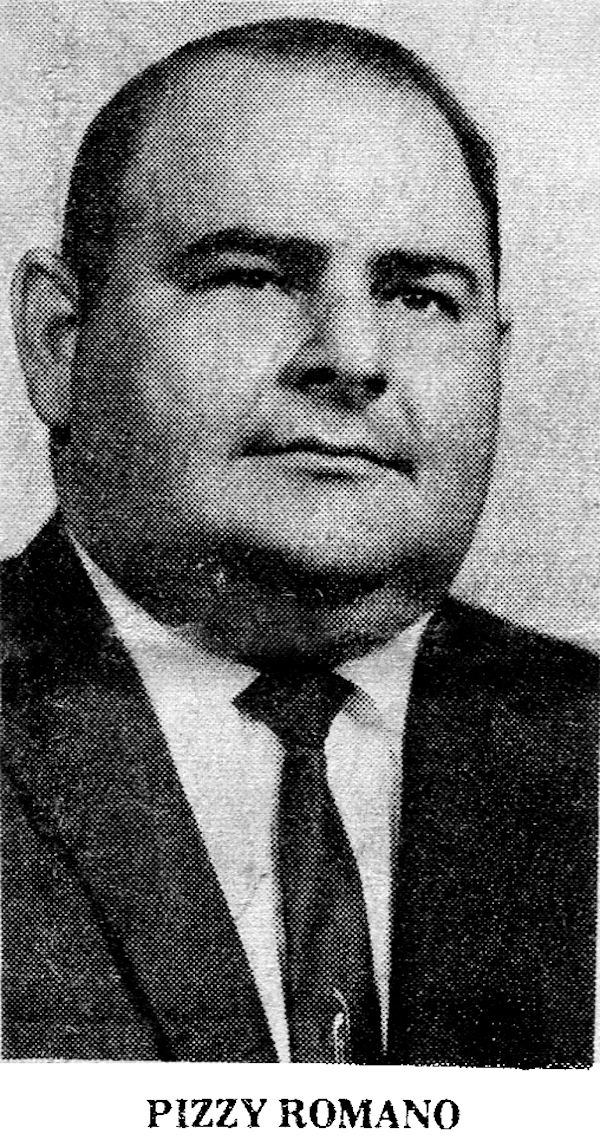
The photo above is from 1961 inside Tugy's. Left to right are Pizzie Romano, Rip Wicker, C. Duvoisin, Wallace Laird and Julius "Tugy" Tugendhaft . Photo submitted to the Remember Covington Facebook page by Wendy W. Talley. 

 It was tradition that after every police jury meeting, parish officials would "re-convene" at Tugy's Bar to relax and talk off the record. A former city councilman was quoted as saying, "There's no telling how many deals were cut in there. That was where the real meetings were held after the meetings."


John "Pizzie" Romano, bought Tugy's from Al Poncet in 1984. He had once tended bar there when he was 18 years of age, and when he purchased the establishment, he was 46 years old. 

Romano was a well-respected businessman in the community. He owned the Heritage Lounge,  Pizzie's Po-boys, Romano's Grocery, and Romano's Steakhouse. He was the Director of the (Livestock) Brand Commission and the Assistant Director for the Horticulture Commission for the State of Louisiana. In addition to serving on the Covington City Council and the City of Covington Planning and Zoning Board, he also served on the St. Tammany Parish Hospital Board of Commissioners. 


Sixteen years after he purchased Tugy's, however, a new courthouse was built at the end of North New Hampshire Street, just three blocks up the street. As a result, the Southern Hotel building was no longer needed by the parish. Romano told a newspaper reporter that when the parish moved out, he lost about two-thirds of his business. "It was a great crowd. You would have a carpenter sitting right next to a judge," he was quoted as saying. 

Romano closed the bar in February of 2004, much to the shock of many Covingtonians.  He owned the bar for 20 years.  "It is such a part of Covington history," he said.


Photo of Ten Year Class Reunion crowd, St. Paul's School Class of 1975, at Tugy's Bar in 1985 (Photo source: Warren Illing)

But then, around 2010, the bar re-opened briefly as "Tugendhaft's Tavern," run by Steven P. Reed.  He was granted a conditional use permit by the Covington Zoning Commission to proceed with re-opening the legendary business, although under a different name, since Romano had registered the name "Tugy's Bar."

The business was closed once again a couple of years later, however, when renovations began on the Southern Hotel building under its new ownership. The space occupied by Tugy's Bar thus became hotel meeting rooms, still a place for people to meet and speak to each other, but without the beer taps. 


The iconic Tugy's neon sign is now on display at the H. J. Smiths Sons General Merchandise Store museum on Columbia Street. It was donated by Mike Pittman who had it refurbished after it was removed from the side of the building. 

Romano died on Dec. 23, 2018, at the age of 81. There is a plaque on the wall of a hallway in St. Tammany Parish Hospital honoring his memory.


The landmark neon sign


Tugy's Tavern

In addition to Tugy's Bar in downtown Covington, there was also Tugy's Tavern, an establishment located on Claiborne Hill in 1937. It was billed as the largest bar in St. Tammany Parish. 


Click on the images to make them larger. 


A change in ownership in July of 1938


See also:

John Fahey Honors Tugy Tugendhaft   

Businesses Located Inside the Southern Hotel

Signs of the Times

Photo Processing Technical Notes


Jimmy Foster, Guitar Maker

 Covington has several well-known guitar makers. One of them was Jimmy Foster, who made 7 string guitars. (Fosters Guitars) He built them out of a shop in Covington for a while and then he built a shop behind his home. He sold to some of the most famous guitar performers from around the country.  

 
Jimmy Foster

 Jimmy Foster, Master Luthier and 7-String Jazz Guitarist, died on April 26, 2011.

Greg Arceneaux said that Jimmy touched countless people’s lives through his skill as a craftsman and musician. "As long as his guitars continue to be played that legacy will also. He made our lives sweeter and more melodic and we can only hope we can do the same," Greg said. 
 
Gary Granger said he met Jimmy twice and both times were memorable. "The first time I simply started talking to him at a music store and realized that he actually built this incredible guitar that I was enjoying. The next time years later I called him up, and he invited me over to his shop in Covington. I spent about 3 hours learning how he created those masterpieces and jamming on all kinds of great tunes with him. He was a great musician, a superlative craftsman and a very open and warm person to be around," Granger said.
 
Some of the players who use Foster Guitars include Paul Simon, Howard Morgan, Fred Fried, Clint Strong, Steve Masakowski, Hank Mackie, Pat Practico, Alan DeMause, Ron Escheté, Ted Ludwig, David Mooney, Rob Block, Todd Duke, Bill Solley and Jim Lichens.

Danny McKnight commented that Jimmy made three guitars for him. "I made three trips from my home in Texas to his shop in Covington to get them when they were ready. Jimmy always gave me a warm welcome and treated me like the friend we had become to each other. Jimmy was a good and honest man, easy and fun to be around, a fine musician and a wonderful guitar builder. He indeed will be missed by his many friends," McKnight said.

 More comments about Jimmy Foster may be found at https://www.fosterguitars.com/in-memory
 
 In 2006 Ted Ludwig interviewed Jimmy Foster. Here are some excerpts from that interview.

"Jimmy Foster is the most celebrated luthier in the New Orleans area. For the past thirty three years he has made guitars for many of the finest players around the world. What makes Jimmy special among his contemporaries is that he is a brilliant 7 string guitarist as well as a wonderful luthier. He has been playing weekly gigs in and around New Orleans since he was a teenager. His experience as a professional musician coupled with his intuition as a fine woodworker has helped Jimmy Foster create some remarkable instruments.

Ted Ludwig asked Jimmy how he first got involved in making guitars. "I spent a lot of time with my dad who was a body and fender man and could make anything out of a piece of metal or wood,: Foster replied. "Making things with my hands was something that always interested me. Being a guitar player since I was 11 years old, guitars had always intrigued me. I always knew that I was going to build guitars someday. When I opened my first shop I called it Foster’s Custom Finishes and Repairs. I was doing body and fender work while taking some guitar repairs. I had two business cards made for that business. One had a picture of a guitar on it and the other had a picture of a car."

According to Foster, his experience with painting cars helped him develop some of the rich finishes that he used on his guitars. "When I was a kid, about 15 years old, I was doing guitar repairs and refinishing work for many of the local music stores. My dad would drive down to the music stores and pick up the repair jobs for me. I would do the repairs and would spray the guitars in a booth that I made in my backyard. When I got my first shop I did work on both guitars and cars and it got to the point where the guitar repair work overtook the car repairs. Back then there was no one in New Orleans doing guitar repair so I got called to do warranty work for Martin, Gibson, Ovation, and Fender. That was when I decided to just do guitar repairs and refinishing."
 
Ludwig asked him if he did any work on some of the hand built custom guitars like D’Angelicos or Strombergs. Foster responded by saying that "Just about every kind of guitar that I can think about came through the shop. Being in a musically rich city like New Orleans, I have had players from all over the world come into my shop for guitar repairs. I have gotten to work on some of the finest guitars in the world. When I would work an instrument that was especially good sounding I would find out what it was that made that particular guitar so great. There was no one here to teach me how to build archtops, so I used the knowledge that I got from doing repairs."

So, over the years, he learned how to build guitars from examining other great guitars. He was particularly selective with the wood that he used. "Great tone woods are an essential part in making a great guitar," Foster said in his interview with Ludwig. "But, it is the way in which the maker carves and works the wood that determines how the guitar is going to sound. Benedetto said it and I think it is well stated. Every piece of wood has different characteristics about it. The way a guitar is going to sound can be adjusted by the thickness of the top and the way in which the braces are shaped.

Ludwig then asked him how has being a player influenced his guitar designs. "Being a player has been the most important asset to my guitar building," Foster responded. "It helps me to be in tune with other players' needs. I have learned to make a guitar that has less feedback and no dead spots. I know how to make a guitar feel great to a player. I have learned how to make my guitars sound great electronically as well as acoustically. Most importantly I have learned how to make a guitar that will last a lifetime and will hopefully give a player a lifetime of enjoyment."

Who are some of the players that use Foster Guitars? Paul Simon, Howard Morgan, Fred Fried, Clint Strong, Steve Masakowski, Hank Mackie, Pat Practico, Alan DeMause, Ron Escheté, Ted Ludwig, David Mooney, Rob Block, Todd Duke, Bill Solley and Jim Lichens.

To view videos about Jimmy Foster making guitars, playing guitars, and talking with other guitarists, click on the following YouTube link: https://www.youtube.com/user/jazzguitarmaker


Monday, May 4, 2020

Keeping Cafeteria Workers Up-To-Date

Training St. Tammany Parish Public School cafeteria workers on the latest in nutritional menu preparations was a continuing effort in the mid-century schools.


Click on the images to make them larger.

Sunday, May 3, 2020

Abita Springs News Summer 1929

Here is a sample of society news focusing on the Abita Springs area as printed in the St. Tammany Farmer newspaper on May 25, 1929. Click on the image to make it larger and more readable.


Saturday, May 2, 2020

John Hodge, Pottery Artist Extraordinaire

In 2009, a special awards ceremony was held at the Louisiana Heart Hospital in Lacombe. It was the fourth annual St. Tammany Parish President's Art Awards. 

The St. Tammany Parish President's Commission on Cultural Affairs named Covington artist John Hodge as its "Visual Artist of the Year." In this short video, Commission vice chairman Stephen Cefalu introduced Hodge, who tells a little of his work, his philosophy, and his thankfulness for the way St. Tammany Parish recognizes and appreciates artists. 

Click on the "play triangle" in the window below to view the award presentation. 


John Hodge at his pottery wheel

See also:

John Hodge Pottery Website

Friday, May 1, 2020

Reptile Jungle: Owned by Famous Exercise Expert

 A popular roadside attraction east of Slidell was the Reptile Jungle, located on U.S. 90 next to the White Kitchen restaurant.


Reptile Jungle was owned and operated by Arthur Jones who, after opening Reptile Jungle, went on to became a millionaire when he invented the Nautilus physical fitness equipment system. CLICK HERE for more information about Arthur Jones. 


According to this article below, he was quite a character. He died in 2007 after a long and intense career. His obituary is printed below, as published in the Seattle Times newspaper. 

 Arthur Jones, eccentric reshaped the exercise world, dies at 80
 
Originally published September 2, 2007, in the Seattle Times.


By Patricia Sullivan
 

    Arthur Jones, the swashbuckling inventor of Nautilus exercise equipment, which revolutionized strength training by replacing the dead weight of barbells with a variable resistance technique, died Tuesday at his home in Ocala, Fla. No cause of death was reported. He was 80.

    Gruff and profane, Mr. Jones did not fit the image of the creator of the machines used by svelte, leotard-wearing exercise enthusiasts. He wore horn-rimmed glasses and ill-fitting pants. He spent his early life hunting big game for zoos and collectors. He made television shows and a movie, all geared to outdoors adventure.


An episode of "Wild Cargo" with local New Orleans announcer Bill Wilson as host . Warning: some scenes may depict the killing of animals in the wild.
Click on play triangle to view.


    It was his invention of the Nautilus that made his fortune and reshaped the world’s physique. It took bodybuilding out of the subculture of dank gyms and brought sedentary office workers into brightly lit fitness centers.


Frustrated bodybuilder

 
    The creation was born of frustration. Living in the Tulsa YMCA in 1948, Mr. Jones became irritated when the barbells and exercise regimes that were then in vogue failed to give him the big muscles he sought.


    “I ended up with the arms and legs of a gorilla on the body of a spider monkey,” he told Forbes magazine in 1983. “I figured there was something wrong with the exercise tool.”


    One day, instead of quitting when he reached a plateau, he cut his routine in half and was surprised to see results. Deducing that muscles need rest to recover and that leverage affects strength, he began experimenting. He introduced his product in 1970 and dubbed it the Nautilus, after the nautilus seashell, which resembles the kidney-shaped cam that was his breakthrough development.


    The machines and the company he formed to sell them made him a multimillionaire and landed him on the Forbes 400 list. At one point, financial analysts estimated that Nautilus, now based in Vancouver, Wash., was grossing $300 million annually.


He was featured on an episode of Lifestyles of the Rich and Famous
Click on the play triangle above to view the video. 

    With his new wealth, Mr. Jones bought 600 acres of north Florida property to house a private zoo containing 90 elephants, three rhinoceroses, a gorilla, 300 alligators, 400 crocodiles and three used Boeing 707 airliners. He founded a “fly-in” community in Ocala called Jumbolair Aviation Estates, whose most famous resident is actor John Travolta.


    But Mr. Jones’ flamboyant personality didn’t play so well in the business world. In 1984, Adweek magazine said he spent $4.2 million on an ad campaign as a purported ploy to avoid making a profit and paying taxes. The Internal Revenue Service indicted him in 1981 on charges of failing to pay federal income taxes in the 1970s.


    As many as six former business partners and distributors accused him of threatening to kill them after disputes. Some distributors accused Nautilus of failing to ship merchandise they had paid for.


    He also disastrously invested $70 million in a video studio, dubbed the Nautilus Television Network, which produced a talk show starring his friend G. Gordon Liddy, the chief of the Watergate “plumbers.”


    He sold his share in the Nautilus business and began experimenting with a new invention, intended to analyze and exercise lumbar muscles for those who have lower-back pain. That invention turned into the company MedX.


    “This is the first machine that truly isolates the muscles of the lower back,” he told BusinessWeek magazine. “My competitors who say otherwise are liars or fools — or both. Let them sue me. I can’t wait.” Suspicious of the competitors, whom he called “thieves, frauds, fakers, slanderers and incompetents,” he often carried a Colt .45.


    “I’ve shot 630 elephants and 63 men, and I regret the elephants more,” he once said.


    Born to a well-to-do family in Arkansas, he was the son of two doctors. He started running away from home at a young age and dropped out of school in ninth grade.


    He rode the rails, he later told interviewers, until enlisting in the Navy during World War II and serving in the Pacific. After the war, he launched a zoo in Slidell, La.


    Along the way he learned to fly and began collecting exotic animals, which he ferried to zoos, pet stores and researchers. He claimed run-ins with agencies such as the CIA and FBI, which he said accused him of running guns or bombs to Cuba.

 
    For 12 years, the exotic-animal business thrived. He made a series of TV programs that aired as “Wild Cargo” in the United States. In the mid-1960s, he moved his family to Rhodesia, where they lived two years until the government took exception to his wild-game business and seized his assets, forcing his return to the United States.


    He acknowledged that his politics were to the right of Attila the Hun and, while living in a state plagued by drug runners, advocated killing drug users.


    He sold Nautilus in 1986 for $23 million. He also sold MedX in 1996 and then retired.

End of Seattle Times Article

------------------------------------------------

 A Reading of the Article
"Faster Planes, Younger Women and Bigger Crocodiles"

From Slidell Magazine   


Slidell Magazine has a video that features an article about Arthur Jones read by John Case on its YouTube.com channel. 

To view the video, click on the play triangle in the window below.


John Case reads about Arthur Jones


Interview with Arthur Jones