The blooming of the long-lasting daisy flowers are popping up in a number of places nowadays, giving a bright yellow splash of color along fences throughout St. Tammany.

Click on the images to make them larger.


Bees a'buzzing


The blooming of the long-lasting daisy flowers are popping up in a number of places nowadays, giving a bright yellow splash of color along fences throughout St. Tammany.

This picture appeared in the St. Tammany Farmer newspaper in 1964.

The 1960 Robert H. Burns Post No. 16 American Legion Baseball Team in Covington is shown below. Click on the image to make it larger.

Here is a photograph of the basketball team at Covington High School in 1912.

In the early 1900's, several groups got together to work out a way to build a bridge across Lake Pontchartrain between New Orleans and Mandeville. Here is an account of one of them.
Click on the image to make it larger or just read the text from the article below the image.

Here is the text from the above 1967 article.
Lake Bridge Idea Was Long, Long, Time In A-Hatching
Today, there are four single automobile bridges across Lake Pontchartrain, counting the old "Watson-Williams" bridge at Slidell and the new Interstate I10 twin bridges alongside it, plus the 24-mile long Causeway between Jefferson Parish and Mandeville. Two more cross Rigolets and Chef Menteur.
The first of the bridges was built in the late 1920's or early 1930's as a private venture, but it couldn't pay off after the late Gov. Huey P. Long, who failed in an attempt to buy the span, had the state build free bridges at Rigolets and Chef Menteur in competition with the toll structure.
This was the "Watson-Williams" bridge, which took traffic from the ferries which previously were operated across the Rigolets and Chef Menteur. But even the Watson-Williams bridge was far and away behind the times as an idea.

Back in 1911 a group of New Orleans men dreamed of a bridge between their city and Mandeville, and started a stock company to raise $5 million for fee its construction, figured at 20
Though the present Causeway cost something like $30 million, back in 1911 a dollar went considerably farther.
The New Orleans and St. Tammany Bridge Association, in August, 1911, adopted by-laws at its meeting and elected directors. An article in the old New Orleans Times-Democrat, said "Considerable enthusiasm was injected into the meeting by J.E. Glisson, who submitted a draft for a charter for a corporation to build a bridge, and in doing so, declared he would subscribe $1,000 and guaranteed he would obtain subscriptions to the extent of $10,000."
Glisson, a New Orleans real estate operator, was the father of Miss Lucille Glisson of Covington. The information on the bridge plan comes from scrap-book clippings in Miss Glisson's possession.
The newspaper said those promoting the bridge should hold a mass meeting in New Orleans, and publicize the bridge into Washington and St. Tammany parishes in order to secure additional support.
The actual name adopted for the group was the New Orleans and St. Tammany Bridge and Railway Company.
During the preliminary sessions, it was planned to have the New Orleans Public Belt RR bond its facilities for $55 million to gain funds for the bridge or a causeway, as it was originally planned.
Bridge Description
The idea was to build a retaining wall and fill it with dirt dredged from the lake itself.
Henry Clay Riggs, president of the St. Tammany Bridge & Ferry Co., was one of the leading proponents of the structure. He estimated it could he built for $3.5 million. The crown was to be about 60 feet in width and the base 300 feet wide. There would be four miles of concrete arched spans 50 feet wide. The roadway would be 14 feet above the lake's level.
Plus A Railroad Track
Original plans called for two divided oiled shell road surfaces, separated in the center by a railroad track.
One reason for wanting the private rail line was the charges exacted by a 'major" line which "throttled the enterprises of the city." Costs of shipping from Baton Rouge or Gulfport, it was said, was phenomenally less than from New Orleans because of rail charges.
If the Public Belt Railroad controlled the abridge, it would grant all lines an entrance to New Orleans on an equal basis, it was said.
Within a distance of 10 miles from Mandeville were rail connections which would mean "the building of seven new railroads into New Orleans, Riggs said.
On Sept. 6, 1911, Abita Springs devoted a day to the "bridge builders", when the "great project" was discussed at a mass meeting.
Abita Springs In Favor
Said the Times-Democrat: "If the bridge across Lake Pontchartrain is left to Abita, the great structure will surely be built, for the flourishing little health resort, set right in the midst of the healthiest section on earth, and surrounded by beautiful dells and woodland reaches, is all enthusiasm over the project."
N. S, Hoskins of the Mercantile Club, New Orleans, led the delegation, and Mayor A. Mutti and Abita citizens, commented the newspaper, kept open house for the visitors."
Mayor A. Hartman of Mandeville entertained visitors at that town. Committees met the lake steamer, "Louis Dolive", which carried the New Orleans delegation. Mayor Martin Behrman of New Orleans was unable to attend because of the death of his brother-in -law.

Covington, the account said, sent "a good delegation, including J. B. Lancaster, member of the general assembly, and S. D. Bulloch." Popular-priced excursions were run from Covington and Mandeville to Abita, where they were greeted at the depot by Mayor Mutti.
The bridge was never built, but it seems there was a heap of fun in the planning. The reason, we understand, is sufficient money was never raised to start the operation.
End of newspaper article


See also:
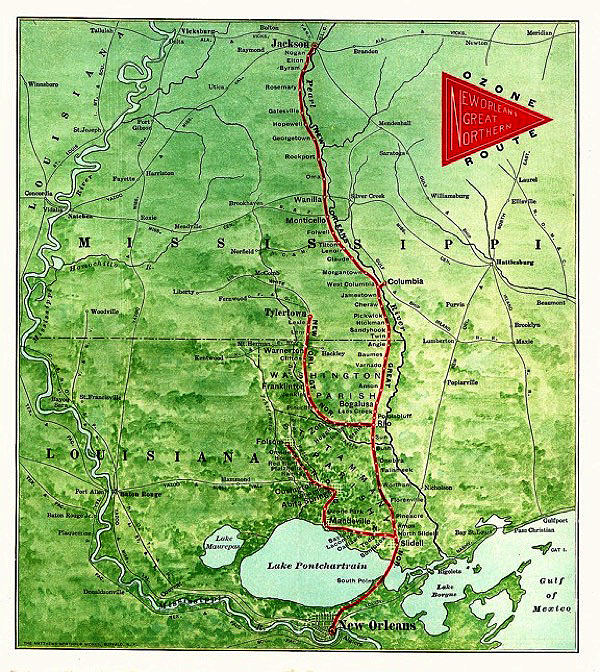
Ralph Hawkins, a former resident of Covington, now oversees the "HawkinsRails.net" train photo scrapbook, with hundreds of pictures of trains, locomotives, specialty cars, and railroad information, including maps.
Here's a link to his page on the history of the New Orleans Great Northern Railroad, which was called "The Ozone Route" because it passed through portions of St. Tammany Parish.
Click on the link below:
https://hawkinsrails.net/steam/nogn/nogn_steam.htm

See also:
Here are two photographs of the intersection of Carey and Cousin Streets in Olde Towne Slidell, facing east, taken 77 years apart. The top photo is from 2019 and the bottom is from around 1942.

In 1976 the News Banner ran an informative article on the Greater Covington Chamber of Commerce's Auxiliary Group and its plans for the upcoming annual Spring Garden Tour as well as events pertaining to that year's American Bicentennial celebration.
Click on the image to make it larger and more readable.

.jpg)


The Final Friday Block Party, Car Show, and Art Market was held on Friday, September 30, 2022, along several blocks of Columbia Street in Covington. Hundreds of area residents, plus a few Florida evacuees, turned out for the occasion, enjoying the variety of automobiles, music, and artwork on display.
Here are a few photographs from the event. Click on the images to make them larger.


125.jpg)
125.jpg)


