Some forty-three years ago, in 1976, the American Bicentennial Year, there was a lot of speculation about what life in the United States would be like 100 years from then, in the year 2076. I sat down with all the mayors in the area and posed them the question: "What will your community be like 100 years from now?"
The mayors responded from Covington, Mandeville, Abita Springs, Madisonville and Folsom. Here is the article from Folsom.
This photos shows the Folsom Town Officials in 1973,
Mayor Vera Faye Forbes at desk signing a document.
Folsom Interview With Mayor Forbes Published on December 30, 1976
Mayor Vera Faye Forbes of Folsom recently looked at the future of her town in St. Tammany Parish and predicted what was in store for it in the next 100 years. By the year 2076, the American Tricentennial, Mayor Forbes felt that Folsom would still be in the center of a rural farming area, with advances in agriculture providing better hybrid seeds, healthier crops and no weeds or pests. "Farming equipment will probably be automated enough so that the farmer won't have to go out in his fields and harvest his crops," she said. The population of Folsom itself will not be over 20 per cent more than it is now, she said, and transportation will probably be powered by solar energy. "I don't think the corporate limits of Folsom will be much larger than they are now," Mayor Forbes commented, "but the entire town will probably be a business district rather than residential." By 2076, the main highway La. 25 will be a four lane thoroughfare, she feels, and there will be a lot of apartment complexes in Folsom. However, she does not think there will be any buildings over two stories high. The people living in Folsom 100 years from now will be mostly retired, she said, and there will not be as many commuters residing there as one may think. She also did not foresee any kind of industry coming to the Folsom area over the next 100 years.
A number of blog articles on https://tammanyfamily.blogspot.com/ have featured information on the St. Tammany Parish Fair. Here are links to some of them:
The Mount Vernon Motel was located on Hwy. 190 halfway between Covington and Mandeville. It was an unusual motel in that its furnishings were all antiques, the bed, the chest of drawers, the amoires. Many St. Tammany residents remember staying there or putting up their out of town visitors there, just to show off the antiques.
A Mount Vernon Motel Postcard
The back of the above postcard says the Mount Vernon Motel was located two miles south of Covington. "Shady grounds in quiet rural area. Colonial style brick motel. Antiques are sold in the home in the rear. Mr. and Mrs. R.V. Caravetta are owner/manager.
A souvenir matchbook
About 24 years ago, however, many of those antiques went up in flames. Here are two photographs of the motel the day after it burned down in the mid 1990's. A new two story unit had recently been built in the back and it was unaffected by the fire, so the motel did continue in business for a while after that.
The motel was located where the Gulf Coast Bank in front of Lowe's is today.
What was going on 100 years ago this week? CLICK HERE for a link to the St. Tammany Farmer of June 7, 1919. The link is provided by the Library of Congress and its Chronicling America service.
Click on the sample images below to see larger versions.
At the beginning of her career, Laura Allums Mitchell, after receiving a Bachelor of
Arts Degree in Art, worked in retailing as a buyer and in the space
program at Michoud as a graphic artist. Upon moving to St. Tammany she
began her career in education, as a teacher, reading specialist,
supervisor and administrator.
Twenty-eight years later, she retired from the St. Tammany School System in 1998 as the
principal of Mandeville Elementary School.
Now An Acclaimed International Artist
Upon retiring from the school system she returned to her first love of
painting. She is a signature member of the National Watercolor Society,
the Louisiana Watercolor Society, and the Mississippi Watercolor
Society. She was invited to exhibit her work in Belgium in 2014 and has
been invited as a guest of honor to the Internationale Exhibition in
France in 2016.
Laura Allums Mitchell
According to Rhonda Chambers, who wrote a profile of Laura for the St. Tammany Retired School Employees Association website, Allums has been juried into many local, state and national art exhibitions, receiving numerous awards throughout the years. Her paintings are in permanent collections in the United States and Australia. "Laura likes to be in her studio by 9 a.m. where she either works on a current painting or lesson plans for the watercolor classes she teaches at Christwood Community Center. Her day is through by 3 p.m. She then likes to curl up with a good book; she is an avid reader. She is currently reading the “Into the Wilderness” series by Sara Donati," Ms. Chambers stated.
A Laura Allums Mitchell creation
When asked to name three people she would most like to invite to dinner Laura answered Jane Austen, Diana Gabaldon, and James Toogood, a nationally acclaimed watercolorist who teaches at the Pensylvania Academy of Fine Art in Philadelphia. Studying at the Art Students League in New York City is high on her “bucket list” of things to do. A favorite memory is sitting on the back porch of her childhood home in Mississippi listening to family stories. This is something she and her sisters enjoy to this day. Ms. Chambers then notes that Laura's favorite animal is Jazz, who is a rescue dog she shares with her sister.
Another of Laura's artworks
Television Interview
St. Tammany
retired educator Laura Allums Mitchell was interviewed several years ago
by Marian Arrowsmith on the St. Tammany Parish Public School System's
"Channel 13" Reflections program.
Here is the video of that interview. Click on the "play" triangle to start the video.
The American Bicentennial Medallion as displayed at the "Eight Flags Over St. Tammany" Historical Exhibit held at the Art Association building in 1976.
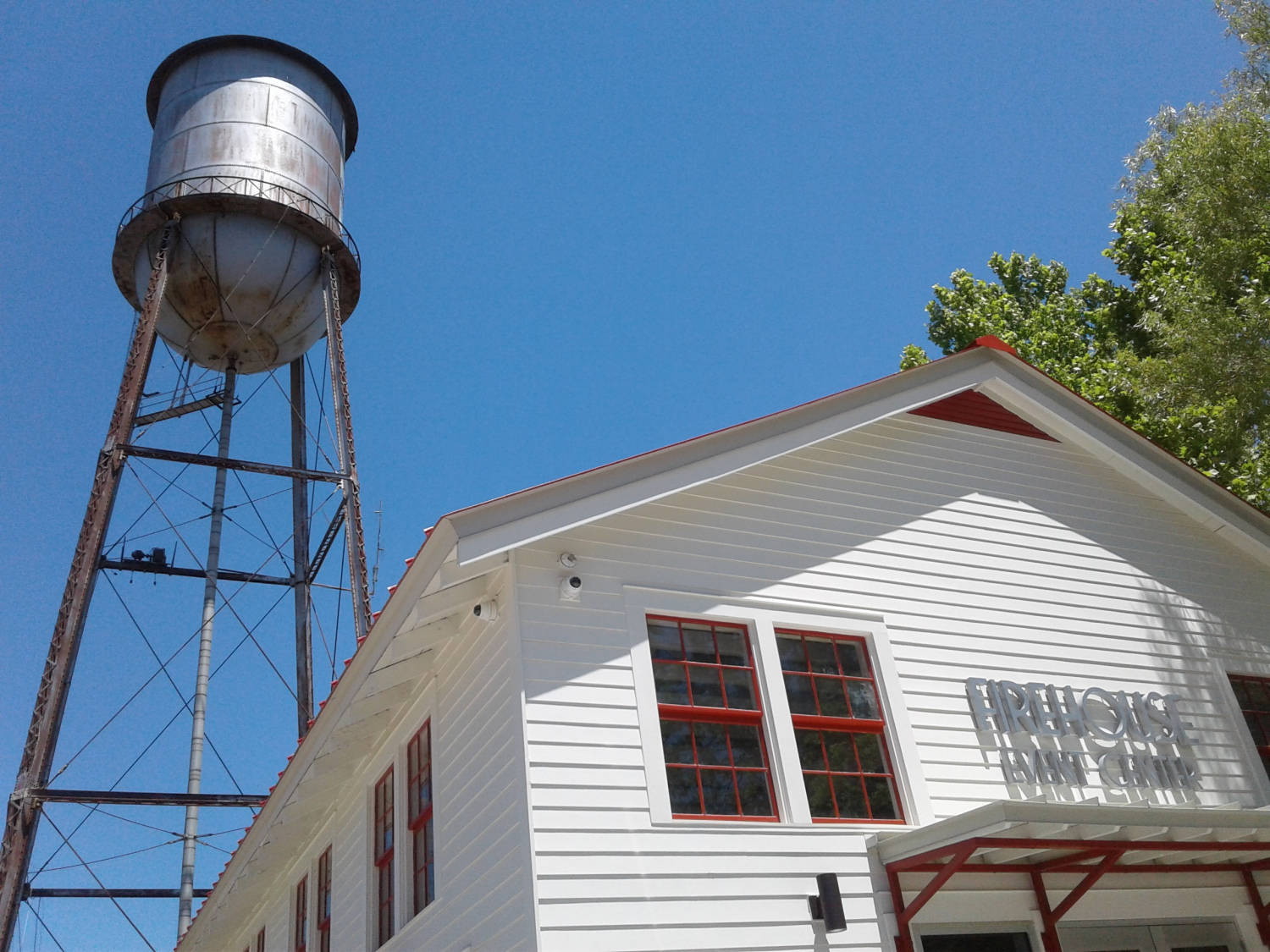
The old Fire House No. 1 on Theard St. in Covington has been thoroughly rebuilt and is now a meeting and event center for the city.
The previous structure served as the fire station for many years. The building has many memories of the
people who lived there and worked there, meetings among firefighters,
and the upkeep of the fire engines that were housed in the structure.
The old fire house
The old fire house and water tower
The new Fire House and Events Center and water tower
Louis Ross Jr. talked with some of the old firefighters who remembered the original
building, and they wished they could have gotten a
memento or souvenir of the old structure, a shingle or something to help remember
it by. It had been used for decades by the volunteer firefighters. Here are a few pictures of the new fire station event center at the Theard location.
Here's a picture of the old fire station structure. Picture taken by Doug Harrison
The southside second floor landing on the old building
Google Street View caught several good photos of the project
Twenty seven years ago, in the early 1990's, a group of St. Tammany parents became concerned about how pesticides were being sprayed in municipal and school playgrounds. News had come from other parts of the state where workers had accidentally exposed students to pesticides during routine sprayings, and pesticide application incidents with local playgrounds were also being questioned.
The parents did research, brought in experts, and drafted a plan to implement less toxic methods of pest control for use by public agencies. Several of those parents were from the Mandeville area.
Parents Speak It was a classic example of grass-roots efforts to solve a problem that not many people realized was a problem. It was such a powerful story, that in 1996 I produced a two-hour video documentary on how those parental concerns rallied the political forces on the local, parish and state levels to make things better. The documentary began with three questions: (1) Do pesticides pose a danger to childrens' health and development? (2) Can pesticides interfere with childrens' ability to learn? and (3) Is there an alternative to chemical pest control?
Pilot Project
The effort resulted in a "pilot project" at two schools in the school system using less toxic pest control methods. It was such a success that it was then adopted parishwide, and that quickly led to statewide legislation to expand the safer pest control practices to schools throughout Louisiana.
The parents advocated for a relatively new system called 'Integrated Pest Management,' a method of pest control that had proven effective in other parts of the country. The question was "would it work in the Louisiana climate with Louisiana pests?"
How It Progressed
One of the first public meetings on the question involved an informational presentation at Mandeville High School. I video-taped several speakers on the subject. One of those speakers was Wayne Bruno of the Society for Environmental Education. Click on the play triangle on the video below to hear his introductory comments.
Wayne Bruno video
Parents also brought in consultant Dr. Marion Moses, president and Founder of the Pesticide Education Center (San DIego, CA) . She helped them understand the threats posed by indiscriminate pesticide use. I went to Metairie to video-tape her presentation, and it was worth the time and effort.
Dr. Marion Moses defines a pesticide and its impacts
Several experts recommended that local residents consider trying "Integrated Pest Management." It was viewed as a viable alternative because of its three simple steps: (1) physical barriers would be installed to keep pests from entering buildings in the first place, (2) cleaning up and maintaining interior spaces would reduce the likelihood of pests being provided habitat, and (3) the use of sticky traps and other non-chemical devices to capture and remove pests.
The
school board agreed to try the IPM method in a test project at two of
the schools. In this video segment Dr. Ellen Winchell of Mandeville tells about the "pilot project" in public schools.
Ellen Winchell Interview
(Video by Ron Barthet 1996)
In gathering information for the video documentary about the effort, I interviewed several parents, the executive director of a state environmental protection group, Mandeville Elementary school principal Laura Allums, School Board member Patti Young, Assistant Superintendent Richard Tanner and Supervisor of Administration Simmie Fairley, who was the person charged with implementing the new program in the schools.
Although there was some initial skepticism about the program, school officials found a pest control contractor interested in the IPM method who agreed to take part in the pilot project.
Here is what Tom Smotherman of Smotherman Pest Exterminating Service, Slidell, said about the new system. Click on the "play triangle" to view the video.
Tom Smotherman talks about the pilot program
(Taped in 1996)
It was found that the alternative method was not only effective in reducing pests, but it would even cost less than applying chemical pesticides. Even though some chemicals were still judiciously used when needed, overall the IPM techniques proved themselves up to the task, even in Louisiana.
State Representative Eddie Deano was so encouraged by the local results, he introduced a bill in the state house to expand the IPM method statewide.
Eddie Deano Interview
Taped in his Mandeville law office
The results of implementing IPM in St. Tammany Parish (over the course of three years) was an outstanding example of parents and school officials working together to protect children and students from toxic exposure to pesticides. As the program was extended in all parish schools, the overall results were encouraging.
The Results
With its successful first implementation of IPM in Louisiana schools, the St. Tammany Parish Public School System became a source of information about the program, and school systems around the state called local officials to see how they could implement the new pest control methods in their own facilities. The fact that it could cost less to use than the regular chemical pesticide methods was an added incentive.
The Schools Adopt The Program
Linda Roan of the school system public information office helped sum up the impact of IPM in St. Tammany Parish.
Linda Roan recaps IPM Implementation
(Interview taped by Ron Barthet in 1996)
Overall, switching to the new procedure was a success story that proved the effectiveness of parents working with politicians working with school system employees to do what was best for the students.
The two-hour video documentary about the process was put together with the help of Lynn and Randy Perkins of Perkins Productions, whom I thank for the use of their editing equipment and expertise.