Though a relatively new St. Tammany town, its history is unique. It began as an end-of-the-line railroad town, where timber and lumber were the chief resource and product. As it grew, bricks and tung oil were added to its exports.

Aerial Photo of Folsom - 1975, by Ron Barthet
Click on images to make them larger.
Click on images to make them larger.
I visited the town library branch earlier this week, and they were very gracious in sharing their scrapbooks full of information about the community, the issue files of its two newspapers, the numerous clippings from Covington newspapers over the years, and most of all, its comprehensive body of documents gathered during the village's Centennial Celebration 15 years ago in 2004.
The library offered so much information, in fact, that I would suggest that anyone interested in the history of Folsom should just clear their schedule for a few hours and go there to peruse the scrapbooks, picture albums, and history reports.
They have a copy of the special section put out by the St. Tammany Farmer back in 2004 to help mark the 100 years anniversary of the town, as well as collections of the ongoing weekly columns by local writers chronicling the hopes and dreams, trials and tribulations, and family connections of prominent citizens from all walks of life.
Folsom has had its share of famous folks and local politicians, artists, librarians, and others. There was even a book written about the town to commemorate the Centennial, and a pictorial map of the village that I drew up to suggest what the town looked like 100 years before.

The hard cover history book written by Davice Bice (2004). The Village of Folsom, Louisiana: A Centennial Celebration.Heritage Publishing Consultants, Inc, Clanton, AL

The pictorial map of Folsom as it was in 1903
An extensive history of the Village of Folsom was compiled for the community's "Comprehensive Master Plan: Vision 2030" published in 2010 by Villavaso & Associates, LLC
Here is the text of that document's history section:
Incorporation of Folsom
By 1880, the area that is now the Village of Folsom was occupied by several families. As recorded in the 1880 United State Census, adults in Folsom were listed either as farmers or a housewives. At the time St. Tammany continued to be mostly virgin forestland and land used for cultivating crops. The parish was traversed by trading routes, including Holmesville Road, which were dirt roads that were maintained by the St. Tammany Police Jury.
Police Juries were the form of local government at the time and semi-annual meetings were held in January and July. Often, the Jury would wait 3-4 days before a quorum was present to begin the meetings, and meetings would last up to six days.
Here is the text of that document's history section:
Incorporation of Folsom
By 1880, the area that is now the Village of Folsom was occupied by several families. As recorded in the 1880 United State Census, adults in Folsom were listed either as farmers or a housewives. At the time St. Tammany continued to be mostly virgin forestland and land used for cultivating crops. The parish was traversed by trading routes, including Holmesville Road, which were dirt roads that were maintained by the St. Tammany Police Jury.
Police Juries were the form of local government at the time and semi-annual meetings were held in January and July. Often, the Jury would wait 3-4 days before a quorum was present to begin the meetings, and meetings would last up to six days.
Land in the area was available for homesteading under the Recovery and Reclaims Acts of 1855 and 1857, averaging about $1.25 per acre. Between 1868 and 1886, over 3,200 new acres of land were homesteaded, in 1887 another 2,500 acres of land, and between 1888 and 1897, another 4,000 acres of land was homesteaded in the Folsom area.
Amidst this growth in new landowners, Native American tribes still lived and traded. It was in 1904, when George M. Fendlason and his brother Hines Norman filed for a plat of survey, that Folsom became a village, which became known for its towering pines and its rolling hills. Folsom earned its name from President Grover Cleveland’s wife, Frances Folsom Cleveland, an icon for working women at the time.
Amidst this growth in new landowners, Native American tribes still lived and traded. It was in 1904, when George M. Fendlason and his brother Hines Norman filed for a plat of survey, that Folsom became a village, which became known for its towering pines and its rolling hills. Folsom earned its name from President Grover Cleveland’s wife, Frances Folsom Cleveland, an icon for working women at the time.

One of the first lots was sold in Folsom in November 1904. In 1881, work began on the Northshore’s railroad. Completed in 1887, this railroad connected New Orleans to St. Tammany Parish, including Slidell, Lacombe, Mandeville, and Abita Springs. By 1888, Covington was connected and by 1905, the East Louisiana Railroad had laid tracks down and built a depot on what is now Railroad Avenue in Folsom.

During this time, the principle crops of the area were cane, cotton, rice, and corn, but through the railroad and with the abundance of local pine, Folsom was also known as a logging community.

In 1885, eggs cost 20 cents a dozen, coffee 20 cents a pound, cheese 10 cents a pound, and haircuts 20 cents.
By 1908, as reported by the St. Tammany Farmer, the Village had grown to include several prosperous merchants, including a general merchandise store, drug store, a barbershop, a meat market, a brick company, a gin company, and what was said to be one of the best hotels in the area.
By 1908, as reported by the St. Tammany Farmer, the Village had grown to include several prosperous merchants, including a general merchandise store, drug store, a barbershop, a meat market, a brick company, a gin company, and what was said to be one of the best hotels in the area.

In 1915, the Village of Folsom was incorporated, however Folsom did not have enough revenue to operate as an incorporated village between 1928 and 1947.


Folsom was re-incorporated in 1947, and it was then that Folsom’s municipal government was established with William P. Dyess becoming the first mayor and Hayden Lavinghouse the first policeman.
The Louisiana State Tobacco Tax of 1947 provided the much needed tax revenue for the Village.
By 1938, the New Orleans Great Northern Railroad, successor to the East Louisiana Railroad, had ceased operating the railway through Folsom. Although the right of way had been dedicated to public use in 1904, the rail company sold its land in the right of way.

Between 1938 and 1967, Railroad Avenue was occupied by various single-family homes. It was not until 1964, when the Village filed a lawsuit to determine rightful ownership of this right of way that Railroad Avenue returned to the Village. It is now home to the police station and library.

In 1950, St. Tammany Parish had a total population of 26,988.
Click here for Folsom Aerial View - 1954
Regional Growth and Folsom, 1950s –2000
It was in the 1960's that St. Tammany Parish began to see moderate growth from NewOrleans residents moving to the Northshore. Until that time, the parish had been largely sheltered from rapid growth, allowing its municipalities the ability to maintain their ways of life and regional cultures well into the 20th century. Growth in the western and northern areas of the parish in the 1960s, including in Folsom, was less dominated by commuters from the Southshore.

In the 1970s, growth on the Northshore really took hold. Despite this growth in the southern and eastern areas, Folsom has remained a quaint and small town. Folsom established its first Zoning Commission in the mid-1970s. The commission, whose purpose it was to protect property values, created a 300-foot commercial zone along both sides of Highways 25 and 40.
History of the Local Economy
Climate and soil have always been the backbone of Folsom’s economy and it is from these local virtues that the people of Folsom have found established their high quality of life and small town atmosphere. The land in Folsom was first farmed.
With the arrival of railroad, lumber, tar, and turpentine became the locally exported products. This was then replaced by tung nut farming and finally, the growth of the local plant nurseries. Horse farms compliment the nursery economy in Folsom and these two industries are what Folsom is known for today.
The virgin forests surrounding Folsom originally initiated interest in the timber industry in the early 20th century. In 1902, the Greenlaw Lumber Company, Ltd. was established in Covington and operated as a mill, manufacturer, and distributer of lumber, with business connections to operating mercantile and shipping businesses. Other local lumber mills, turpentine, and tar companies included Jones and Picket, Ltd. (est. 1903), Frederick and Joseph Salmen’s lumber company, Holliday and Ray, Covington Naval Stores Company, the Frederick and Singletary Company, and Great Southern Lumber.
The virgin forests surrounding Folsom originally initiated interest in the timber industry in the early 20th century. In 1902, the Greenlaw Lumber Company, Ltd. was established in Covington and operated as a mill, manufacturer, and distributer of lumber, with business connections to operating mercantile and shipping businesses. Other local lumber mills, turpentine, and tar companies included Jones and Picket, Ltd. (est. 1903), Frederick and Joseph Salmen’s lumber company, Holliday and Ray, Covington Naval Stores Company, the Frederick and Singletary Company, and Great Southern Lumber.

Koepp Lumber Mill
In the early 1900s, many of the local residents were subsistence farmers, growing what they needed to clothe and feed themselves, including crops such as cotton, corn, cane, strawberries, grapes, and tomatoes. Local families helped each other in their fields picking cotton and strawberries and cane was processed into syrup.
Turpentine, made from the sap of the pine trees that were so abundant in the area, also created the need for local turpentine mills to be developed, with this industry dying down in the 1930s.
In the 1940s, the pine tree limbs left by lumber companies were gathered and used to make tar in the local tar kilns. Some sought work in other nearby towns and in the City of New Orleans. Domestic work and sewing jobs were often held by women to supplement the family income. Land cleared for lumber around Folsom provided grazing land for cattle and sheep.
A short, but important industry in the history of Folsom was the tung oil industry, a key ingredient in lacquer, paints, and varnishes. This industry came to Folsom via the US government in anticipation of WWII, because the oil was used in the paints used on naval ships. In the local climate, the nuts thrived and tung oil became a short, but major business between 1945 and 1965. Tung farms in Folsom spurred the development of processing plants in nearby towns, including Bogalusa and Franklinton.
Although relatively short lived, this industry was important enough for Folsom’s economy that it inspired a Tung Oil Festival and Beatrice “Sally” Core was the first Tung Oil Queen. Winter freezes from 1955 to 1959, lower cost imports from Argentina, and the development of acrylics delivered a blow to this economy in Folsom. One of the largest tung oil land holders, Louis Chenel of Normandy Farms, converted his 1,000 acres to housing development, foreshadowing the influx of retirees to the area.
Landscape Nurseries
In the 1940s, the pine tree limbs left by lumber companies were gathered and used to make tar in the local tar kilns. Some sought work in other nearby towns and in the City of New Orleans. Domestic work and sewing jobs were often held by women to supplement the family income. Land cleared for lumber around Folsom provided grazing land for cattle and sheep.
A short, but important industry in the history of Folsom was the tung oil industry, a key ingredient in lacquer, paints, and varnishes. This industry came to Folsom via the US government in anticipation of WWII, because the oil was used in the paints used on naval ships. In the local climate, the nuts thrived and tung oil became a short, but major business between 1945 and 1965. Tung farms in Folsom spurred the development of processing plants in nearby towns, including Bogalusa and Franklinton.
Although relatively short lived, this industry was important enough for Folsom’s economy that it inspired a Tung Oil Festival and Beatrice “Sally” Core was the first Tung Oil Queen. Winter freezes from 1955 to 1959, lower cost imports from Argentina, and the development of acrylics delivered a blow to this economy in Folsom. One of the largest tung oil land holders, Louis Chenel of Normandy Farms, converted his 1,000 acres to housing development, foreshadowing the influx of retirees to the area.
Landscape Nurseries

Folsom Area Nurseries in 1975
(Photo by Ron Barthet)
Throughout this varied economic history tied to the land, there have always been nursery businesses in Folsom. Magee’s Folsom Nursery, Evergreen Nursery, Midway Nursery, Mizell Nursery, and Holly Point Nursery, all owned by brothers Dallas and Price Magee and various family members, were the first nurseries in Folsom.
The heritage of nurseries has been passed down since. Jim’s Nursery, Hillside Nursery, Yates Nursery, Brumfield Nursery, Burris Nursery, McKee’s Nursery, and Green Thumb Nursery are just some of the nurseries that have contributed to the heritage.
In 1974 a group of nursery owners from New Zealand heard about Folsom's success and came half way around the world to tour the area's most notable nursery landscape providers.


“The industry had two major advantages in the Folsom area" according to Clarence Mizell. "Soil and faithful workers made the business successful.”
Local resident and owner of Savannah Spring Nursery in the 1980s, Robert “Buddy” Lee developed the “Encore Azalea” which is sold worldwide. Folsom’s nurseries have had an impact nationwide. Floyd Magee, the son of Dallas Magee, first sold nursery products by mail order and provided Montgomery Ward with all of its catalogue sales. The “Weeping Yupon” tree was also developed in Folsom.
Young Thoroughbreds
In addition, thoroughbred racehorses and equestrian activities play another critical role in Folsom’s economy. According to local resident Jimmy Erwin, good local drainage, north of Bennett Bridge Road, provides solid footing for training horses.
It was Jimmy Erwin’s father Andrew “Red” Erwin, the first president of the Louisiana Thoroughbred Association, who was instrumental in bringing the horse business to Folsom by developing the first horse farm on land defunct from the tung oil industry.

The Broken R Ranch
(Photo by Ron Barthet)
(Photo by Ron Barthet)
In 1958, he opened Broken R Ranch. Erwin, with State Senator B.B. “Sixty” Rayburn was influential in getting the Louisiana Legislature to create incentives through the Louisiana agricultural program for breeding thoroughbreds in Louisiana. Races at the New Orleans Fairgrounds and at Louisiana Downs in Lafayette have supplemental purses for Louisiana bred horses and each racetrack must have three Louisiana bred horse races each day.
Local horse farms have contributed greatly to Folsom’s economy, employing local residents and becoming known for their fine training. A stable fire in 1966 caused the Broken R. Ranch to rebuild and upgrade their stables to ones with open sides to allow breezes in to lessen the summer heat.
Local horse farms have contributed greatly to Folsom’s economy, employing local residents and becoming known for their fine training. A stable fire in 1966 caused the Broken R. Ranch to rebuild and upgrade their stables to ones with open sides to allow breezes in to lessen the summer heat.
Other ideas brought to Folsom and cultivated as part of the local horse culture included rehabilitation pools and horse training centers where horses could be housed over longer periods of time and thus be able to get used to other horses and the track on which they trained.

Each owner who bought shares in the training center was allowed to build their own twenty-stall barn and local trainers and jockeys are readily available. The largest horse training facility in Folsom and the largest full service thoroughbred farm in Louisiana is the 300-acre Clear Creek Stud Farm. Owner of the farm Val Murrell’s granddaughter expressed that life on the farm was “like a picture postcard and I’m in it.”
Clear Creek also serves as a rehabilitation center for injured thoroughbreds, with numerous full and part time employees taking care of injured horses. As with the nurseries influence and exportation across the United States, Folsom’s horse industry play an important role nationwide in thoroughbred culture.
In addition to the thoroughbred culture, Folsom is known for its equestrian industry, with show horses and jumpers raised locally.

The New Orleans Polo Club is active in the area. Click here for a link to its website.
Folsom Today
Folsom today is dotted with small businesses along Hwy 25. J.C. Pittman’s store and gas station is no longer there, but Gus’ Restaurant and a New Orleans style bakery have become local staples.
Most residents in Folsom have long family roots here. Today, continuing in its tradition of valuing open space and a connection to the land, Folsom is known for its thriving plant nurseries and beautiful horse farms.
The countryside outside of Folsom is home to exotic animal farms, including emu and ostrich, and reserves, including the Global Wildlife Center in Tangipahoa Parish, which sits on land once used by the lumber industry. The Global Wildlife Center is a major educational facility and critical in the preservation of various species.
The countryside outside of Folsom is home to exotic animal farms, including emu and ostrich, and reserves, including the Global Wildlife Center in Tangipahoa Parish, which sits on land once used by the lumber industry. The Global Wildlife Center is a major educational facility and critical in the preservation of various species.
This was the end of the Comprehensive Plan: Vision 2030 history narrative.
-----------------------------------------------------
In an April, 1986, history class report entitled "The Founding Fathers of Folsom," Pat Carr wrote that while the Folsom area is "not very densely populated, but is presently showing a great increase." She attributed that growth in population to an increase of influence by New Orleans landowners. At that time, the village had a new "supermarket" and even a few subdivisions.
"Hopefully, this will not destroy the friendly country atmosphere that Folsom has always had," she said.
Here is an excerpt from her account:
Norman Feldlason was one of the homesteaders of the area around Folsom. His family was one of many that came to the Florida Parishes in the 19th century from the Carolinas and Georgia. His parents, John Fendlason and Katie McLain, were married in South Carolina in 1830. Five years later, in 1835, they moved west with their children, Daniel, Margaret and John Jr., and with Katie expecting her fourth child, Flora.
On October 15th, 1841, she bore twins, Elizabeth and Norman. In the winter of 1845-46 the Fendlasons moved to Taylor Creek, a tributary of the Tchefuncte River and in present day Tangipahoa Parish above Louisiana Highway 16. The family farmed here that year and in 1847 John got a job working at Harper's Saw Mill.
In 1881 Faye Carr, Norman's great granddaughter, found the old Fendlason cemetery where John and Katie are buried. Located deep in the woods along Taylor Creek, it is small and has only a couple of graves.
Norman married Mary Core on November 15, 1860. She was from the Covington area, and they built a house in Alma a few miles west of what is today Folsom. He was very active in the community. He served in the War of the Confederacy, was a member of the Police Jury, as well as a member of the Parish School Board. From 1894 to 1898 he was Superintendent of Education for St. Tammany Parish.
Norman and Mary had four children. The last two were Hines Norman, born November 12, 1872, and George Martin, born September 1, 1875. George married Nettie Rogers on January 17, 1895, and Hines married Neva Rogers, Nettie's sister, on March 6, 1898.
These two brothers were very influencial in the area. George and Hines did a lot of buying and selling of land and timber rights. They were also involved in many other business ventures, including being partners in a turpentine business in the late 1800's. The Naval stores industry was an important part of the economy of St. Tammany Parish as far back as the 1730's. The abundance of pine trees provided sap needed to make tar, pitch and resin. These products were used on the hulls of wooden ships to keep them from leaking.
End Of The Line Right-of-Way
In 1901 the Fendlason brothers sold all of their interests in their turpentine business to a larger company, Holiday and Ray. The Fendlasons had realized that the Greenlaw Lumber Company was planning a railroad and had bought land where the tracks would terminate. They sold a right-of-way for the railroad to Greenlaw in 1902.
Norman Fendlason in 1902 built a heart of pine home near this right-of-way. It still stands today and is owned by Mr. and Mrs. Cyril Wilde, who planned to completely restore the home.
Seeing that the railroad could unify the community, the Fendlason brothers had an area surveyed for streets and lots and on June 8, 1904, they dedicated the new town of Folsom at the Covington courthouse. Grover Cleveland was President of the Untied States at that time, and George Fendlason admired him greatly. Cleveland had married Francis Folsom, at 21 the youngest first lady in the White House. George is said to have named the town after her.
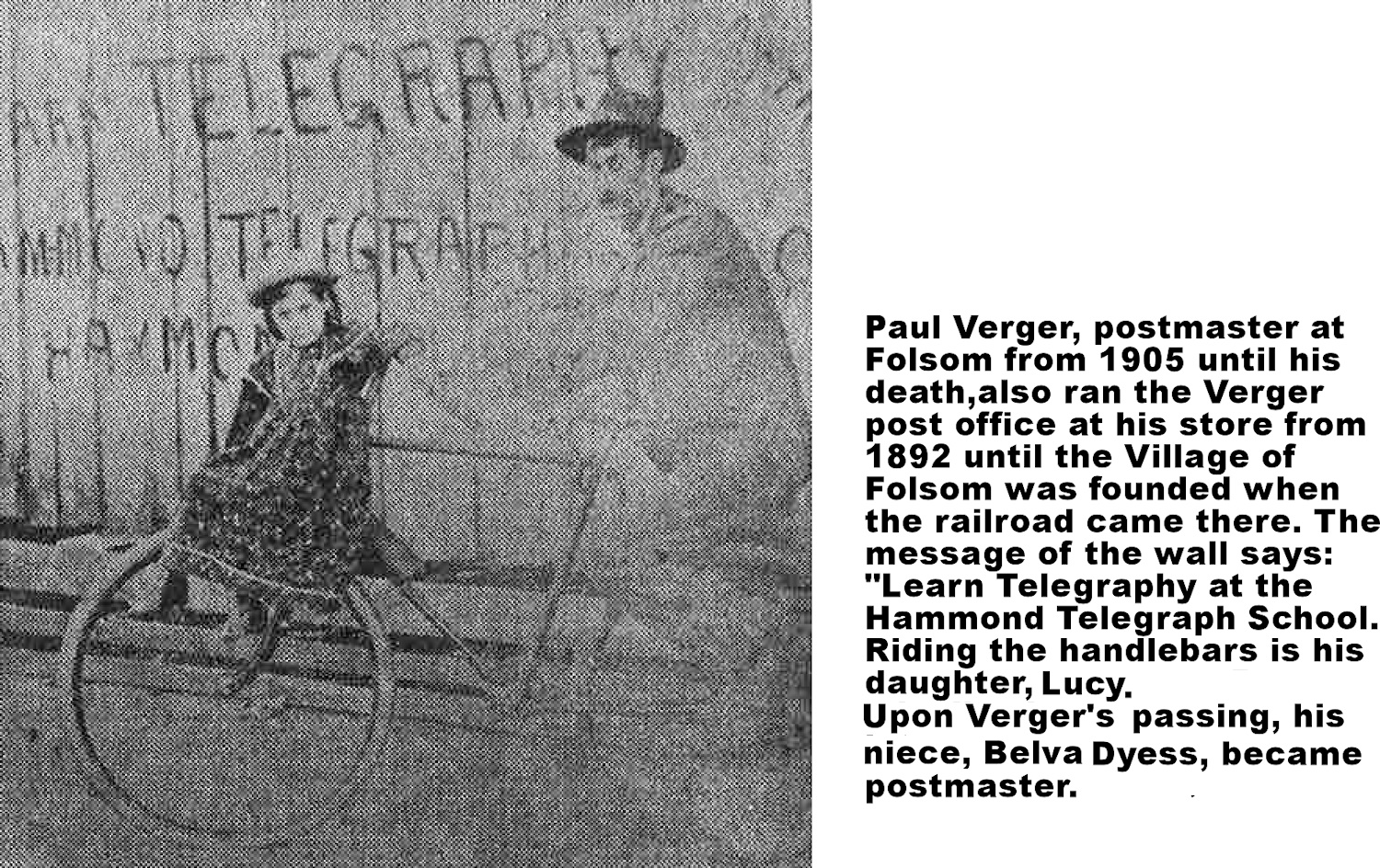
George sold lots in the town and the population grew very rapidly. Paul Verger had established a Post Office in 1892 at the 11 mile house. When the railroad came through it was combined with the Alma Post Office. Mr. Verger went in a partnership with the Fendlason brothers. George ran the general store and Paul ran the Post Office out of the same building.
Fendlason and Verger became the largest mercantile business in Folsom, selling dry goods, groceries, hardware, all kinds of furniture, saddlery, farming and hunting supplies and many other necessities. There were several other businesses including a drug store, a barber shop and other retail stores. George built a hotel and livery stable and was mayor of the town for a long time.


With access to the railroad the new lumber companies opened up. Folsom Export Lumber Company, Inc. specialized in exporting high quality lumber to the German and British markets overseas. Other new industries were the brick and cotton market of New Orleans. The Fendlason and Son Brick Company and the Folsom Gin Company were shipping out bricks and cotton to New Orleans in 1908.
This was a form of reciprocal trade comparable to other big cities and rural areas. St. Tammany supplied food and raw materials, and New Orleans industries built furniture and fashioned clothing, some of which was shipped back to the north shore.
The deep pine forests were finally cleared to a point where the lumber companies began to fail, and the spur to Folsom was eventually abandoned and the tracks taken up. Tung nut trees we grown on the cleared areas for the oil but did not last after the petroleum industry got going. Today Folsom is the center of a growing plant nursery industry.
The Fendlason family believed in hard work and totally abstaining from all intoxicants. There are no Fendlasons left in Folsom but old folks in the town still remember them. Norman Fendlason died October 8, 1937, at the age of 95 years, outliving his wife and all of his children. George had gone to work for the state Highway Commission in Amite and died September 27, 1934. Hines died January 19, 1930. They are buried in the Fendlason Cemetery at Alma, a few miles west of Folsom.
All of the other descendants no matter where they are, hold a special place in their heart for Folsom. I know because I am one of them. Hines Norman Fendlason was my mother's grandfather.
And thus ended Pat Carr's 1986 history report on the Founding Fathers of Folsom.

Folsom's Original Library Building

A Plaque Honoring the Founder of the Folsom Branch Library
Ella Odetha Pittman
"Aunt Decie"

The library branch today
See also:
Parish Library's History of Folsom
A map of Folsom in the 1920's
Village of Folsom Master Plan, 2010
Village of Folsom Website, About Us
Folsom Oath of Office
Folsom School Photos
Folsom Village Officials Group Portraits
Other Folsom Pictorial Maps

Folsom in 1987

Folsom in 1995

Folsom Map in 2022
The History of St. John The Baptist Catholic Church