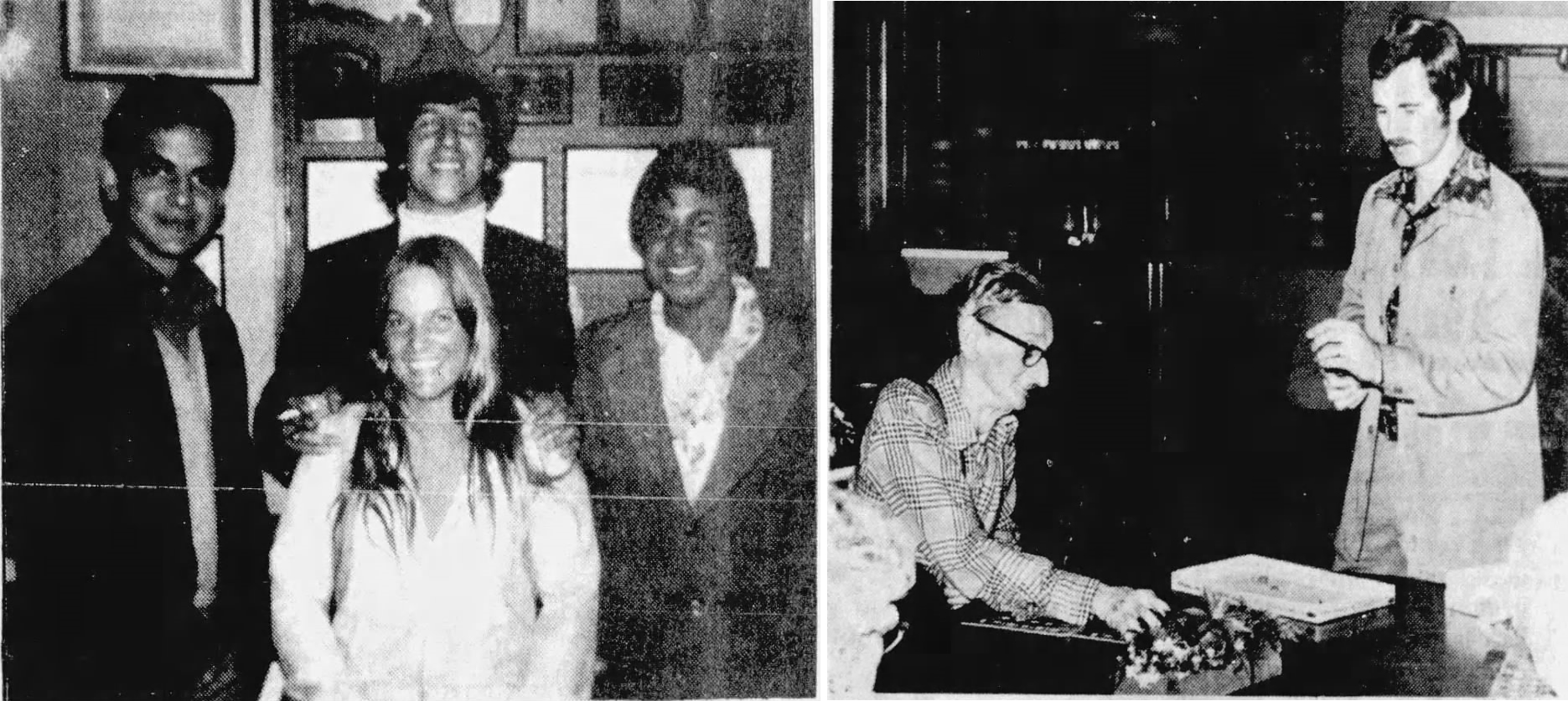
In the 1970's one of the key civic organizations in western St. Tammany Parish was the Jaycees. Both Mandeville and Covington had Jaycee chapters, and in January of 1976, the St. Tammany News Banner ran a full page of pictures and information about the groups. Click on the images to make them larger.
Thursday, August 25, 2022
Wednesday, August 24, 2022
Southern Hotel in 1972
The Southern Hotel in Covington operated for many years before it was designated in 1962 as a "motel" in an effort to keep up with the times.
But even that came to an end in 1972, when it was announced in an article in the St. Tammany Farmer newspaper that...The closing of the "motel" part of the Southern Building brought back a flood of memories for many townspeople, and the following week, the paper's editor Bob Landry wrote a lengthy history of the Southern Hotel and what it had meant to Covington over the decades. Its lively commercial retail rental spaces on the first floor were of particular interest.
Here is his feature story, published on February 3, 1972.
Here is the text from the above article:
Memories of the Past Are Linked With Covington's Southern Hotel
By Bob Landry
Old-timers with a love for atmosphere and tradition lament that a part of Covington is passing into limbo with the closing of the old Southern Hotel Feb. 1. Originally a hotel in the finest sense of the word, later modernized into a motel, it lost its distinctive exterior and interior appearances over a decade ago through changes designed to incorporate waste space into use.
A veranda which ran the length of the hotel facing Boston street was a place to watch the world go past, or at least, our small part of the world. Inside the. entrance doors was the massive, comfortable lobby, its floor of Spanish tile and its back wall highlighted by a huge stone fireplace, which in wintertime reflected a cheery glow from crackling logs.
In the center of the lobby, a tinkling fountain sprayed water into a pond beneath, where goldfish lived and played. Stepping through glassed French doors, guests found themselves in a tropical patio, where banana trees rustled their giant leaves, oleanders nodded their blooms, azaleas burst into bloom and camellias peeped from thick bushes.
Other tropical plants and evergreens decorated the patio and crowded St. Tammany of 1972 was far away. Built in traditional Spanish styling, popular in New Orleans in or around 1900 when the hotel was erected, it boasted a large dining room which was once visited by Duncan Hines, who recommended both the hostelry and the food.
Spanish architecture here, however, was not commonplace, and the Southern Hotel was unique.
A firm remembered as the Jenkins Brothers were contractors who built the hotel, which covers a quarter of a city square on Boston and New Hampshire streets. In remodeling, the cornerstone evidently was lost or covered, so the exact date of construction is not known. When the hotel opened, the first guests came by train from New Orleans, and a bang-up dedication followed.
There was a big dance, with gourmet food served by the hotel chef who had come from Europe to take charge of Southern's culinary delights. Summertime, as has always been the case in St. Tammany parish, was the hotel's busiest season. Some visitors came by train, others by boat. Two ferries plied Lake Pontchartrain at the time, the SS Susquehanna and the SS Madisonville. The ferries landed at Mandeville, and usually horse-drawn carriages provided transportation from there.
Popular in Covington at the time were the white sand beaches on Bogue Falaya River and the clean, cool, clear water in which to swim. Long-remembered river resort spots such as Sulphur Springs, Charropin Beach, and Bogue Falaya Park furnished picnicking spots for visitors. Many families in those days registered at Southern Motel for the entire summer.
The hotel was originally owned by the late C. E. Schonberg, who was also president of Commercial Bank & Trust Co., with offices in the hotel building. The hotel was purchased in 1948 by Bryan D. Burns and Philip Burns and was immediately renovated.
Owners and managers of some of the better and larger hotels in New Orleans came here to admire the "new" Southern, remaining awhile as guests.
The building at present is owned by Mrs. Bryan D. Burns and five children. Ten years ago, the hotel was again remodeled, and the colorful front porch was removed. Its space was incorporated into stores, offices, a restaurant and bar, fronting on the sidewalk.
At one time, there were several offices upstairs. The late Dr. H. E. Gautreaux was located there, as was the late Monroe Simmons, prominent Covington attorney. St. Tammany Insurance Agency, once had upstairs offices before moving downstairs. The agency has been in the hotel 40 years.
The front gallery, or veranda, or porch, is most remembered by old-timers, who tilted in oversized rocking chairs to relax, smoke a cigar, discuss politics just off courthouse square, or complete business deals. They say the veranda was a meeting place for people wishing to discuss business in a pleasant atmosphere.
Dances at old Southern Hotel were social events to remember--the mellow music of the bands, moonlight over the patio, and pretty girls in long evening gowns. But, like many other things, these too passed on.
There have been many famous guests at Southern Motel, but none attracted more attention than the late Gov. Earl K. Long, who had been committed to the hospital at Mandeville and was to undergo a court hearing in order to gain his release.
There are many people who recall something special about old Southern Hotel and The Farmer would appreciate hearing from these. Perhaps the correct date of its construction or interesting tales of the past.
But there's a brighter side to this picture. Though the building will not be used as a hotel, it will continue to rent its commercial space, and there are plans to utilize the upstairs portion, which has about 40 rooms, 32 of them in use by the motel at present.
St. Tammany Farmer, Covington, Louisiana, Thursday, February 3, 1972.
Tuesday, August 23, 2022
Elementary Cookbook
Nothing says kids in the kitchen like this article from 1975, some 47 years ago. Click on the image to make it larger and more readable.
Text from the above article:
by Ron Barthet
If elementary school students were asked to write a cookbook, what kind of gastronomical goodies and nutritional nightmares would they come up with? The answer to that question was supplied by students of Mrs. Melanie Edwards class at Mandeville Elementary School. Together they compiled a cookbook for parents as part of their holiday activities.
The following are excerpts from that cookbook.
Dondra Bettencourtt explained how to prepare macaroni: cook one pack a little while and put one pound of cheese in. And there it is.
John Cousin offered his recipe for rice and gravy: put everything that's good in a pot, and cook it three hours. Then you eat it all.
For Cream of Wheat, Amy Norton said to get a pot with a circle on the handle, then you put in four cups of Cream of Wheat and let it cook for 60 minutes.
This recipe for hamburgers came from Douglas McIntosh: the bun was freezed, so you put it in the oven. Cook any kind of meat (four pounds for one family) in the oven, and then you put on ketchup and mayonnaise. Yum, yum! That's all.
Hunter White gave this recipe for lemon pie: you have to get a pan and then you get four lemons and 25 spoonsful of milk and three cupsful of flour. And then you cook it ten hours.
Danielle Geoffrion gave these directions for meat loaf : you get a whole thing of peppers, one onion, three pounds of lamb meat, and one drop of ketchup. Cook it for ten hours.
Donna Stumpf offered this salty recipe cheeseburgers: mix ten pounds meat and five pounds of cheese. Cook on stove for ten minutes and put on one gallon of salt.
And this economical recipe for ravioli came from Laura Kimball: put five pounds of water in a pot. Stir it till its good and hot.
This personal recipe for red beans and rice was suggested by Sabrina Foret : put rice and about 40 beans in a bowl and cook it for one minute. Put seven pounds of salt and put it on the table. I don't like this anymore.
Sharyn Cost offered this recipe for potatoes: get four potatoes and put six salts on them. Put 'em in a pot on the stove and put in eight peppers. I'm gonna cook 'em nine minutes then put one cup of flour. Put one cherry on top.
This string bean recipe came from Lori Beaujeaux: put six beans into a pot with fire. Take 'em out and stack 'em in a plate and put in seven cups of salt.
This interesting recipe for meatballs and spaghetti came from Kenny Foil: you put two gallons of gravy and 12 pieces of ham and four potato chips in a pot and cook it all day. Then you eat it.
Heavy on the mayo was this recipe for hamburgers from James Earl Sandifer : pat 'em down and fry 'em. Take 'em out of the skillet and put 'em in two slices of bread with two cups mayonnaise.
One of the longest dishes to prepare came from Andy Simpson for gingerbread cookies: you just get dough and you flat it and push the gingerbread maker on it. Just cook it maybe 13 hours.
This recipe for candy apples came complete with a dental warning from Louis Martin: you get five caramels and take an apple and put the caramel in the pan and melt it it the oven and make it all gushy. Put a popsicle stick in the apple and put it in the caramel. Then put it in the freezer for five minutes. I bit this apple and knocked my loost tooth out.
One of the fastest recipes was for scrambled eggs by Stacy Smith: put one pound of butter in them and eat them.
The trick is in the pouring for this recipe for Spaghetti-o's by Vaughn Sollberger: you have to open the can, then you pour it in very gently. Then you turn the oven on, and it cooks about a whole hour. Take the pot and get a bowl and pour about 20 spoonsful in.
Fried chicken fans can try this recipe from Michael LaCour : put two spoons flour and one spoon salt in and put it in the oven for six hours. Then you take it out, I think.
For those who like pig, this recipe from Ronnie Palmer should be of interest: put plenty water in the pot and cook it. Put two peppers and one pail of salt.
And finally comes this. recipe for grilled cheese from Mark Sieverding: Put one scoop of butter in a pan, NO mayonnaise. Put butter in the sandwich and then as much cheese as covers the butter.
Cook it until it doesn't burn. I don't like it burnt.
Alas, students, who does like it burnt? Just make it heavy on the salt, cook it for ten hours or so, and we may all be eating out this holiday season.
Monday, August 22, 2022
The Battle of Lake Pontchartrain - Amplified
An extensively detailed account of the Revolutionary War naval battle fought in Lake Pontchartrain in 1779 was provided by William E. Sorensen in the February 10, 1972, issue of the St. Tammany Farmer newspaper. It gives a colorful and lively description of the events of the encounter.
Here is the text of the article which described the battle between British and American vessels that in many ways decided the fate of those living on the northshore.
Pioneer settlers and red skinned natives of the area north of Lake Pontchartrain were on Sept. 12, 1779, startled by thunderous booms reverberating through forests, hills and vales. Grouping at the lake shore those people were gazing amazedly at the spectacle of two warships bombarding each other.
Clouds of acrid powder smoke drifting shoreward nearly concealed the combatants, but one of them was recognized as the rapacious English frigate, "West Florida." Her adversary's flag was unknown, but regardless of the stranger's nationality, spectators were hoping she would lambast the Britisher.
The conflict was sparked by the holocaust then roaring towards its climax a 1,000-odd miles away, where the 13 revolting colonies were struggling for independence.
Many of the area's settlers had in past times left the turbulent colonies to avoid hostilities looming on the horizon. Preferring to remain in English territory, they had settled in the western terminus of the then British province of Florida.
After the long smoldering contention set the colonies aflame, some of those settlers' farmsteads were at times pounced upon by armed boats, confiscating livestock and food crops for British garrisons on the Gulf Coast. Enraged farmers damned the lying marauders, who swore that King George would soon pay them.
The obstreperous colonies were eventually assisted by France, and as the fracas intensified misdoings on the Florida settlers' lakes gradually assumed piratical proportions.
Small vessels carrying supplies to and from New Orleans and other points were seized and robbed of their cargoes by the baneful frigate, "West Florida." Having in vain asked English officials to stop such outrages, victimized shippers requested the Spanish Governor Galvez at New Orleans to police the lakes.
For, after all, the southern halves of Lakes Maurepas and Pontchartrain and the regions south of these were parts of the then Spanish Louisiana Territory governed by Galvez. Though lacking a naval craft capable of dealing with the heavily armed frigate, the governor promised to "slay the lake dragon."
Governor Galvez was in June, 1779, informed that Spain had joined the colonies and France in their brawl with Britain. Then, with mostly volunteer soldiers, he took several English strongholds on the Mississippi, including a sloop-of-war which was brought to New Orleans.
The governor turned the sloop over to a spunky American privateer captain named Wm. Pickles, who was chafing in the city while his ship was in dry dock. Having named the sloop "Morris," Pickles engaged battle-seasoned dare-devils and announced that he intended to lay the Pontchartrain pirate by the heels.
Observers termed this venture foolhardy. The sloop was half the size of the frigate. The latter's cannons could hurl nine pound balls. The sloop had only three pounders, hence the contest might be comparable to a terrier versus a mastiff.
Of light draft, the "Morris" went skipping over shoals and shell reefs in Pontchartrain while hunting for the English man-of-war. Visibility was hampered by drifting patches of mist. Suddenly, by rounding a cape at the north coast (Goose Point?) the "West Florida" was sighted, examining a schooner's cargo.
Interrupting those proceedings, a cannon on the sloop boomed and a shot splashed up a geyser at the frigate's bow.
A strange ensign soared to the masthead of the sloop as she scudded within hailing distance of the frigate. Magnified by a megaphone the stentorian voice of Capt. Pickles dictated to the English captain: "Get yo' hog through out o' this lake!"
The "West Florida's" captain, Joshua Payne, recognizing the ensign as the American Navy Jack, guffawed. "Poppycock!" he bellowed. "Begone with your toy boat. Give it to your childish-minded Georgie Washington to play with!"
Cannons on the "Morris" roared and shots tore through the frigate's rigging. Capt. Payne spouted curses and frenzied commands of "set sails! Fire at the tub! Squash She insect!"
A freshening breeze billowing all her sails, the sloop skimmed over the waves, hurling bullets onto her English enemy and evading most of the mighty warship's barrages. Determined on taking the frigate but seeing he could not do so by gunnery, Capt. Pickles decided on a different tactic.
The "Morris" veered off, causing Capt. Payne to guffaw again, hollering: "had enough? - you damn American maniac!"
Payne's plunder-laden ship had run afoul of a sand bar and got its prow embedded. Her entire crew was busy warping her clear when the sloop, emerging from a fog bank, crashed against the frigate's side. Pickles and his stalwarts swarmed speedily over the British warship's railing.
Volleying vituperation, a martial horde headed by Capt. Payne rushed upon the invaders. A murderous melee erupted. And presently the frigate's deck assumed the aspect of a shamble.
After Payne's most ferocious fighters had been slain or wounded, the battle waned. When it ceased, Capt. Payne and ten of his companions lay weltering in their blood. The frigate's crew, some of which had kept clear of the carnage, all surrendered.
Now Capt. Pickles learned that his ensign had saved his sloop from severe damage. Most of the frigate's gunners happened to be impressed American seamen who, recognizing and respecting the ensign as their country's Navy flag, botched their shooting.
(Depicting a rattlesnake across thirteen alternate red and white stripes, this emblem was by the Continental Congress of 1775 chosen for its Navy).
Given command of his prize by Gov. Galvez and cruising the lakes to divert intruders, Capt. Pickles, on Sept. 21, 1779, landed by a settlement at the north shore, along which he was hailed as the hero of Lake Pontchartrain.
Having hoisted an impressive looking flag displaying thirteen stars in a circle and thirteen horizontal stripes, a replica of the National Flag adopted June 14, 1777, the plucky captain exhorted the assembly to swear allegiance to the United States of America. He got no argument.
This eccentric coup d'tat was indulgently smiled at by the Spanish officials. After the war, Florida reverted to Spain until purchased by the U. S. in 1819. In 1810, however, people in the segment comprising the present Florida parishes staged an uprising resulting in the area's annexation by the U. S. A."
End of Article
St Tammany Farmer Feb. 10, 1972
See also:
St. Tammany's Part In The Revolutionary War
Sunday, August 21, 2022
Rutland Street Machine Shop
The Rockenschuh machine and blacksmith shop was located on Rutland street in Covington, between Florida Street and Lee Lane. In this photo from left to right are Albert Rochenschuh, the owner, with his children Albert and Henry, Mrs. Jennie Wallace and Mrs. Rockenschuh. The shop was built before 1900 and was believed to have been an icehouse originally.
See also:
Rutland Street Row
Saturday, August 20, 2022
Banana Split Bonanza
It's the fifth year the Legion has hosted the banana split spectacular, and over the years scores of ice cream lovers have turned out for the event to enjoy custom-ordered banana splits with a variety of flavors, syrups, and a cherry on top. Members of the American Legion man the ice cream scoop, and other volunteers do the order-taking, decorating, and serving.
Friday, August 19, 2022
St. Paul's Class of 1926
A photo combining all the student pictures from St. Paul's College Class of 1926 was published in the St. Tammany Farmer newspaper in 1972. Here it is.
Tuesday, August 16, 2022
Rainbow Over Water Tower
This recent photo of a rainbow over the Covington water tower was taken by Lola Restaurant Chef Keith Frentz.
Paul Swain of Covington has also captured a number of rainbows with his cellphone. Here they are.
Saturday, August 13, 2022
SLU's Showcase of Energy-Savings
The Sustainability Science and Technology Center at Southeastern Louisiana University in Hammond not only educates students about new and exciting energy generation techniques, but it also demonstrates energy-saving technologies that result in saving money on monthly electric bills.
It helps the university itself save significant amounts of money on heating and cooling campus facilities. The center’s goal is to educate the campus and local community about promoting sustainability within their day-to-day activities.
A few months ago, I visited the Sustainability Center and met Alejandro Martinez, who serves as the physical plant's Sustainability Manager. He gave me an extensive tour of the facility.
It not only shows students and visitors how the new energy-savings systems work, it also informs them on how they can benefit from it in their own home. The center researches, implements and test various energy-saving systems, and then, if feasible, transitions to those systems at various locations across campus.
Director of the Physical Plant Services Byron Patterson and Manager of Grounds, Landscape and Recycling Carlos Doolittle helped create and promote the university’s Sustainability Center, turning it into an opportunity to educate visitors, businesses, students and others on energy conservation.
Starting with Landscaping
The landscaping plants surrounding the center are not only attractive looking, but many of them are edible. "Everything we do here is organic," said Martinez, mentioning the growing of plants in the community garden, a plot of ground which people from the community come to tend their own planting beds. "We let them use it for several months," he explained. Organic gardening is one of the key tenets of sustainability.
Hurricane Ida hit the Southeastern campus hard last year, causing significant damage to trees and buildings, and the Sustainability Center also took a hit. The lack of electricity to the hot houses was a major blow to the hydroponic and aquaponic systems. "The system was working well, but the hurricane set us back." Martinez said.
Hydroponics
Hydroponics is a food growing system that sustains plants in a hothouse, with tubes automatically feeding those plants water and nutrients on a regular basis. Aquaponics is a food growing system that combines a plant growing system with a fish growing system, with the waste water from the fish tank pumped to the plant tank where it provides nutrients to the plants. The plants, in turn, produce waste products that, when filtered, go back into the fish tank where it helps nourish the fish. So the end result is edible plants and edible fish as well.
The solar panels are always the star of the show. At the entrance to the center, there is a group of solar panels arranged in a unique "sunflower" array that supplies power to a Tesla battery storage unit. That, in turn, supplies power to an electric vehicle re-charging station. The "sunflower solar panel array" is visible from the east side entrances to the University Center, where all the big events take place on campus. The sunflower was built to be durable and withstood the winds of Hurricane Ida.
Recharging Electric Vehicles
Solar panel stations are being installed to help recharge electric vehicles on campus as they become more popular. While electric cars are in the news now, industry observers are beginning to think that hydrogen powered cars may be the actual wave of the future. California is already experimenting with hydrogen-fuel.
At this time the university is testing newly-available electric-powered lawn mowers, which, considering the amount of grass that needs to be regularly cut on campus, may be the solution for gasoline-powered lawn mowers. The durability and capabilities of the electric mowers are a concern, but the premise seems promising.
Thermal Panels
While there are many solar panel installations on the grounds, the center also uses several thermal panels. These, when aimed at the sun, warm up water circulating through their pipes, and that warm water goes into the adjacent buildings to be used where needed.
The Green Building
The "green building" is the demonstration center, so it has its own set of thermal panels, as well as a geo-thermal heating and cooling system. That geo-thermal system utilizes an underground pipe that goes from the building to a nearby water-retention pond, where the pipe is submerged at a depth where it can transfer heat to and from the water as needed. Then the temperature-moderated water is returned to the building by the other pipe.
It's a closed-loop system, where in winter the warmer water goes into the building and helps warm the building, and in summer, the cooler water helps cool the building. While the difference of a few degrees may not seem important, when you are talking about saving energy, any method to take the edge off the extreme heat and bitter cold of Louisiana seasons is bound to help. It's a heat exchanger on a large scale.
Rainfall keeps the retention pond full most of the time, but in times of little rainfall, there is a back up water well that tops it off and keeps the geo-thermal pipes covered with water.
A commercial building in Mandeville has adopted the geo-thermal system to help reduce its own energy costs after consulting with the Sustainability Center.
The green building is completely energy sufficient on its own, even to the point that during the day many of the interior lights are actually just skylights that use a system of mirrors to focus the sunlight into the rooms.
Inside the green building are a variety of exhibits, flow diagrams, and control panels for showing the effectiveness of the different kinds of energy-saving systems. The displays are designed to appeal to people of all learning types: visually, auditory, and interactive. Anyone visiting the green building leaves with a thorough understanding of what's available, what works and what doesn't work in the Louisiana climate. A visit to the green building inspires hope for the future of solar-supplied energy.
Wind Turbine On Display
While they do have a wind turbine mounted on a pole near the green building, it is more of a demonstration unit than something that, in Louisiana, can actually provide a cost-effective return. The wind turbine is something that has caught on bigtime in Texas and Oklahoma, however, as huge wind farms spread out across the landscape with the promise of free energy. However, a super cold winter a couple of years ago raised concerns about the usability of the windmills in cold climates.
Even the waste water coming of the green building is sorted out and the gray water is diverted to irrigation systems outside.
The Big Geo-Thermal Project
In 2019, a similar geo-thermal system was installed at the site of two newly-constructed residence dormitories. It uses a closed-loop system that runs a pipe into and out of hundreds of ground wells that were drilled just for the purpose of evening out the temperatures in the new structures.
The new housing complex built to the east side of Zachary Taylor Hall includes 560 beds. A number of wells were drilled down 300 feet below the complex in order to dissipate heat underground and operate the two new buildings off of one third the previous energy usage.
University officials were told that such a system would not work at the campus location, but investigation determined that the soil and water conditions were perfect for such a system.
Significant energy-cost savings have resulted from the network of water wells that circulate cooler water in the summer to help control the temperature of the building. It is a hybrid system that also uses a cooling tower and a boiler to fine tune the system on really hot days. The hybrid system offers a redundancy that backs up the energy-savings, and the system works so well it is already close to paying for itself in energy savings.
In an article about the Sustainability Center, Patterson revealed that the college's overall Physical Plant operates on about 37 percent of the energy of a standard system. Several solar thermal projects are on campus including the pool in the Kinesiology and Health Sciences building, which is heated by solar thermal hot water.
Documentation Is Important
A major part of this research and implementation of new systems is the intense documentation of the costs and benefits that result. That means computerized spreadsheets that show every variable, every result, and every developing trend over time. There are graphs and charts proving the cost-savings of each new system, and the documentation includes thermostat settings all over campus. Record keeping is key to proving the viability of these new systems, and those records also determine the "break-even" point of each system. If a particular system, as wonderful as it sounds, doesn't actually save money, then back it goes for more research and fine-tuning.
Location-Specific
As expected, energy sustainability is, in part, location-specific. Each geographic location has a unique combination of weather and terrain factors that determine the best methods to use for energy generation and savings. What works in Arizona doesn't necessarily work in Louisiana (and vice versa.)
If you live near a volcano, a couple of geo-thermal underground pipes collecting that volcanic heat can pipe it over to your house and help reduce your heating bills in the winter. Even roof slope angles play into usefulness of solar panels, and Louisiana with its flat roofs doesn't compare to northern states with their steep roofs that help reduce snow loads in the winter.
Buildings Benefit
There are 54 buildings on the Southeastern campus that are constantly monitored for temperature and humidity, and ways are sought to keep them as energy-efficient as possible. The physical plant operation is meticulously-monitored as part of the ongoing search for every possible energy savings.
The thermostat in each building is programmed to heat and cool according to the hourly needs for comfort. After classes are over for the day, the heating and cooling systems automatically adjust. At five a.m. the next morning, those systems kick on and start preparing the building for its next round of classes.
Room-sized Heating and Cooling
One building had a meeting room that was in almost constant use, from early in the morning til late at night, way past the time when the rest of the building was emptied. The most cost-effective solution there turned out to be to go ahead and tune down the entire building at night to save energy, and just install a small heating and cooling system for that one meeting room that was in use most of the time.
Consideration is also given to the age of specific buildings, the amount of insulation they have, the amount of window glass that faces the sun at certain times of the day - just some of the factors that go into adjusting heating and cooling to keep the folks inside comfortable.
The Mold Problem Solved
When Hurricane Ida took out the electricity for two weeks, mold could have become a problem in certain buildings. but the physical plant department had previously installed "I-wave air ionizer" equipment. As soon as the power came back on, the unit kicked in and the mold and mildew literally disappeared from view within days. Oversized ionized air units saved the buildings from extensive (and expensive) restoration efforts. The equipment sanitized the walls, carpets and sensitive equipment and took care of the growth of mold and mildew. Martinez was so impressed, he went out and bought a similar unit for his own home.
Recycling
The sustainability center also promotes recycling services, with limits on what it can recycle. Various combinations of recycling have been tried, and with a campus the size of Southeastern, the challenge of recycling can be both rewarding and difficult at times. Working with local recycling companies varies according to fluctuating costs and benefits.
Glass recycling is a continuing question, a special challenge that area recycling companies have been trying to address, but its availability varies from area to area.
Expired food from the food bank and discarded grocery store packages, although a possible source of organic matter for composting, is sometimes more trouble than its worth to try to process and recycle.
Sometimes wood and other biomass can be possessed into gasification pellets.
Collecting electronic waste (computers mainly) is complicated by an ownership question. The center is not able to engage in electronic waste collection due to a number of legal hoops that have to be dealt with in handling the disposal of used computers.
Heliodon
The sustainability center also features a device that helps students (and prospective homebuilders) visualize how the orientation of a new house can improve its energy-savings through proper placement of solar panels. The device is called a heliodon, and it assists in calculating the proper north/south/east/west placement of a home to best capture available sunlight every month of the year.
In the heliodon, a small scale house model is surrounded by sliding circular tubes which allow for a light source substituting for the sun to be infinitely adjusted when set for different times of the year, different times of the day and at different latitudes. It helps suggest the best placement of porches, windows and rooflines to best suit energy-saving efforts.
While Louisiana is in a good location for capturing sunlight most of the year for solar panels, homeowners should also direct some attention to interior temperature moderation through proper window and porch placement as well as roof overhangs where shading will prevent direct sun where it's not wanted.
Houses should be built with proper compass-point orientation and designed to maximize the possible benefits of sun exposure. Trees can also be planted in key locations to shade windows and walls in summer to reduce interior heat build-up, but lose their leaves in the winter to allow sunlight to provide warmth when desired.
SLU Gets Green Building Award
In July of 2016 The Louisiana chapter of the U.S. Green Building Council awarded its Operational Excellence Champion Award to the Southeastern Louisiana University Sustainability Center. Southeastern physical plant director Byron Patterson accepted the award on behalf of his team for its efforts to make the campus as energy efficient as possible.
In 2013 the St. Tammany West Chamber of Commerce gave the University an award for its outstanding environmental stewardship work. The center has also won several state and national awards.
Tightening the Envelope
Much of the work in making the buildings on campus as energy-efficient as possible is the physical work of finding air leaks in the insulation envelope, caulking windows, and making sure doors close properly and snugly. Installing solar panels may be a good idea, but money saving begins with keeping the building well-insulated. Local electric companies sometimes offer homeowners energy-audits that measure heat and cooling loss through the windows, doors, and even the walls.
Water Bottle Refill Stations
Now with so many people carrying around water bottles all day to stay hydrated, refilling the bottles as needed, the upgrading of water fountains around campus was a major project. Filters were installed into the water fountains, all in an effort to have faculty and students refill their own bottles instead of using disposable plastic bottles.
Tree Preservation As Well
Taking measures to protect the oak trees on campus is another effort that falls under the umbrella of the Sustainability Center. Hurricane Ida decimated the trees on campus, and efforts continue to protect the soil around the remaining trees from contamination and pollution.
Part of the sustainability center is also the campus greenhouse, where plants of all shapes and sizes are grown to provide greenery where needed. That greenhouse also provides potted plants for temporary use at special events and gatherings. The watering of the greenhouse plants is done through a network of tubes fed by water from the retention pond outside, which is re-filled by rain, instead of using water pulled out of the ground through wells.
Earth-Sheltered Buildings
Earth-sheltered homes are not that common in the Florida Parishes, Martinez stated, and underground homes which offer temperature moderation year round are not well-suited to the flat topography. In Washington Parish and north Tangipahoa Parish the gently rolling hills may offer some opportunities for earth-sheltered homesites, but drainage and moisture-proofing walls against high water tables are the key challenges. There are a few earth-insulated buildings built above ground, and "bermed" with earth piled up on one or two sides to moderate interior temperatures.
Sustainability encompasses many efforts available to the community. Martinez said that in many ways, sustainability is just "common sense," seeing ways in which to identify sources of energy, store that energy, and direct it to where it's needed when it's needed.
This solar panel array is now permanently aimed at the optimum angle for solar energy, but in the beginning it was hand-cranked month-to-month to better align it with the path of the sun. Efforts to design an electric motor to automatically move the panel to "track" the sun day-to-day were set aside when it was found out the electricity needed to power the motor was not worth it.
See also: