
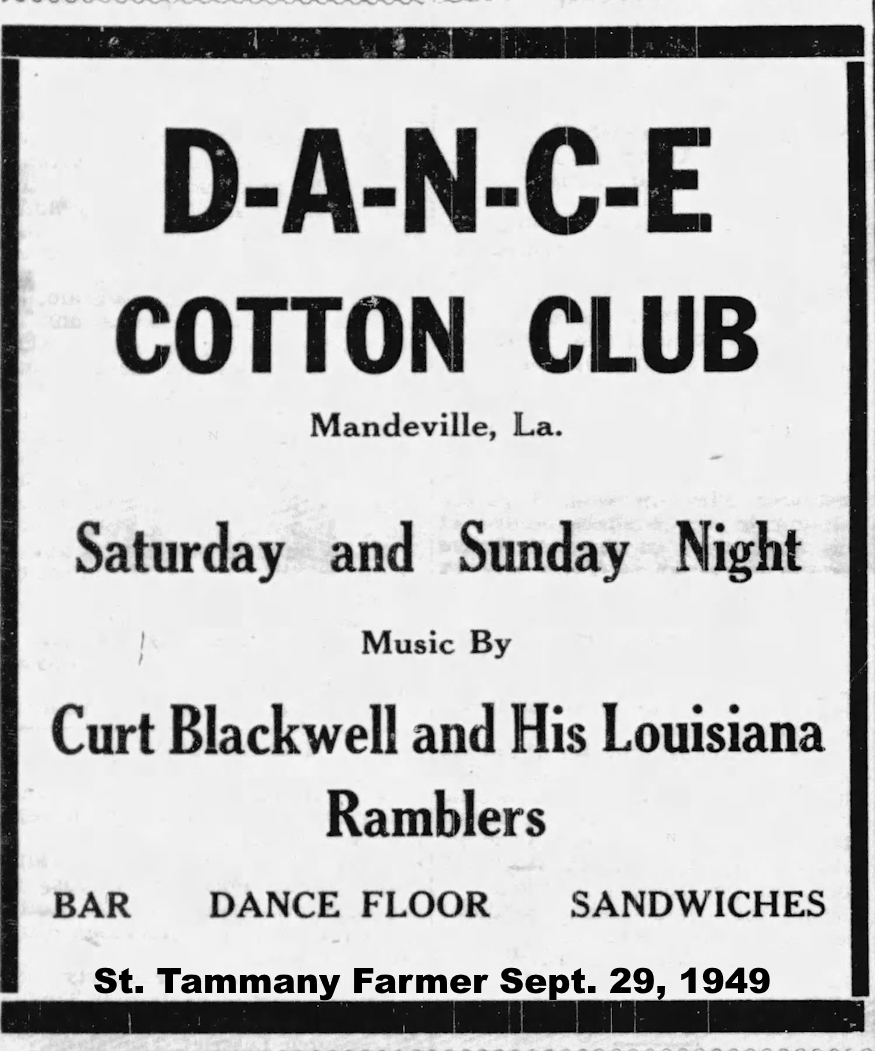
But his unique fiddling style caught on, along with a group called "The Louisiana Ramblers," and he and his wife became area favorites. Here's a late 1970's article about him that was published in the New Orleans Times Picayune. Click on the images to make them larger.


According to a relative, Donna King Ratcliff, Curt and Irene played at the White House in 1985.

In 1986, they provided some "Ole Tyme Fiddlin" at the dedication of the Our Heritage Celebration Museum in Covington.



Text from the above article:
Sawmill Fiddler by Jan Gilbert
Just north of Barker's Corner, down a narrow, rutted country lane, there's a homestead with old wagon wheels marking the driveway and an incongruous rock garden dominating the front yard. On the mailbox it says "Irene and Curt." They've been around these parts for so long, they need no further identification.
This is a place where a special part of parish musical history is kept alive.
Curt Blackwell rears back in his old rocker and starts tale-telling. His voice is a deep bass rumble, retaining just a trace of a whiskey rasp, a holdover from what Irene calls his "galavantin' days."
"My great-grandaddy, Joe Rodriguez, came over here from France and homesteaded on the Bogue Falaya River. He ran a water powered sawmill, grist mill and a cotton gin near Folsom. He used to tell about how it took three days to make the wagon trip from Barker's Corner to Covington for supplies. He'd buy up whiskey in big wooden kegs, then sell it out in gallon jars up at the little crossroads store. I guess you could say he was a bootlegger."
Curt's daddy, John Blackwell, was one of the first in the area to plant Tung oil trees after the Great Southern Railroad had stripped the landscape of the virgin pine timber. In addition to the Tung oil business, Daddy Blackwell was a sawmill worker. "That was about the only kind of work you could get around here in them days," Curt says.
"Him and an ole guy named Pass Toney, who was a well-digger , used to build the bridges around, here. Well, my Daddy was a fiddler player in his young days, and whenever they'd finish one of them bridges, they'd celebrate with fiddle playing and square dancing. They'd go from one bridge to another, over every one of the running streams up here, just a-fiddlin."
"Back at that time, they didn't call 'em parties, they called 'em frolics. Just about everybody could call a square dance, and, back at that time, almost everybody would play the fiddle.
My Daddy'd say if you wanted to take a break from fiddlin' and get a drink or something, why, you'd just hand the fiddle over to the one next to you -- girl or boy."
Those were the days when fiddles were homemade: Irene's Daddy made his from an old cigar box, and Pass Toney's folks made theirs out of dried gourds. The refreshments at these frolics were homemade too, says Irene. Folks would bring their own homebrew beer, wine and what was locally known as "white lightening." The women didn't partake, as Curt recalls, and dressed in long skirts, bonnets and aprons, tapping time to the music in high-button shoes.
Because fiddles were at that time the only musical instruments used - new fangled guitars came later says Irene - players would beat out the rhythm with fiddle straws on the neck of the fiddle. The straws are made of broom sedge or thin reed cane, and besides spontaneous clapping by the frolickers, provided the only accompaniment.
"My mother taught me to beat the straws," recalls Irene. "She'd also played the Jews' harp as a girl." That early instrument was a kind of stringed reed contraption, which the player would hold between the teeth and blow through, while strumming the strings. Curt says the old timers had a way of changing the pitch of the instrument by opening or closing their mouths.
While Irene was learning to beat the straws, Curt got his first fiddling lesson from his Daddy at the age of seven. He began picking up the old tunes his great-grandaddy would sing to him, tunes like "Ole Bill" or "Cotton-Eye Joe." Curt. snorts derisively when asked if he ever took lessons. No, his music comes from the folks he grew up with; it comes from the heart.
While at Franklinton High School, Curt was the star of the weekly Friday night get togethers. "I played the fiddle pretty good by then, and I also sang - mostly songs with fancy yodeling in them."
Curt was always a wild one, it seems, and his Daddy made him change high schools to straighten him out. After school, Curt faced the choice of every other local young man: move away or work in the saw mills. But, while he was cutting lumber in the daytime, he was cuttin' the rug at night. "I learned my fiddling in the sawmill days, so I just started calling myself the `Sawmill Fiddler'."
During the 1930's - what he calls the slot machine days - Curt was the main local attraction. Whik folks were feeding the machines, Curt and his pickup band would fiddle Depression-era blues away. "I used to play at the Plantation Club in Sun, the Cotton Club in Mandeville, and I played all the bar rooms in Covington. I got in some fights, I'll tell you - guess I never had the sense enough to run," he laughs.
"Seems like Abita Springs was where all the New Orleans people would come, especially on a Saturday night. I was real young then. I'd tell the girls I'd meet I was from Chicago one time - and then tell 'em I'd be from way-yonder the next," Curt hoots with a gleam in his eye.
Fifty years later, Curt breaks out in a booming acappella:
"Purty little girl just sixteen, I am twenty-two,I asked her if she loved me,She said 'You know I do'."
Irene was in the audience one of those nights, and she fell hard for the rambunctious fiddler with the flashing eyes. When asked if he was wild when she met him, Irene rolls her eyes and says, "You better believe it!" She was fifteen, going on sixteen when she and Curt were married in 1938.
It takes an intimate syncopation for a straw beater and a fiddler to make good music together. The beater must keep exact time to the tune, taping on the neck of the fiddle, while staying out of the way of the wildly swinging bow on the strings. Through the years, Curt and Irene have managed to keep in tune. But there have been a few sour notes.
After nearly fifteen years of marriage, Irene found herself with two young boys to raise and a husband who was raising cane all over the countryside. She decided to call it quits.. Both she and Curt re-married - he twice -- and -then, years later, decided to try the duet again. As Curt says, "Our relationship didn't get really good until after about twenty years."
You couldn't tell it to look at them today. Curt coats his bow with a chunk of St. Tammany pine resin and entertains a visitor with a lively rendition of song his Daddy taught him; Irene keeps perfect time with the sticks, all the while smiling up at that craggy, weather-worn face.
"We still try to fiddle the old-timey songs that was popular in Grandaddy's day," says Curt.
Though slowed down a bit by illness, Curt is still in demand at regional hoe-downs. Open heart surgery prevented him from accepting an invitation to play at the World's Fair last year, but the family was represented by a display of Irene's fiddle straws and homemade pepper jelly at the Louisiana Folklife pavilion.
These days Curt occasionally plays with other area musicians up at the Friday and Saturday night "Pickin' Parlor" at the Riverbend Camp in Bush or at the Five Lakes Pavilion with his buddy Red Crawford. "I'm not the only old time fiddler," Curt is quick to point out. "Uncle Dewey Williams is eighty years old, still fiddling in Bogalusa."
And, every year, the old timers like seventy-seven year old Ben Morgan, Williams and Blackwell resin up their bows for the area Bluegrass festivals. Curt says he just might play for this year's Five Lakes Bluegrass Festival at the end of May. That is if he doesn't go up to Alexandria, La. to compete with other Musicians at the' Louisiana State Fiddlers Championship on June 1st.
He's content, too, to sit back and listen to his son James, a left-handed fiddler, who plays with area bands. Rocking in the old cane botton chair, living on the land that's been his family's home for generations, Curt nods approval at passing down the fiddling skill that he inherited from his Daddy and Grandaddy.
Curt swears his late night cane-raising days are over, saying, "Nowdays, I just like to go out and meet the people; I don't play steady anyplace anymore. I tell everybody I got to slow down. I'm kind of a daytime fiddler now."
Across the room, Irene smiles to herself. Seeing his visitor to the door with a hearty invitation to come again, Curt hollers after the departing automobile, "Tell 'em all about me - but don't tell 'em everything. You'd have to come bail me out of jail if you told it all!"
Click on the images to make them larger


Links of interest:
