Wednesday, January 9, 2019

Mandeville's Music Heritage

In the winter of 1986, some thirty-two years ago, Jazz historian Dr. Karl Koenig wrote a great article in the New Orleans Jazz Club magazine "The Second Line." The article dealt with the music heritage of Mandeville: its musical styles, musicians and appreciative audiences. 

He particularly wrote of the band leaders who regularly visited the Dew Drop Dance Hall. Dr. Koenig's background and expertise in researching New Orleans jazz made him an excellent choice to chronicle the historical highlights of the legendary dance hall establishment. 


The Dew Drop Jazz Dance Hall

His article is filled with rich detail and fascinating tidbits about life in Mandeville in the early part of the 20th century. There were dances of every description, local bands, traveling bands, excursion boats, hotels, and people came from far and wide to enjoy it all. 

The following are three excerpts from the article:

 "New Orleans bands traveled across the lake on boats, playing for their passage to the north side of the lake. Their itinerary might include playing in Madisonville on Friday night, the Dew Drop Dance Hall on Saturday night and Abita Springs on Sunday. The circuit might include Bogalusa on Monday, and other small towns on other nights. They might return to play the Dew Drop on Wednesday, sleep there and catch the boat back to New Orleans for a job on Thursday.

"Along the shore line of the northern part of Lake Pontchartrain there were three boat landings and a number of hotels, all using live music. Many of the local musicians liked the style of country living in Mandeville and found enough work in the area. They did not want to, or have to, go into New Orleans for work. The Dew Drop had at least two dances a week."

Dr. Koenig also wrote about life in Mandeville based on his talks with Ella Paine and Norma Core, two well-known area personalities. Here is an edited excerpt where their recollections were spotlighted:

" Ella Paine, born in 1895, lived all her life on the lakeshore on the corner of Coffee and Lakeshore Drive. She remembers seeing the boats land and hearing the music of the bands from the boats. Many of the people from the boats stayed near the boat in the pavilions built on the ends of long piers, around 150 yards into the lake as the big boats could not come near the shore due to the shallow water there. 


Ella Paine

"Others got on the train that ran from the lakeshore to Covington and Abita Springs. This railroad, built in the early 1900's, ran from Covington to Mandeville, passing through Abita Springs. It was called the "Doodlebug". The first such train was gas with a later one being run by electricity. The depot was on the site of the present Covington City Hall. It ran several trips a day to meet the boats that landed in Mandeville. 

"It was very popular with young people and presented a very pleasant outing because big excursions came from New Orleans to Mandeville on weekends. It was a good way to spend an hour and a half with your girl and to enjoy the good music the people on the excursion had. Many of the people would ride the boat over to New Orleans and then come right back to Mandeville..

"The three places the boats from New Orleans landed near Mandeville were:

 1)    St. Tammany Pier — This was in the middle of the block between Coffee Street and Carroll. There was a large pier built for the boats — it extended about 1500 feet into the lake. It had to be far out as the big boats had to have deep water to dock. There was a large dance pavilion at the shoreline. This pier burned down around 1916 and was never rebuilt.

 2)    The Camellia Landing was built around 1850 and was at the end of Girod Street and the lakeshore, opposite the Nemo Theater. It, too, was destroyed by fire around 1912.

3)    Lewisburg Landing — at Dr. Lewis' Plantation. Boats from New Orleans would first dock at Camellia Landing, then to St. Tammany Pier and then to Lewis Landing. The boat then might continue to Madisonville and then up to Covington up the river and would dock at the end of New Hampshire Street in Covington, near Bogue Falaya Park. 

"Ms. Paine recalls the Dew Drop Dance Hall and remarked: "The Dew Drop was always having some kind of affair. In 1928 it was going strong and very active."

"She remembers some of the bands around Mandeville: "There was a Negro String Band -about eight pieces. They didn't read any music, but they played the greatest dance music.

"Then when they played at the Dew Drop they played 'hot' — you could really dance to that music. They also played at Jackson Park on Coffee Street. There they had concerts, picnics, and dances on a big pavilion in the middle of the park.

"Mandeville had a brass band in the early 1900's. There were about 12 in the band. On the shore of the lake were various hotels and restaurants that used music. The Audubon Hotel was at the comer of Lakeshore and Wilkinson. The present location of the Rest-a-While around 1900 was the Frappe Hotel."
 
"Other places located on the waterfront included the St. Tammany Hotel at Lakeshore Drive and Lafitte Streets; Mitchell's Hotel at Girod and Lakeshore Drive; A dance hall on Lakeshore Drive between Coffee and Carroll Streets; the Lake View Hotel at Adair and Lakeshore Drive.

"Norma Core attended dances on the waterfront many times. Mrs. Core is the leading historian in St. Tammany Parish and possesses many documents on early St. Tammany Parish History. 


"She remembers riding the 'trolley' to Mandeville and attending the dances that were held on the Camellia Pier. 'In the 20's I attended the dances at the St Tammany Hotel,' she said. 'We had both black and white bands playing for the dances. Evening clothes were worn to these dances. The ladies wore evening gowns and the men suits. 

"The Saturday night dances at the old Nemo Theatre were more informal. The bands usually were from five to seven pieces; trumpet/comet clarinet, trombone, banjo, bass, drum, and sometimes piano.

"To attend the dances it was usually from $1.00 to $2.00. We attended dances in Jackson Park and danced on the pavilion in the center of the park. We would go to Madisonville on Friday night for dances and Abita Springs on Sunday. 

"One band I remember was called the Dixie Rhythm Boys. The dance on the week-ends began at 2:00 - we would meet the boys there at the dance.  At night the dances would start at around 8:00 or 9:00 p.m. and last until 2:00 a.m."

In the next excerpt, Dr. Koenig tells about the local musicians meeting people at the boat landings, inviting them to come visit their clubs and attend their concerts:

"Musicians from the bands on boats like the Susquehanna, Camellia, Hanover, Victor and the Mandeville, which made fairly regular trips across the lake, would come to Mandeville and Madisonville. The boats, which made one trip on Sundays, would arrive in Mandeville about 11 a.m., the boats would go to Madisonville that night and tie up, and leave Monday, sometimes Tuesday for New Orleans. The Camellia sank at its dock in the Tchefuncta River near Covington of old age.

"There is no longer any evidence of the boat landings along the lake shore in Mandeville, nor are the dance pavilions there. There are a few hotels left along the beach but are no longer the exciting places they were during the early Twentieth Century. Jackson Park now has a number of houses on the area it once occupied." 


Dr. Koenig included this and much more information about jazz heritage on the North Shore in his book "Mother of All Jazz Waters: Lake Pontchartrain."  In a press release distributed about the new book, it was stated that local Jazz historian, Dr. Karl Koenig, the recipient of a grant from the Jazz &  Heritage Festival had completed a book on the history of music on Lake Pontchartrain.  

"The material within the book includes information on both the South and North shore of Lake  Pontchartrain. The lake front on both the south and north shores played a very important  part in the evolution of jazz.

"The book, a large volume of information, includes material on the music scene of  many of the towns of the north shore: Mandeville, Covington, Madisonville, Abita  Springs, Bogalusa, Ponchatoula and Hammond - all are included. 

"Many of the most  famous musicians in jazz either lived on the north shore or performed numerous times in  the jazz sites mentioned in the book. The history of the south shore is given and includes the colorful history of  Milneburg, Spanish Fort, West End and Bucktown. 

"Also included is material on the  various lake steamers that continually crossed the lake carrying passengers and large  groups for excursions to the north shore famous resorts.The book was published by Basin Street Press."
 
His many other books on jazz history are foundational to any study of jazz, especially his "Jazz in Print (1859-1929): An Anthology of Early Source Readings in Jazz History."


His book on Northshore jazz heritage is available for reading online in a Adobe Acrobat PDF file which may be accessed by CLICKING ON THIS LINK.

The book includes the outstanding history of the lakefront in Mandeville and Madisonville and describes the very active musical scene on the north shore, which at times rivaled the extremely active lakefront of the south shore, the home of the legendary town of "Milneburg."


The Milneburg lighthouse was a key feature among the camps of Milneburg, which was also known as Port Pontchartrain. It was a resort town offering all kinds of entertainment, especially jazz. Boats would leave from here and head across the lake to Mandeville. Milneburg was connected to downtown New Orleans via trains pulled by the famous "Smoky Mary" locomotive. Later this area continued its entertainment heritage by becoming "Pontchartrain Beach" amusement park.  

Dr. Koenig's book also has an interesting account of dances and bands in Covington during that time period. Start reading the PDF file above at page 105 for that Covington information. His extremely detailed account of the music offerings and heritage of the entire North Shore of Lake Pontchartain makes for an entertaining several pages of reading.

According to Dr. Koenig, "It has been said that on the weekend a New Orleans musician was either playing on an advertising wagon on the streets (of Mandeville) or at the lakefront playing for a picnic, party or dance." His jazz history book covers the bands and musicians that played in the Mandeville area from the 1890's to the 1930's.

Tuesday, January 8, 2019

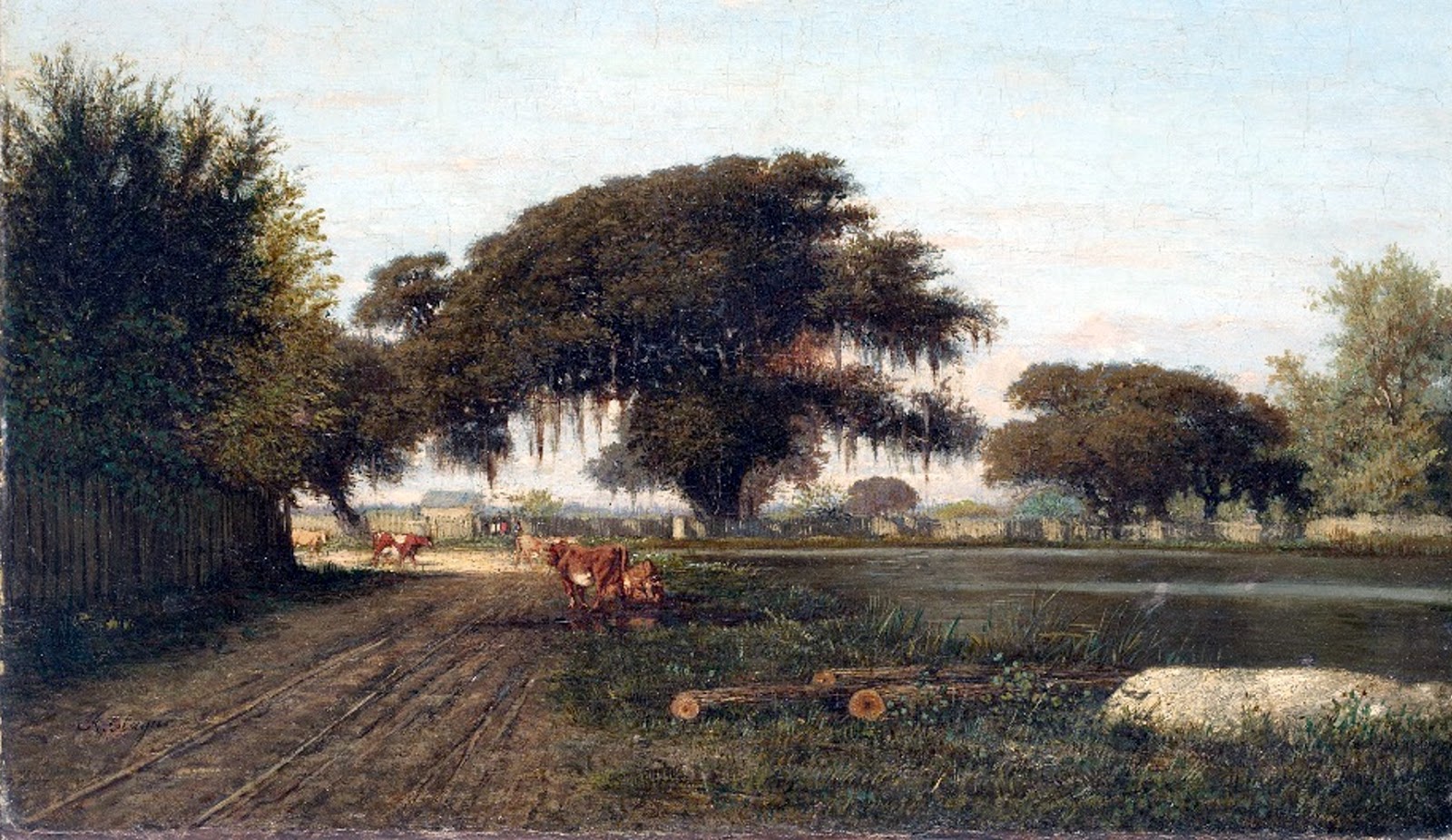
Tammany Landscapes Attract Artists

St. Tammany has been home to a number of fine artists, but even in its early years, say about the 1850's and 1860's, there were many visiting artists who came across the lake from New Orleans to capture on canvas the scenes of daily life in St. Tammany. 
  
Several of Richard Clague Jr. paintings featured scenes from the north shore of Lake Pontchartrain. Here are a few of them:


According to the website "64Parishes.org" Artist Richard Clague Jr. and his students often worked in New Orleans’ City Park or at his studio. He also spent many summers during the 1860s working in the wetlands along the southern coast of Louisiana near the resort towns of Mandeville and Abita Springs.


The above painting was produced by American artist Richard Clague (1821-1873) sometime between 1851 and 1870. The artwork is entitled "Farm in St. Tammany." Click on the image to make it larger. Painting Source: LSU Museum of Art

According to Richard Anthony Lewis with the Louisiana State Museum, Richard Clague (1821 -  1873) was widely credited as the founder of the landscape painting tradition in Louisiana. Born in France, Clague received most of his formal artistic training in Europe. 

"Clague helped define a market for easel-size landscapes following the Civil War. Influenced by realism and the Barbizon School in France, Clague’s naturalistic approach to landscape painting appealed to middle-class patrons. He was also among the most successful teachers in Louisiana, inspiring a generation of landscape painters known as the “Bayou School.”

Lewis goes on to say that in 1850, Claque was in New Orleans with a studio at 40 Camp Street, listed in the city directory as a painter and teacher.  "However, he seems to have lived primarily in France, opening a photography studio in Paris about 1853.

"From November 1856 to March 1857, Clague traveled to Egypt with the French Army. According to New Orleans papers, he worked as a “special artist” on an expedition to find the source of the Nile River. Given the École’s curricular emphasis on drawing, it is not surprising that landscape sketches Clague produced on this trip demonstrated a mastery of French academic practices and conventions.

"In 1857, Clague returned to Louisiana to establish an essentially permanent residence. He spent his remaining years living modestly in Louisiana, often staying with the de Breuys family, to whom he was related.

"Clague depended in large measure on teaching for income. Notable students included William Henry Buck and Marshall J. Smith, Jr., as well as George David Coulon, Charles Giroux, William Aiken Walker, and Joseph R. Meeker. Clague and his students often worked in New Orleans’s City Park or at his studio.

"He also spent many summers during the 1860s working in the wetlands along the southern coast of Louisiana near the resort towns of Mandeville and Abita Springs.

"Clague died in Algiers, across the Mississippi River from New Orleans, on November 29, 1873, at the age of 52. His obituary in the New Orleans Bee was unequivocal: “Mr. Clague has stood at the head of his profession in this state and his works have always been highly regarded by connoisseurs in New York as well as here.”

See also:

St. Tammany Artist Famous For Theatrical Scenery Painting 

Monday, January 7, 2019

The Chamber Auxiliary

 The Covington Chamber of Commerce Auxiliary kept very busy in the 1980's conducting spring garden tours, helping the chamber in a number of ways, and even putting up a welcoming entrance sign to Covington. 


The history of the auxiliary of the Greater Covington Chamber of Commerce Auxiliary was told in an article published in the 1981 annual chamber magazine. Here it is. Click on the image to make it larger. 


The group helped showcase new business accomplishments.


Past presidents of the Greater Covington Chamber Auxiliary

Among the women who took leadership roles in the Chamber Auxiliary were Donis Jenkins, Judy Bloom, Katie Friedrichs, Lib Milhan, Pat Clanton, Meda Koepp, Darleen Holden, Fritzi Martin and Becky Gelatt. They were well-known for their annual Clean-Up campaigns. They also took part in many beautification programs and the Chamber's monthly "Best Appearance" award. 


The chamber auxiliary was also active with the "Olde Towne Festival" in the mid-1980's. It also helped purchase or find donations of desks and other office furniture for chamber use.

The book "The History of Covington Cemetery No. 1" was published in 1988 by the St. Tammany West Chamber of Commerce Auxiliary. Entitled "The Legends of Covington Cemetery No. 1: Covington, LA, 175th Anniversary 1813-1988" the 166-page book contains volumes of information about the cemetery and who is buried within.

The group was one of the sponsors of the "Restoration in Progress" efforts to clean up and restore the looks of Covington Cemetery No. 1 back in the 1990's. CLICK HERE for more information about that project.

The group also had speakers of interest address the group at its regular meetings. Mrs. Amos Neff once addressed the Chamber of Commerce Auxiliary about the history of Covington, particularly the more interesting tidbits about taxes and civic obligations. CLICK HERE for more information. 


Sunday, January 6, 2019

CHS Football Wall of Fame

Over at the Covington High School webpage, there is a link to the CHS Football "Wall of Fame." The webpage offers an overview of the outstanding football players from Covington High over the past several decades, from 1966 to 2007. There are photographs, stats, and a variety of information.

Here is what the page looks like:


To visit the Wall of Fame webpage, click on the link below: 

http://covingtonhigh.stpsb.org/community/CHS_History/Regular/hall_of_fame.html

The top photo box with the blue "Football Wall of Fame" button brings up a video that launches your video player and shows a number of pictures.

The bottom row of montage photos offers a decade-by-decade look at the football players, but it brings up Microsoft Powerpoint shows, and since everyone doesn't have Powerpoint, I have converted those presentations to PDF files that most everyone can enjoy. The material was put together by Dwayne Kelly, Sebastian Pastor and Emily Galiano. Please bear in mind that most of this information is more than 10 years old so it is not current. Here are the links: 

1966 to 1974:

1975 to 1980:

1980 to 1990:

1991 to 2007: 

Saturday, January 5, 2019

Trapping Insects For Science

To say that Vernon Antoine Brou Jr. and his wife Charlotte study butterflies and moths is an understatement. The Abita Springs area couple have etched out a reputation of considerable renown for their knowledge of Louisiana Lepidoptera and the skills for collecting them. 

Their work, both in the field and in publishing reports on their findings, have earned them thanks, acknowledgements, and appreciation from museums around the world which have been the recipients of their insect collection donations.


Vernon Antoine Brou Jr. 


The pages of the Southern Lepidopterists' Society newsletter are filled with their research, detailed articles describing all manner of lepidoptera, as well as "how to" instructions on collecting and preserving.

The couple has placed numerous "traps" across their ten acres near Abita to capture their insect specimens. "This location has undergone extensive surveillance of the populations of many insect orders, using several hundreds of self designed insect traps of many types and purposes," according to Brou.

 "Insect traps have operated continuously for the past 36 years, year-round 365-366 days and nights, 24 hours every day, regardless of weather conditions or temperatures.  As a result, this trapping location is recognized worldwide by professional and amateur entomologists to be the "most intensely studied area in North America pertaining to its insect fauna.  Hundreds of insect species new to science have been discovered at this location."


The Abita Entomological Study Site is probably the most intensely studied entomological location in North America.

The couple also travel the state at times, placing additional traps.   Why are so many traps necessary? To get a good sampling of the insects for study, primarily for insect photography for Vernon's many scientific publication contributions.

Their insect specimen donations to museums and nature centers have been well-received and sought after across the United States. Members of the Lepidopterists Society since 1968, they have followed their passion in the field by self-funding much of their own entomological research.  "This is my 49th year of operating numerous insects traps continuously ," Vernon stated.

Among his involvements have been working as a Research Associate for the Florida State Collection of Arthropods since 1972, being a charter member of the Southern Lepidopterists Society as well as a member of the Entomological Society of Washington since 1985. He's also been a Research Associate for the McGuire Center for Lepidoptera and Biodiversity, Florida Museum of Natural History since 2010.

A lifetime resident of Louisiana, Vernon was born in 1949, and he began his interest in insects as a very young child. "My activities became more scientific around 1968, and I began light trapping during 1969, and have continued to run numerous types of insect traps including a series of five to seven or more high-wattage light traps continuously 365-366 nights each year since that time to the present, regardless of weather conditions." Charlotte also is a lifetime resident of Louisiana.


Publishing his photographs and data is a key component in the work. "We published in two parts (1997 and 2002), a 30 year study of the Sphingidae of Louisiana, which also resulted in the discovery of a new sphingid species, Lapara phaeobrachycerous Brou.

"Our biggest investigation involved the Sphingidae of Louisiana and covered the years between 1970 and 1999. During that time we reported capturing 83,889 Sphingidae specimens representing 46 species within the state of Louisiana," Vernon explained.


Charlotte Brou
 
They have published 399 entomological articles/investigations over 49 years. Their research and interest is confined to the state of Louisiana, however, and trips are made across the state to sample different habitats. Charlotte has been his assistant and companion over 43 years of these daily entomological endeavors, and one new species, Catocala charlottae Brou was named in her honor, Vernon noted.

The work required them to be quite inventive at times, designing and producing more effective traps with which to capture desired specimens. Well over 400 various specialized insect traps, and associated collecting devices were designed, constructed, tested and operated, including: flight traps, bait traps, pitfall traps, and pheromone traps.  Each night during most years, some 80 to more than 130 traps of various types were in operation.

"We have concentrated on moths, collecting millions of moth specimens alone, and insects of all orders, processing hundreds of thousands of Louisiana insects for distribution to researchers and museums throughout the world.  We have discovered several hundred new undescribed moth species in Louisiana.  At this point, we have officially donated in excess of 343,238 Louisiana insects to museums in the United States alone," Vernon recounted.

Their specimens can be found in these museums: Louisiana State Arthropod Museum, Florida State Collection of Arthropods, American Museum of Natural History, United States National Museum, Los Angeles County Museum, McGuire Center for Lepidoptera and Biodiversity, Carnegie Museum, Prague Museum, Canadian National Collection,and The Natural History Museum-London.

"We have also provided additional hundreds of thousands of Louisiana insects to scientific collectors and researchers and to other museums throughout the world. Our current personal scientific research collection of Louisiana insects contains an additional 400,000 specimens (primarily lepidoptera, and some coleoptera).


One new species of saturnid moth was discovered and co-described by Brou. It was named Automeris louisiana Ferguson and Brou. 


Automeris louisiana Ferguson and Brou


The Contributions of Vernon Antoine and Charlotte Dozar Brou

The following information is one published account of his success in the field, since he is regarded as "one of America's preeminent private Lepidopterists."

"Vernon began his unofficial career as an insect collector as a young child over 60 years ago, and in 1969 began continuous operation of ultraviolet light insect traps (i.e., every night of every year) since then, with only a 30-day interruption without electricity following the passage of Hurricane Katrina," it was stated. The eye wall of Katrina passed over his property, causing much destruction and a small distraction from the valuable work of insect collecting and research.

"Vernon's seasonal data for moths at his property in Abita Springs is one of the most comprehensive data sets on "seasonality" or phenology of these insects available anywhere in the world. In addition to his personal collection, he and Charlotte have donated in excess of 343,000 archival quality specimens, including long series of newly described and rare species, to various institutions over the years, including 209,640 insects to the Louisiana State Arthropod Museum (LSAM.)"

"Vernon is also an accomplished photographer, and one of the most prolific specimen processors known. Vernon and Charlotte assist with displays and outreach for organizations, including the Audubon Institute in New Orleans, and the Louisiana Department of Wildlife and Fisheries. Just one tray from the 2009 LSAM donation consisted of approximately 28,000 specimens. 


"Vernon is the winner of the prestigious John Abbot award for the year 2000 presented by the Southern Lepidopterists Society. An exhibit dedicated to Vernon's accomplishments is on public display at the Audubon Insectarium in New Orleans. The display uses Vernon's passion for moths to highlight the contributions of private collectors to the science of entomology and taxonomy worldwide.

"We at the LSAM appreciate and acknowledge Vernon's and Charlotte's valuable contributions to our museum holdings and to the knowledge of Louisiana's Lepidoptera fauna," the organization stated.


Difficulties Encountered

Trapping, collecting and processing insects are not without their challenges, however, as Brou found out in 2012 when he "fought the bugs and the bugs nearly won!" To read about that life-threatening situation in which he found himself, CLICK ON THIS LINK for a PDF file.

The Brou's have published more than 400 articles and investigations mostly on Louisiana Lepidoptera. Vernon and Charlotte have welcomed inquiries and collaboration with residents of all parishes interested in discovering and expanding the knowledge base of Louisiana Lepidopterology.


To read a list of the hundreds of articles and investigations written up by the Brous, CLICK HERE to read a PDF file containing the titles, descriptions and names of the journals publishing their research and photography. 


Lithophane abita Brou & Lafontaine 

In 2022 the couple published a synopsis of their lifetime (now 54 years) of scientific discoveries and accomplishments.  "We are finally slowing down due to our age and had a insect trap inventory of around 500 automatic capture traps of various types and purposes.  We personally logged a record 51,000,000 trap hours," Brou noted.

To view the synopsis in PDF form, CLICK HERE.


Friday, January 4, 2019

100 years ago this week

What was going on 100 years ago this week? CLICK HERE for a link to the St. Tammany Farmer of January 4, 1919. The link is provided by the Library of Congress and its Chronicling America service.

Click on the sample images below to see larger version.


A wedding, a New Year's Eve party, and a return to the jewelry business


Thursday, January 3, 2019

St. Tammany History by Chamber Magazine

In the 1981 edition of the Greater Covington Chamber of Commerce's annual magazine, this article appeared which gave an overview of the history of St. Tammany Parish, as well as the area's most outstanding attributes. Click on the image to make it larger.


Here is the text from that article:

The History of St. Tammany Parish

     St. Tammany is rich in history. This beautiful, thickly wooded area of pine, oak, magnolia and many other trees supported a large Indian population. Records of pre­history activities can be read from mounds and mindens still untouched by archeologists. It has attracted settlers almost from the beginning of its discovery by the white man. It, with the other Florida Parishes, to distinguish them from the rest of Louisiana which was part of the Louisiana Purchase, has history dating back to the time of Bienville and Iberville. They passed through here on the way to found the city of New Orleans. One could say that St. Tammany was discovered 282 years ago, in March of 1699, and has been involved in making history ever since.
     The parish fronting on Lake Pontchartrain attracted settlers from the Eastern Seaboard and the Gulf Coast area. It has flown the flags of France, Spain, a short-lived independent statehood and that of the United States. It flew the flag of the Confederacy during the Civil War.
     The territory was annexed to the United States by Madison in 1810 after the West Florida Rebellion. Gover­nor W. C. Claiborne carved the area into four parishes, naming St. Tammany for a Delaware Chief. His name, Tamenand, meant friendly or affable to the white people, hoping the restless Indians would take the hint.
     Governor Wm. C. C. Claiborne gave the name "St. Tammany" to the parish after the revolt of the settlers in the District of St. Ferdinand in Spanish West Florida. This resulted in a short-lived republic which accepted the flag of the United States when Governor Claiborne sent Colonel Covington to convince them. This same Covington, later a general, died in the War of 1812.
     It was not until the middle of the 18th century that any whites settled west of the Pearl River. After the Revolution some families emigrated from Georgia, the Carolines and Virginia, and settled in this unbroken wilderness.
     The first courthouse was erected at a place called Clai­borne, on the west side of the Bogue Falaya. about op­posite to the present town of Covington, but the parish seat was removed to Covington in 1829. St. Tammany is situated in the extreme southeastern corner of the state and from its original territory have been carved Washing­ton Parish and a part of Tangipahoa. It is now bounded on the north by Washington Parish; on the east by the Pearl River, which separates it from Mississippi; on the south bounded by Lake Borgne, Orleans Parish and Lake Pont­chartrain; and on the west by Tangipahoa Parish.
     At the time of its founding, the population of the parish was predominately Anglo-Saxon, and English was the language and culture. In 1819 the population of St. Tammany Parish was 4,000. By 1860 it had grown to 5.406 (1,841 of which were slaves.) St. Tammany Parish today consists of 1411 square miles, with a population of approximately 92,585.         Today, family names like Baham, Badon, Jones, Collins, Gibson, Ellis and Morgan are found throughout the parish and are the descendents of the original settlers.
     In December of 1803 Jacques Drieux, a New Orleans Creole, acquired from the Spanish government 1600 acres of land lying in the fork between the Bogue Falaya and Tchefuncta Rivers on which he planned the town of St. James Due to the instability of the times and the meager population, nothing came of it until some time after the Annexation of Florida Parishes to Orleans Terri­tory when John Wharton Collins bought the town from Drieux in May, 1815, for the sum of $2,300 with a claim of four inhabitants.
     On July 4, 1815, Collins dedicated a portion of the area which he called the Division of St. John of Wharton. The Collins Family were "off-shoots" of the Wharton family of England made famous by the Whig leader. Thomas, Marquis of Wharton in King William's time (1690). In March of 1816 Wharton was incorporated by the Legis­lature, but in so doing, lawmakers changed the name to Covington in honor of General Leonard A. Covington.
     The city is unique, even today, because of the way it was designed. In the center of each block a portion of land was left free for the use of teamsters for their oxen and wagons when they came to town, heavily laden with produce. The produce was then sent down river and across the lake to New Orleans.
     The Covington area was originally inhabited by Indians. Before 1875 there were a few white families in the area. The area is part of what was known as Spanish West Florida, hence it is known as one of the "Florida Parishes"
     Covington is located 8 miles from the north Toll Gate of the Lake Pontchartrain Causeway Bridge . . . World's Longest Bridge. The Causeway affords residents a direct route into the heart of New Orleans.
     Covington is found in the center of the Ozone Belt. Ozone is the term applied to the healthful air in this area which is spiced by the rich fragrance of pine trees. There are only two other recognized Ozone Belts in the world . .. one in the Hartz Mountains of Germany and the other in Arizona. The land around Covington is divided be­tween green flat meadows and rolling hills. It is rich with many acres of standing timber. Large lung farms and nurseries are located in the area and ship to cities all over the world. There are also 68 thoroughbred horse farms in the surrounding towns of Folsom, Abita Springs. Lacombe, and in Covington, too.
     The land is high and dry and is covered with beautiful pines, oaks, magnolia, holly, and gum trees. In the spring­time the area is a riot of color when the azaleas, camellias, purple and white wisteria, dogwood, and redbud are in bloom It is also blessed with large supplies of fresh ground water for irrigation, industrial and domestic use The chemical content of the water is such that a local plant bottles and ships it to the Greater New Orleans area and other sections of the state.
     Covington is located along U. S. Highway 190. This highway, along with four state highways, now connects Covington with other sections of the state and nation. In addition, Interstate 12 now connects directly with Interstates 51, 59, and 10. and passes approximately 3 miles south of Covington.
     Due to its excellent water supply and close proximity to New Orleans, Covington is ideally situated for any industry wishing to locate in this area. The St. Tammany Parish locale remains one of the select Louisiana areas where moderate to large supplies of softwater are readily available to industry at attractive costs.
     Another material found in abundance in these parts are the clays, which is the raw material for making fire bricks, etc. There are also many producing gravel sand pits in
the general area.
     With its mild climate and healthy air, Covington and the surrounding area have become a favored location for retirees It is especially adaptable to research type activi­ties and convalescent institutions.

Chamber of Commerce Magazine 1981


Tuesday, January 1, 2019

Ralph Menetre Remembered

Longtime area resident Ralph Menetre was born in Covington, went to school in Covington, and taught school in Covington for many years. He died on August 31, 2022. 


Here is his story, from an interview with Marian Arrowsmith a few years ago on the School System's Channel 13 television program "Reflections." Click on the play triangle in the middle of the image below to start the video.


Coach Jack Salter, CHS Principal Roslyn Hanson, and Ralph Menetre


Celebrating Covington's Bicentennial


The dedication of the C. J. Schoen Administrative Complex in 2007 also brought together some former principals who served as administrators during the history of the building. Principals who came to see the results of the renovation of the building included, front row, left to right, Ralph Menetre, Roxanne Lagarde, Ronnie Pogue, and back row, left to right, Lawton McKee, Jack Loup, and Henri Ferrer. 
 

Three longtime local public school educators were honored at the 2015 Northshore Heroes program held by the West St. Tammany YMCA:  at left, Jack Salter, former CHS football coach who led the Lions to their first state title; center,  Ralph Menetre, former CHS educator. coach, administrator and “Voice of the Lions”; and at right Les Heidelberg, recently retired teacher from Pitcher Jr. High as well as former site coordinator for 21st Century Community Learning Center at Pine View.
 
 
Ralph Menetre receives YMCA award
 
 
Mr. and Mrs. Ralph Menetre (YMCA Photo)


Above is a group photograph of the Lyon High 1945 Boys Varsity Basketball Team in Covington. On the bottom row, left to right: Jimmy Riley, Hezzie Fauntleroy, Ralph Menetre, Ronnie Pogue, Buck Monlezun, and Cyp Schoen. On the top row, left to right: Coach Hubie Gallagher, Fred Terry, Troy Jackson, Huey Thompson, Henri Ferrer, Manuel Dugas, and Ball Boy Hubie Gallagher, Jr., at bottom.

A photo of Herbie Clairain's baseball team. Members included L.A. Bubba Davenport, Troy Jackson, Bussy Mire, Henri Ferrer, James McLachlan Jr., Ralph Menetre Jr., Leo Stroble, Robert LaBorde, Sam Blossman, Emile Judge Seely, Ronnie Pogue, Robert Fuhrmann Myers, Jack Tannehill, with Hubie Gallagher kneeling at the right.


Jack Salter and Ralph Menetre


Ralph Menetre speaking at the Hubie Gallagher Gym dedication program

He died on August 31, 2022. Here is a link to his obituary. 


"A native and lifelong resident of Covington, he was born May 28, 1928 to the late Ralph Norman and Lucy Welsh Texada Menetre. Ralph graduated from Lyon High in 1944. He was a star athlete, playing both football and basketball.

"From there he received a football scholarship and played and lettered for the LSU Tigers. After graduating from LSU, he provided service to the community for a span of over 40 years to the St. Tammany Parish Public School system as a Coach, teacher, principal, supervisor, and Assistant Superintendent. 

"Throughout the years, he volunteered countless hours in support of athletics at Covington High. In 1957, he became known as “the Voice of the Lions” for 40 years. He was instrumental with the successful construction of the Centennial Bell Tower that proudly stands at the entrance of Covington High School.


Speaking in 2013 at the CHS Bell Tower groundbreaking

He was a life-long member of Christ Episcopal Church where he served on the Vestry, taught Sunday School, sang in the choir, and was a licensed Eucharistic Minister. He was instrumental in the formation of the Chapel Garden. He made it his mission to take care of the gardens around the Chapel, spending countless hours in the Memorial Garden adding beauty and providing a peaceful final resting place.

He also was an original board member of Christwood Retirement Center. He served as chairman of the board for Hospice of St. Tammany, was a direct care volunteer, and received the “Angels Among Us Award”. He also served with the Covington Heritage Foundation.  He earned the YMCA “Hero Award”, “Service Before Self Award", and the City of Covington “Exceptional Community Service Award" for his selflessness to the community. He was a past member of the Lion's Club. He was recently honored to be named the Grand Marshall for the Covington Lion's Club Mardi Gras Parade.


See also: