This map shows lots in Mandeville in 1928 as they were being sold by real estate brokers at the time. Click on the images to make them larger.


A close up of the lakefront
See also:

This map shows lots in Mandeville in 1928 as they were being sold by real estate brokers at the time. Click on the images to make them larger.
See also:

Garic Kenneth “Nikki” Barranger was a well-known and respected Covington attorney, active in a variety of theatrical and literary pursuits. He was the son of Miriam Barranger, one of the founders of and first president of the St. Tammany Art Association.
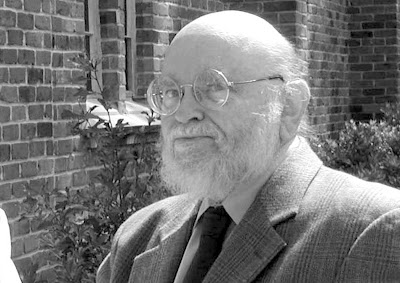
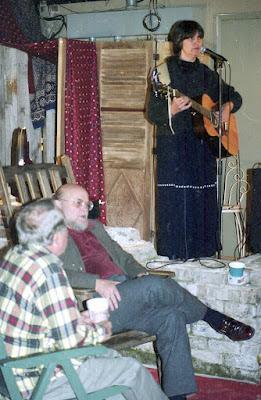
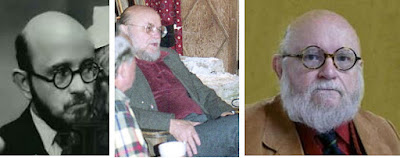
Garic "Nikki" Barranger
His community involvements included Playmakers amateur theater group, the Head Start childrens' agency, and literary legends Walker Percy and John Kennedy Toole.
Barranger died at St. Tammany Parish Hospital in Covington on April 15, 2015, at the age of 80 years. Born in December of 1934, he was the son of Dalton Joseph and Miriam Garic Barranger. His obituary notes that he was a native of Covington, he attended Covington Elementary School, St. Paul's College, Yale University and Tulane University Law School.
His interest in the theater prompted him to become a member of Dramat, Yale University's student dramatic organization. According to his obituary, after receiving his law degree, he practiced in Covington and became a senior partner in the law firm of Barranger, Barranger, Jones, and Fussell.
Ox Lot Lawsuit
In one of his more famous legal efforts, he represented the City of Covington in the 1972 case of Ross v. City of Covington, the lawsuit which asserted that the city’s ox lots were public domain and private buildings were encroachments. That lawsuit helped secure National Register of Historic Places status for the city’s Division of St. John. His obituary stated that he later established a solo law practice, where he helped underdogs and always sought that which was "right and just."
Novelist Dr. Walker Percy and Barranger were good friends, working together on several projects, one being the posthumous publication of "The Confederacy of Dunces" by New Orleans author J.K. Toole, as well as helping Headstart services get going in the Covington area.
A Confederacy of Dunces
Barranger was involved in helping the mother of John Kennedy Toole, Thelma Toole, get her son's novel "A Confederacy of Dunces" published. J. K. Toole died in 1969, and his mother strived continuously to have his novel read, edited and published. It captured the attention of Walker Percy of Covington, who in turn, gave a copy of it to Barranger to read, and shortly afterwards the issues arose about the publishing rights.
Barranger worked for a time with Mrs. Toole, navigating the legal ramifications of trying to get the legal rights to the novel settled and the publishing contract squared away. It was a difficult endeavor, and prompted several pages in Toole's biography "Ignatius Rising: The Life of John Kennedy Toole" where Barranger's name was repeatedly mentioned.
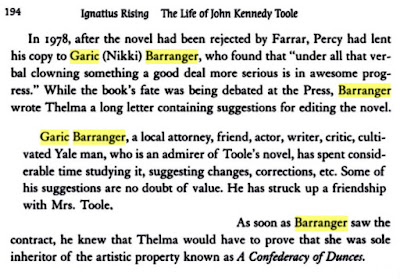
The portions of J.K. Toole's biography where Barranger was mentioned.
In 1979, Barranger wrote several letters to Thelma Toole, in one of which he said he thought John Kennedy Toole had been a victim of bad editing and that, consequently, some parts of the book might be lost. The book was preserved, published, and went on to win the Pulitzer Prize for Fiction in 1981. One of Barranger's letters is now part of the J.K.Toole Archives in the Howard Tilton Memorial Library and the Tulane University Digital Library.
New Orleans Jazz & Heritage Festival
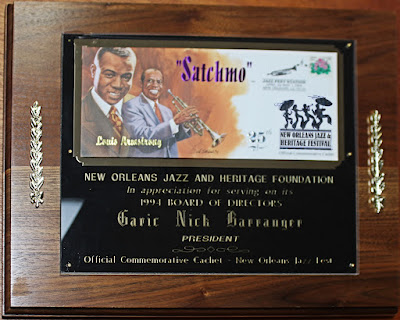
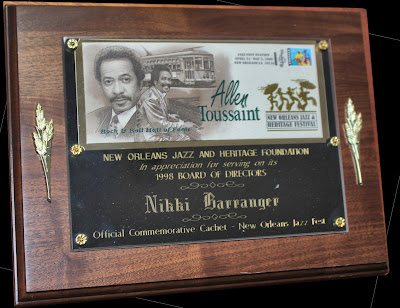
Barranger was also involved in the New Orleans Jazz & Heritage Festival, where his legal skills "proved invaluable during his tenure on the board of the New Orleans Jazz & Heritage Festival and Foundation." He served as president from 1993 to 1995 (see plaque below) and was President Emeritus at the time of his death. "He was a Jazz Fest regular and was usually found in the Economy Hall tent," it was noted.
Playmakers
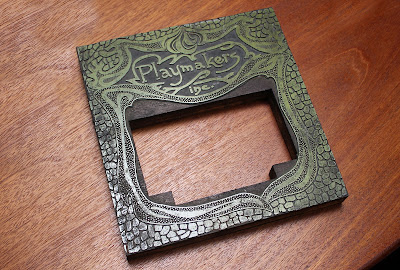
"Over the years, Nikki employed his dramatic talent in stage productions at Tulane's Summer, and Summer Lyric, Theatres; the Gallery Circle Theatre; and Playmakers Theatre in Covington, which he helped organize. His stage appearances were a delight to his audiences," his obituary information went on to say.
"When the Playmakers theatre burned, he worked diligently to preserve the organization and raise the funds necessary to rebuild. In recognition of his many years of involvement and support, he was named an honorary life patron," according to his obituary. He was also active, for a number of years, in editing an abridged version of a Shakespeare play read at the New Orleans Shakespeare Society’s annual gathering.

Art Collection
His obituary continued: "He had an extensive contemporary art collection and was a prolific author. He wrote poems, plays, short stories, and two books, one, “Continuities”, about his father, and another, “Southern Karma”, about his mother. That huge volume, hard-bound and ornately decorated, contained many photographs.
Head Start and Regina Coeli
He helped further minority rights by helping Head Start, and in the establishment of a credit union for African-Americans.
In a history of the Regina Coeli Child Development Center, Barranger is credited with many contributions. In 1968, he helped write a grant application for $45,000 to enable Head Start to operate an eight-week program in the summer of 1969.
CLICK HERE for a complete history of Regina Coeli.
In the organization's official history, Helen Frick noted that the Covington law firm of Barranger, Barranger, and Jones drafted the original corporate charter as an in-kind service for the group. On August 14, 1969, the Secretary of State affirmed that Regina Coeli Child Development Center was officially incorporated as a private, non-profit corporation. The first board members of the corporation included Dr. Walker Percy, Garic K. Barranger, Dr. Suzanne Hill, and Helen Frick.
The Regina Coeli history concluded that "Few Head Start programs in the country can boast of having a Pulitzer Prize winning novelist (Dr. Walker Percy), a Yale educated attorney (Garic Barranger), a university developmental psychology professor (Dr. Suzanne Hill), a Tulane Delta Primate Research psychologist (Dr. Charles Hill), a Baptist minister (Rev. Lawrence Tyson), and an Episcopal minister (Rev. Nolan Pipes) on their original board of directors."

See also:
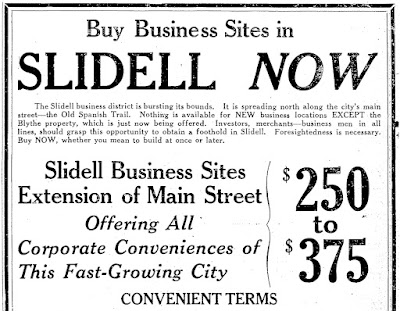
In 1927 the bridge over the eastern end of Lake Pontchartrain from Chef Menteur to Slidell was nearing completion. So the push was on to sell land in Slidell.
Numerous newspaper ads appeared in the New Orleans Times Picayune commending the new city for its business potential, as well as its beauty and promise of tourism. Ninty-five years ago, this advertisement on June 30, 1927, talked about Main Street extension for business location properties:
Click on the images to make them larger and more readable.
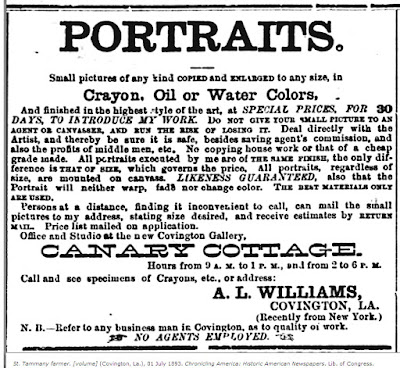
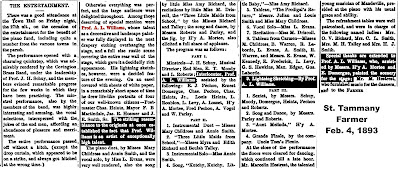
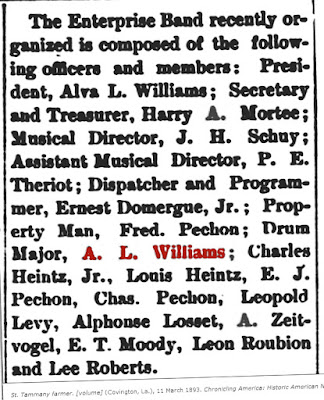
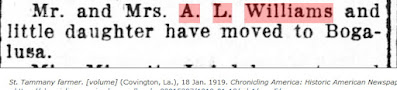
In 1893 artist A. L. Williams moved from New York to Covington to set up his portrait studio, mainly taking small portrait photos and enlarging them into hand-drawn paintings, Here's an advertisement advertising his services.
Recently we looked at a 1904 map showing the area of downtown Covington below Gibson Street between New Hampshire St. and Florida Street.
Today we move northward and look at the same map showing what is above Gibson street. A lot was going on in 1904 north of Gibson street, and here it is.
Click on the images to make them larger.


In front of what is now Hebert's Cleaners, the tracks split into two, with one track curving northward and the remaining track continuing westward. The track heading northward served the freight/cargo loading platform, seen below.
That remaining track on Gibson St. immediately split into two tracks again, this time with the upper track serving the passenger loading platform at the train depot on the northeast corner of the Gibson/New Hampshire Street intersection.

To the west of the intersection, where the Maritime Pilots Institute is today, there was a large warehouse with a train unloading platform of its own.
Heading eastward on Gibson, towards the right, we come across the Commercial Hotel, which later became the Patrick Hotel, which later became Hebert's Cleaners. The building pictured below was, unfortunately, destroyed by the 1997 tornado. It has been replaced by a one story brick structure.


On the other side of the Commercial Hotel was the large W.R. Badon Livery, an L shaped building that fronted both on Columbia Street and Gibson Street. So the present day Rock N Blues Cafe was at one time a livery stable.


Across the intersection we see another small warehouse next to the tracks, and coming down New Hampshire, we see the tracks split again, with one heading for where Marsolan's Feed & Seed will be located in 36 years. Those rails are still visible at the Covington Trailhead park.


The splitting of the tracks in this manner, forming a triangle with the base on Gibson and peak near Kirkland street, allowed the train to "turn around" and head back out Covington on the same track it entered on. The train would take the first split northward and go until its last car cleared the top split, then it would back down the trailhead's western track and ease backward onto Gibson again, this time pointing in the opposite direction.

Now back to the 1904 map, starting at the Covington Trailhead, we continue down New Hampshire Street where we come to another warehouse, another general store, and just south of that a "carriage house" where the future Deluxe Theater will be built. This is in the vicinity of where Lee Finance and Holistic Life Approach are located.




NOTE:
The buildings on these maps were color coded to indicate type of
construction and materials, so most of them are yellow, wood frame, some
of them are red, brick, and a few of them are blue, made of stone.
What was going on 100 years ago this week? CLICK HERE for a link to the St. Tammany Farmer Issue of January 14, 1922. The link is provided by the Library of Congress and its Chronicling America service.
Click on the sample images below to see larger versions.


